
An iceberg twice the size of London lasted 40 years at sea. Its time is up

A trillion tonnes of ice that broke off Antarctica the same year Chernobyl exploded is nearing its end, dissolving in the warm waters of the South Atlantic after four decades of defying every prediction scientists threw at it.

The berg, known as A23a, once stretched across 4,000 square kilometres, nearly twice the size of Greater London, and spent over 30 years grounded on the ocean floor before quietly resuming its drift in 2020.

Now, battered by summer heat, warm currents, and its own crumbling weight, it is in its final weeks. Scientists say it will be gone entirely soon, and the world will lose the oldest tracked iceberg in recorded history.

WHAT WAS ICEBERG A23A, AND HOW BIG WAS IT?

In 1986, a massive slab of ice split away from Antarctica’s Filchner-Ronne Ice Shelf and dropped into the Weddell Sea.

That process, called calving, is a term used to define a phenomenon in which a chunk of ice breaks off a glacier or ice shelf and becomes a free-floating berg.

The colossus weighed nearly a trillion tonnes. At roughly 4,000 square kilometres, it was larger than many countries’ capital cities.
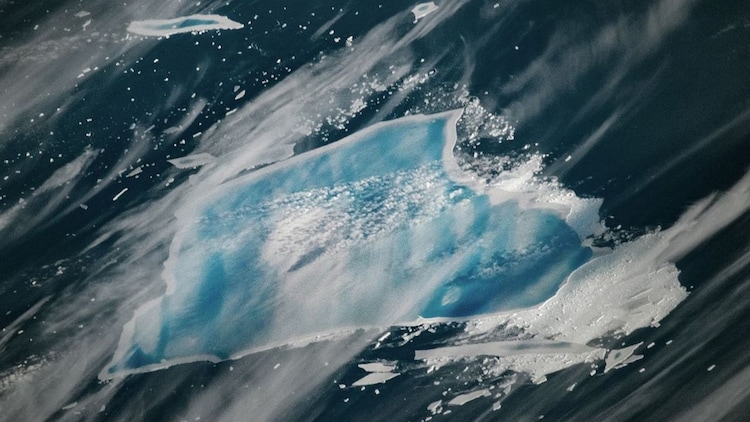
An iceberg that broke off Antarctica in 1986, weighed a trillion tonnes, and survived spinning ocean vortexes for four decades is finally melting away. Scientists say it has just weeks left. (Photo: Nasa)

An iceberg that broke off Antarctica in 1986, weighed a trillion tonnes, and survived spinning ocean vortexes for four decades is finally melting away. Scientists say it has just weeks left. (Photo: Nasa)

What happened next was strange. Instead of drifting off, A23a sank into the muddy seabed and stayed put for over 30 years, completely grounded, going nowhere.

Then in 2020, without much fanfare, it began to move. Scientists noticed, started tracking it, and quickly realised they were watching something extraordinary.

HOW DID THIS GIANT CHUNK OF ICE TRAVEL SO FAR?

Ocean currents pushed A23a northwards along a route researchers call Iceberg Alley, a pathway commonly followed by Antarctic icebergs moving into the South Atlantic.

Along the way, A23a got pulled into a Taylor Column, which is a rotating cylinder of ocean water that forms above underwater mountains. It is a giant natural whirlpool.
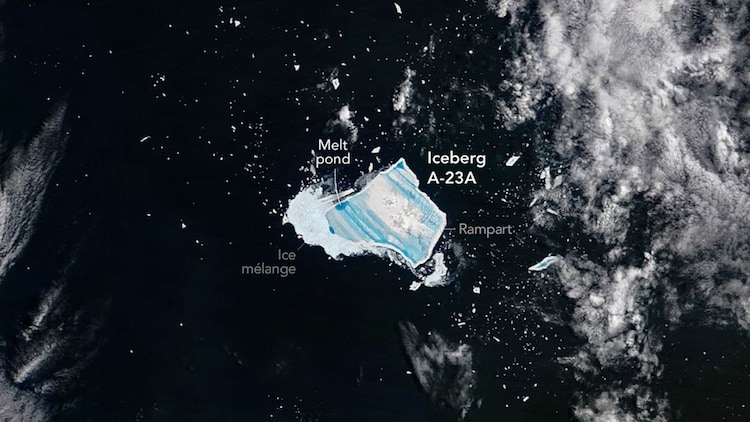
This satellite image from December 2025 shows vivid blue meltwater pooling across the surface of A23a. Scientists say the weight of this water forced cracks open from within, triggering the berg's rapid collapse. (Photo: Nasa)

This satellite image from December 2025 shows vivid blue meltwater pooling across the surface of A23a. Scientists say the weight of this water forced cracks open from within, triggering the berg’s rapid collapse. (Photo: Nasa)

The iceberg spent eight months spinning near the South Orkney Islands.

It then drifted towards South Georgia, a graveyard for most icebergs, broke free, and kept going north.

By early 2026, it had travelled further from Antarctica than any iceberg currently being tracked, sitting closer to the equator than London.

WHY DID IT SUDDENLY START FALLING APART?

In January 2025, its estimated area was 3,640 square kilometres, still the largest iceberg in the world. By September, it had shrunk to 1,700 square kilometres after several chunks broke away.

Then the Southern Hemisphere summer arrived and finished the job. By December, the berg was covered in pooling blue meltwater as it drifted between the eastern tip of South America and South Georgia Island. That vivid blue was not pretty. It was a warning.
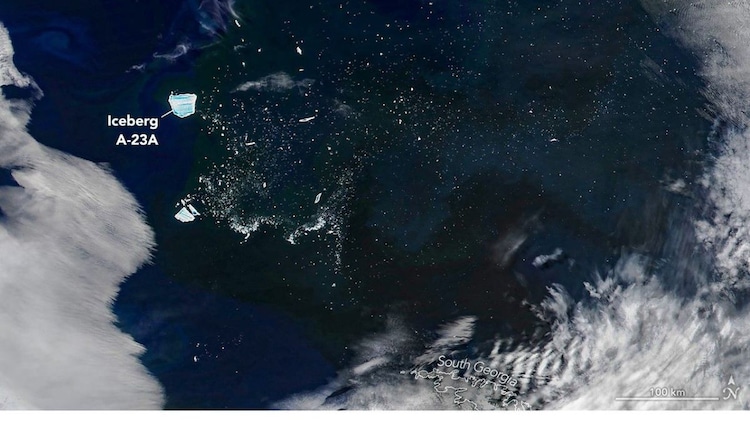
As they melt, large icebergs release nutrients like iron and nitrogen into the surrounding ocean, stimulating phytoplankton growth and feeding entire marine food webs. (Photo: Nasa)

As they melt, large icebergs release nutrients like iron and nitrogen into the surrounding ocean, stimulating phytoplankton growth and feeding entire marine food webs. (Photo: Nasa)

The disintegration was being driven by hydrofracturing, a process where meltwater pools on the surface exert enormous pressure on the ice, forcing cracks open from the inside until the whole structure gives way.

Ted Scambos, a senior research scientist at the University of Colorado Boulder, explained it to Nasa: “You have the weight of the water sitting inside cracks in the ice and forcing them open.”

WHAT DO SCIENTISTS HOPE TO LEARN FROM THIS?

The end of A23a is not just a spectacle. It is a laboratory. Researchers aboard the British Antarctic Survey’s RRS Sir David Attenborough conducted studies around the berg in December 2023 to assess its impact on marine environments.

Dr Laura Taylor, a biogeochemist with the British Antarctic Survey, said: “We know that these giant icebergs can provide nutrients to the waters they pass through, creating thriving ecosystems in otherwise less productive areas.”

As they melt, large icebergs release nutrients like iron and nitrogen into the surrounding ocean, stimulating phytoplankton growth and feeding entire marine food webs.
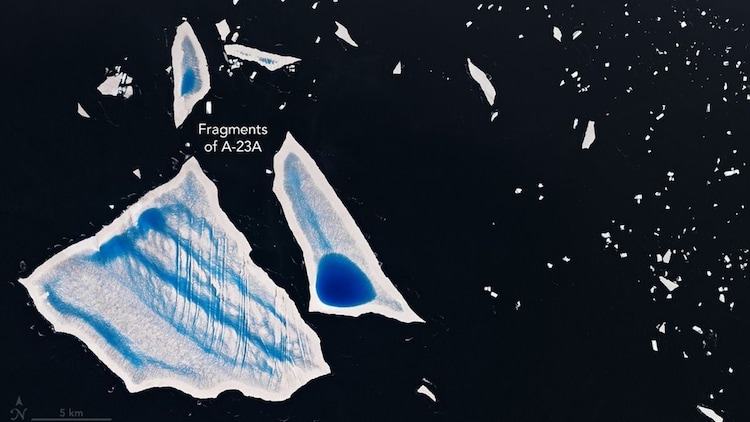
A23a calved from the Filchner-Ronne Ice Shelf in Antarctica. The process of calving, where a chunk of ice breaks off a glacier or ice shelf, created one of the most tracked icebergs in history. (Photo: Nasa)

A23a calved from the Filchner-Ronne Ice Shelf in Antarctica. The process of calving, where a chunk of ice breaks off a glacier or ice shelf, created one of the most tracked icebergs in history. (Photo: Nasa)

But scientists are watching for something bigger too. Antarctica’s ice shelves, the floating extensions of glaciers, are under increasing pressure from rising temperatures.

If they collapse, the glaciers behind them speed up, and sea levels rise. How A23a fell apart is giving researchers a clearer picture of how that could unfold.

WHEN WILL IT COMPLETELY DISAPPEAR?

China’s Fengyun-3D satellite, operated by the China Meteorological Administration, confirmed in January 2026 that the main body had shrunk to just 506 square kilometres, less than one-eighth of its original size.

It has kept shrinking since. According to the US National Ice Center, once it drops below roughly 70 square kilometres, scientists will stop tracking it altogether.
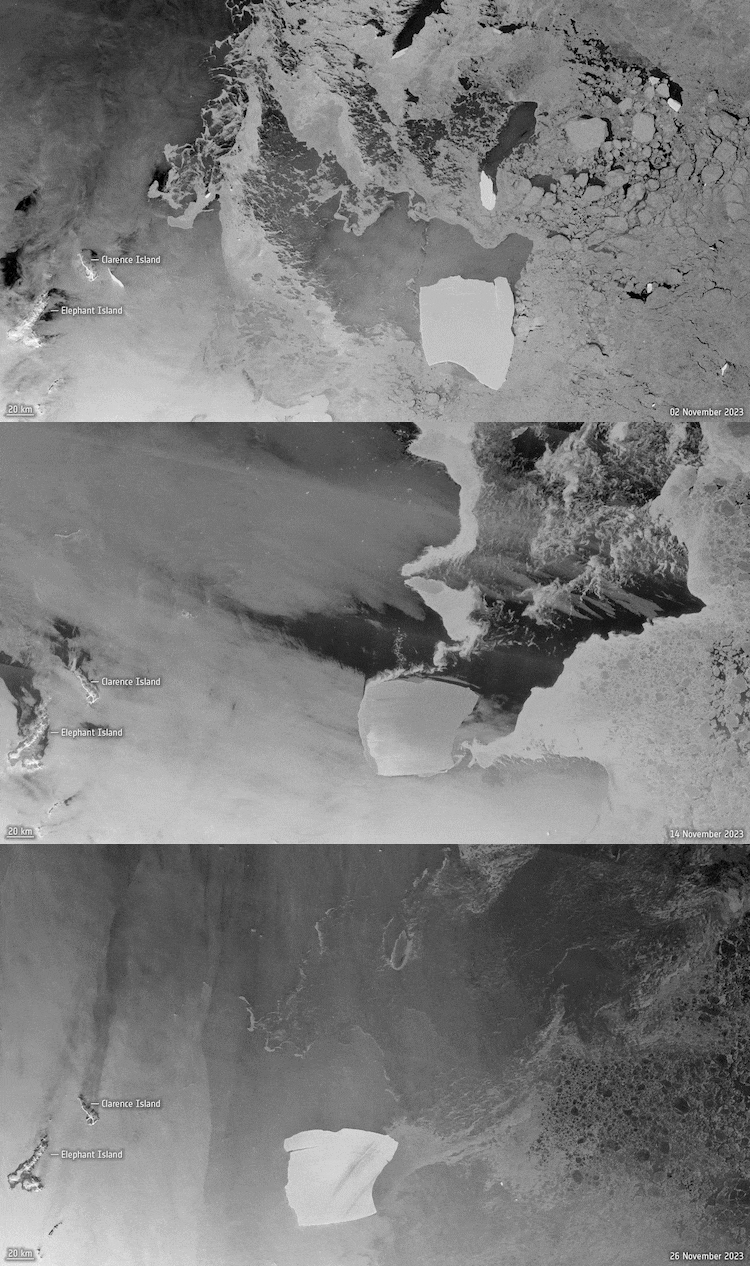
ESA GIF ICEBERG

Retired glaciologist Chris Shuman, formerly of the University of Maryland, Baltimore County, told NASA plainly: “I certainly don’t expect A-23A to last through the austral summer.”

That summer is nearly over. And so is the berg.

Latest

Why India is betting on E85 instead of 100% ethanol: The science explained

India moves forward with ethanol blending regulations amid global oil tensions

Earth glows alone in darkness: Christina Koch captures stunning earthshine video

At that distance, far beyond the altitude of the International Space Station, the planet appears as a luminous marble, its atmosphere glowing faintly against th

Meet Pakistan’s first astronauts selected by China to go to Chinese Space Station

he announcement marks the country’s most ambitious move yet in space exploration and signals deepening cooperation with Beijing in advanced scientific domains

North to sizzle in heatwave, northeast to experience thunderous Wednesday

Temperatures across northwest and central India are expected to climb by another 3–5C before finally dipping towards the end of the month. But before that, he

Plants not just feel, they can hear the rain too, confirms new research

MIT scientists have discovered that rice seeds can sense the sound of rain and germinate up to 40 per cent faster as a result. The study reveals how sound waves

Topics

India needs digital identity for every device and stronger AI-led cyber defence to curb threats: Experts

With the rapid expansion of the digital ecosystem and rising cyber threats, experts have called for creating a digital identity for every device and strengtheni

UN experts raise alarm over forced conversions and marriages of minority girls in Pakistan

Experts mentioned that in 2025, around 75 per cent of the women and girls affected by forced conversion through marriage in Pakistan were Hindus, while 25 per c

India to host IAFS-IV on May 31; Jaishankar highlights stronger Africa ties

External Affairs Minister (EAM) S Jaishankar said that the development partnership and capacity-building initiatives between India and Africa are driven by Afr

Why the Iran conflict is taking a more dangerous turn

Stalled talks, ship seizures and nuclear disputes sharpen the Trump-Iran standoff

Turkish parliament passes bill to restrict social media access for under-15s

Turkish parliament passes bill to restrict social media access for under-15s

‘US spat on India’s face’: Former US Ambassador slams Trump administration for undermining ties with New Delhi

Speaking about the changing geo-political situation and dynamics of India-US ties, former US Ambassador Rahm Emanuel said that he would not have done what Trump

‘Jhal muri maine khaayi, jhal TMC ko lagi’: PM Modi’s dig at TMC in Nadia

PM Modi’s remark came after the Trinamool Congress (TMC) criticised his “jhal muri break” a day earlier. The Prime Minister had taken the break on April 1

Bengal assembly polls: Murshidabad tense after clash between supporters of TMC, Humayun Kabir

West Bengal assembly elections 2026: AUJP founder Humayun Kabir visited Nowda on Thursday morning in the aftermath of the bombing and promptly organised a sit-i
spot_img

Related Articles

Popular Categories

spot_imgspot_img

