
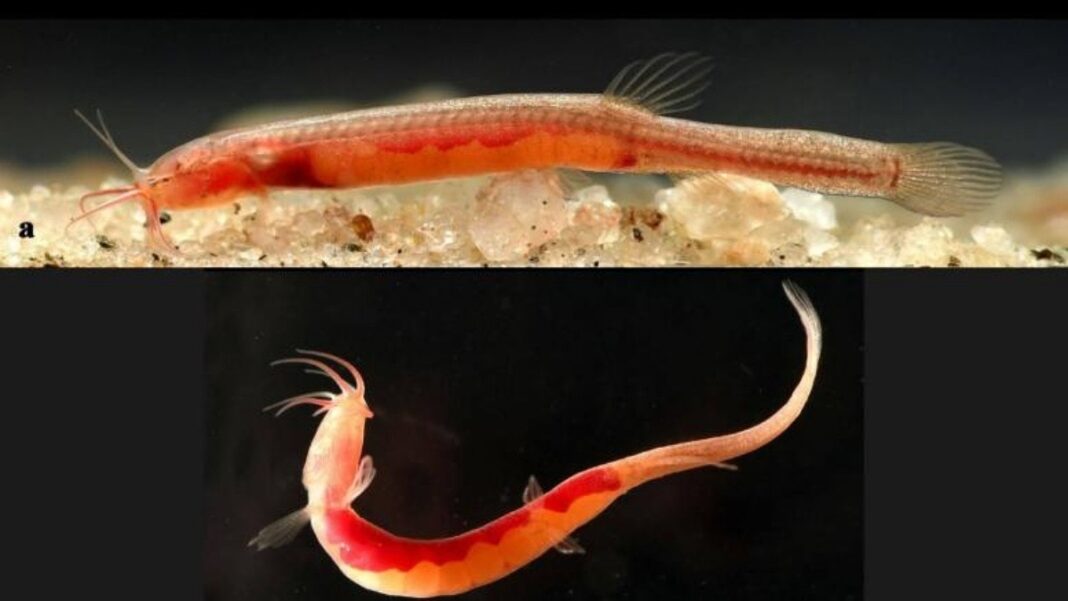
Deep beneath the floodplains of Assam, scientists have uncovered a creature so unusual it seems almost alien.
In a chance discovery that is reshaping understanding of India’s hidden biodiversity, researchers have identified a tiny, blind, blood-red fish living in underground aquifers in Goalpara district.
The species, named Gitchak nakana, is the first groundwater-dwelling fish ever recorded in Northeast India. It was found not in a cave expedition, but by accident, emerging from a concrete-lined well in a village near the foothills of the Shillong Plateau.
Local residents pumping water inadvertently brought the elusive fish to the surface, giving scientists a rare opportunity to study a lifeform that typically remains hidden deep below ground.
Reacting to the discovery, Assam Chief Minister Himanta Biswa Sarma called it a “fascinating” example of the state’s unexplored biodiversity, praising the collaborative effort involving German and Indian institutions.
Measuring just about 20 millimetres, the fish is classified as a miniature species. Its appearance is striking: devoid of eyes and pigment, its translucent body reveals blood vessels and internal organs, giving it a vivid red hue.
This ghostly look is an adaptation to complete darkness, where vision is useless.
But it is the fish’s anatomy that has left researchers astonished. Unlike most fish, Gitchak nakana lacks a protective bony skull roof, leaving its brain shielded only by skin.
It also has an unusually structured spine and elongated neck bones that curve upwards. To navigate its pitch-black environment, the fish relies on highly sensitive whisker-like barbels, packed with taste buds that help it detect food and movement in the water.
Its reproductive strategy is equally rare. Instead of producing large numbers of tiny eggs like its relatives, the species lays only a few large eggs, an adaptation believed to increase survival chances in nutrient-poor underground ecosystems.
The name reflects both its features and origins. “Nakana” comes from the Garo language, “na-tok” meaning fish and “kana” meaning blind, highlighting its eyeless existence.
Subterranean or “phreatobitic” fishes are exceptionally rare, accounting for less than one per cent of known fish species worldwide. While caves in Meghalaya have yielded similar discoveries, finding such a species in the sandy, waterlogged aquifers of the Brahmaputra valley is highly unusual.
Genetic studies suggest the species diverged from its relatives over 20 million years ago, evolving in isolation beneath the surface.
The find points to how much of India’s natural world remains hidden, and how even a village well can reveal secrets millions of years in the making.


