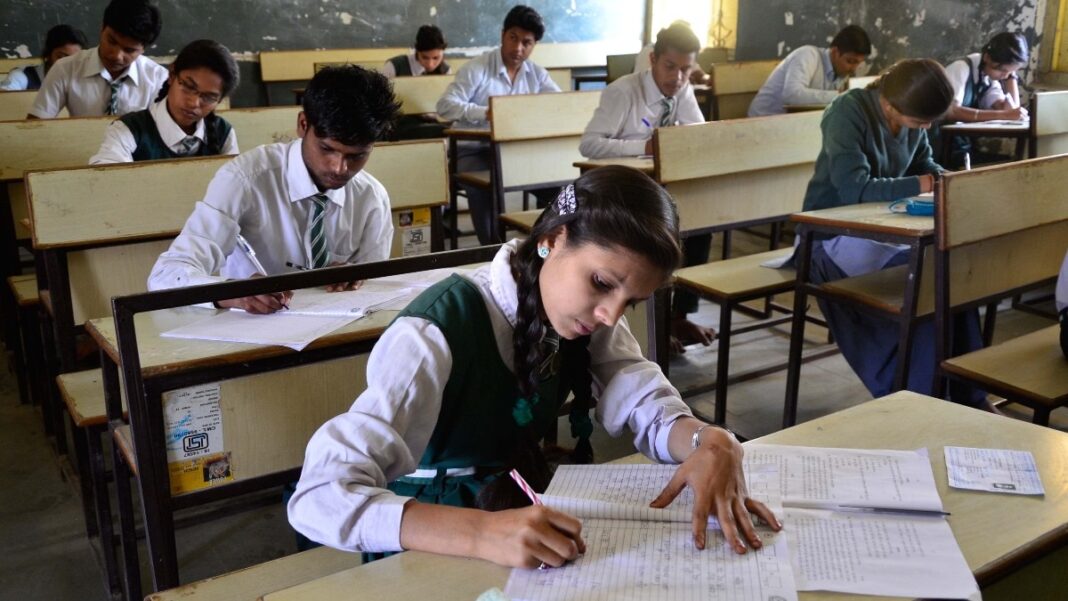
Under CBSE’s revised 2026-27 framework, the three-language structure of R1, R2 and R3 becomes compulsory from Class 6 and will be extended step-by-step till Class 10. The first affected batch is expected to reach board exams in 2030-31.
Unlike R1 and R2, R3 is expected to remain school-based and internally assessed rather than a separate Class 10 board paper.
Across many English-medium CBSE schools, one trend is becoming hard to miss: Sanskrit is emerging as the easiest third-language answer.
Not always because families demanded it. Often because schools already had Sanskrit teachers, old systems in place, and fewer operational headaches than starting fresh with Tamil, Bengali, Marathi, Punjabi, or another language.
That means a policy framed around diversity is, in some places, leading to one default solution.
WHY SANSKRIT IS BECOMING THE SAFE OPTION
There is also a deeper institutional story here. In many CBSE schools, Sanskrit had already been taught in middle classes under older three-language structures, especially across Classes 6 to 8 through materials such as NCERT’s Deepakam. That meant many schools already had teachers, timetable slots and some administrative memory in place.
That legacy now gives Sanskrit a natural advantage in the new rollout. Because several schools can implement it faster than less commonly staffed regional languages, the classical language is moving from an old middle-school option to a mainstream compliance-friendly choice.
In many English-medium schools, where Hindi is already one of the two Indian languages mandated, and English remains the only “foreign language” allowed, Sanskrit has become the easiest R3 fit.

At Silverline Prestige School, Principal Dr Gita Joshi said the transition was smooth because the school already had the framework in place.
“The implementation of the third-language requirement was smooth for our school as Sanskrit was already part of the curriculum as the third language for students,” she said.
“This existing foundation meant no major structural changes were needed.”
That same pattern appears elsewhere.
At Modern Public School, Shalimar Bagh, Principal Dr Alka Kapur said the school managed the rollout by “reorganising the timetable to include dedicated periods for Sanskrit, Hindi and English”.
She added that the school ensured “the overall balance of the learning time was not disturbed”.
For many schools, that is the real story. If Sanskrit was already present, the shift became manageable. If not, it became harder.
Dr Joshi said Sanskrit was chosen through “both pedagogical vision and existing logistical strength”.
“Logistically, Sanskrit was already well-integrated into our curriculum with qualified teachers, structured textbooks and dedicated periods in the timetable,” she said.
THE STAFFING QUESTION SCHOOLS CANNOT IGNORE
One of the biggest concerns around the policy has been simple: who will teach these languages?
Some schools say they were already prepared.
“The school did not need to hire new teachers, as language teachers were already appointed and available,” said Dr Alka Kapur.
“Existing staff were reassigned and their schedules were adjusted.”
Dr Joshi said Silverline also did not need emergency hiring.
“We did not have to hire new language teachers or reassign existing staff,” she said.
“Our Hindi teachers are also well-versed in Sanskrit.”
That may sound reassuring, but it also reveals why Sanskrit is becoming the easiest route. Schools are choosing what they can staff immediately.
Even Manav Rachna International School, Charmwood, while more cautiously worded, admitted that smaller institutions may face “staffing shortages” and “timetable inflexibility”.
FOREIGN LANGUAGES ARE NOT GONE, BUT THEY ARE MOVING OUT
The second shift is about what gets displaced.
Several private schools had built strong offerings around French, German or Spanish. Those languages may survive, but often outside the core structure.
Modern Public School said “foreign languages like German and French will continue to be taught by existing staff as extracurricular activities”.
That distinction matters. A language club is not the same as a classroom subject with marks, periods and continuity.
At Manav Rachna, teacher Tanu Chawla said French and Spanish would continue through enrichment sessions rather than formal assessment.
Students may still hear the language, but the academic weight changes. For some foreign-language teachers, it also raises uncertainty over future classroom demand if these subjects keep shrinking into add-on spaces.
For parents who saw foreign languages as useful for global careers, that is a major shift.
HOW STUDENTS ARE RESPONDING
Schools insist many children are adapting well.
Nyan Dahiya, TGT English at Modern Public School, said students have shown “enthusiasm and curiosity”.
“Most of them are showing enthusiasm and curiosity, especially as they explore new words, expressions, and cultural aspects,” the teacher said.
At Silverline Prestige School, teacher Kavita Bali offered a more realistic picture.
“Students are responding with slight initial confusion, mainly because the subject has now become mandatory rather than optional,” she said.
“Overall, the transition is progressing smoothly, with more acceptance than opposition.”
That may be the most honest summary yet. Students are not revolting. But neither are they all thrilled.
Silverline student Shaurya Jha said the school first held a counselling session and then offered options.
“This approach made the decision feel more informed and student-friendly,” he said.
At Modern Public School, Class 6 student Saiyansh Maheshwari called the new language “a valuable addition to the learning environment”.
“It is an investment that will pay rich dividends in the long run,” he said.

WHAT PARENTS ARE REALLY THINKING
Parents appear less polarised than social media suggests. Many support multilingual learning, but worry about pressure and lost flexibility.
Silverline parent Pratima Jha said the compulsory language “can be helpful for our child’s future”.
“At the same time, it should be introduced in a way that feels meaningful and manageable, so it adds to learning rather than creating unnecessary pressure,” she said.
At Modern Public School, parent Sanjeeta also backed the change, but with a caveat.
“A new compulsory language could definitely be beneficial for the child’s overall development,” she said.
“While there may be some extra adjustments, the school’s balanced approach helps ensure that it does not become unnecessary academic pressure.”
That phrase, “meaningful and manageable”, may capture the national mood better than any circular.

THE BIGGER DIVIDE NO ONE SHOULD MISS
Schools with resources can absorb reform. They can redesign timetables, use existing teachers, hold orientation sessions, and package change as opportunity.
Schools without those buffers may struggle.
Dr Joshi said many school leaders face “staff shortages, tight budgets, and sudden directives”, making implementation “far more demanding than it appears on paper”.
Manav Rachna also acknowledged that resource-constrained schools may face challenges “from sourcing qualified language educators to reconfiguring rigid timetables”.
That is the fault line of many Indian education reforms. The policy is common. Capacity is not.
THIS MAY STILL WORK, BUT THE CLOCK WAS THE PROBLEM
The case for multilingualism is strong. India is a language-rich country, and children can benefit from learning more than one language.
But timing matters. Preparation matters. Choice matters.
Right now, the schools that already had Sanskrit are coping best. The schools that did not are still figuring things out. Parents are adjusting. Students are adapting. Teachers are reshuffling.
And in campus after campus, one old language has suddenly become the newest administrative solution.
CBSE wanted three languages. What it has also created is one very loud national debate.