
24.1 C
Delhi
Saturday, February 28, 2026

Kolkata hit by earthquake: Where did the tremors originate? Science explained

A moderate earthquake of 5.3 magnitude struck near the India-Bangladesh border on February 27, sending powerful tremors across Kolkata and several districts of South West Bengal.

The jolts began at 1:22 pm IST and lasted for several seconds, triggering widespread panic. Residents and office workers in high-rise buildings rushed onto the streets as ceiling fans and furniture began to sway.

While no immediate casualties or major structural damage have been reported, the event has reignited fears about the seismic safety of the Bengal Basin.

WHERE IS THE EPICENTRE?

To understand the shake, we first need to know where it starts. An epicentre is the specific spot on the Earth’s surface directly above the region where the rocks break deep underground during an earthquake.

Today’s 5.3 magnitude quake was centred near Satkhira in Bangladesh, just 26 kilometres southeast of Taki in West Bengal. This area sits within the Bengal Basin, a giant bowl filled with kilometres of soft soil.
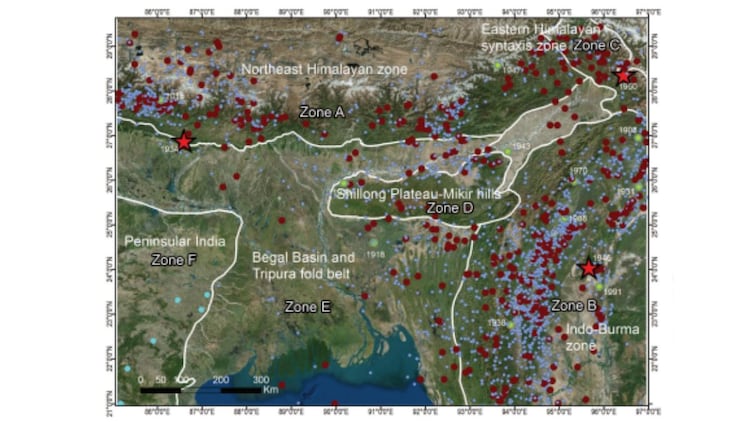
A map of the seismotectonic provinces in the Bengal Basin. (West Bengal Government)

A map of the seismotectonic provinces in the Bengal Basin. (West Bengal Government)

The science behind this is a massive slow-motion collision. The Indian Plate is constantly pushing north into the Eurasian Plate at about five centimetres per year.

This movement creates immense pressure along fault lines. Think of fault lines as giant cracks in the Earth’s crust. When the pressure gets too high, the land on either side of the crack slips suddenly, causing the ground to shake.

HOW DOES SOIL ACT LIKE A SEISMIC MEGAPHONE?

Geologists are currently monitoring the Sylhet Fault and the Eocene Hinge Zone, the main cracks running through the Bengal Basin.

When these faults slip, they release energy called seismic waves. Kolkata has a unique problem because it is built on soft, water-logged soil rather than solid rock.

Hooghly river in Kolkata (File Photo)

Hooghly river in Kolkata (File Photo)

This leads to a phenomenon called amplification. In simple terms, the soft soil acts like a megaphone for the earthquake. Just as a megaphone makes a voice much louder, this loose soil catches the seismic waves and makes them much stronger. This is why the shaking feels 50 per cent more intense in the city compared to areas sitting on hard rock.

CAN SATELLITES PREDICT FUTURE RISKS?

While predicting the exact minute of a strike is impossible, Nasa uses satellite technology like the Nisar radar to track how the Earth’s skin is stretching.

These satellites can measure ground movement with millimetre precision from space.
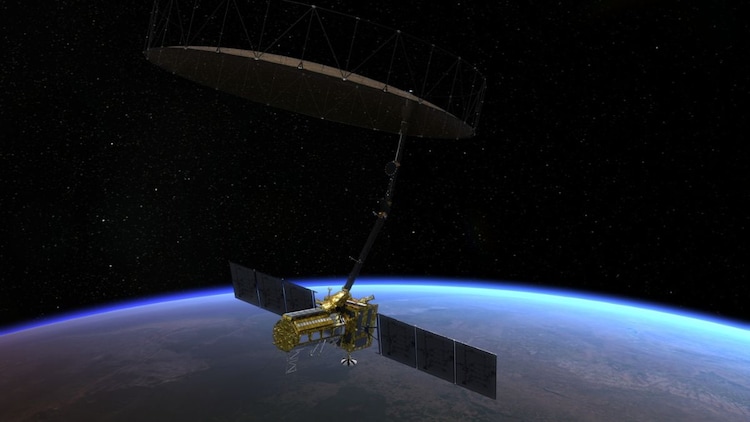
Nisar satellite. (Photo: Isro)

Nisar satellite. (Photo: Isro)

This data helps scientists see which fault lines are under the most stress. For a crowded city like Kolkata, this is vital because of a risk called liquefaction.

This happens when intense shaking causes wet soil to lose its strength and behave like a liquid.

If the ground turns into a jelly-like state, buildings can tilt or sink. Nasa data helps the city plan better for these invisible threats.

Latest

Seeds of change: How India is using science to save farming from climate change

Indian researchers are engineering a new kind of agriculture. Tools and techniques like CRISPR and breeding chambers are showing a glimmer of hope for a future

Nasa begins repairs on Artemis-II Moon rocket. Here’s when it will launch

Once Nasa's Artemis II Space Launch System (SLS) rocket and Orion spacecraft arrived at the Vehicle Assembly Building, technicians immediately began investigati

Australia joins hands with Isro to support Gaganyaan: How will it help astronauts?

Australia has received critical tracking infrastructure for India’s historic Gaganyaan mission. The Cocos Islands Station will monitor the spacecraft to ensur

Neanderthal men dated human women. Study finds how this romance shaped our DNA

A new study in the journal Science reveals that interbreeding between Neanderthals and humans was strongly sex-biased. This social dynamic explains why Neandert

New Study Probes Mystery of Neanderthal-Human Interbreeding

Neanderthal males had a tendency to mate with human females, new research suggests.

Topics

Indian Railways win 72nd Senior Men’s National Kabaddi Championship

Indian Railways win 72nd Senior Men's National Kabaddi Championship

Alisha Crins: 5 things to know about ex-Rhode Island teacher charged with sexually harassing former student

Alisha Crins, a former Ponaganset High School teacher, now faces charges for sexually harassing a former student. 

US issues advisory for citizens in Pakistan amid ‘open war’ with Afghanistan: ‘Keep a low profile’

The US mission in Pakistan urged the citizens “to observe good personal security practices” and asked them to be aware of surroundings and avoid large crowd

Horoscope Tomorrow, February 29, 2026: March may begin with career success, monetary gains and more

Horoscope Tomorrow: Find out the astrological prediction for zodiac signs for February 29, 2026.

‘Legally unsound, dangerous precedent’: Who said what in Trump-Anthropic AI feud

Anthropic CEO Dario Amodei said the company “cannot in good conscience accede” to the Trump administrations' demands.

Living with a rare disease in India: What the healthcare system doesn’t see

Living with Isaacs' syndrome, a rare neurological condition, has made experience with healthcare challenging. Despite millions affected, support is limited.

OpenAI reaches key deal with US Department of War amid Trump VS Anthropic AI

Sam Altman said that OpenAI would build technical safeguards to ensure that the AI models being deployed to the network “behave as they should”.

‘Sharif, Munir great’: Trump’s praise and his team’s ‘support for Pak’s right to defend’ against Taliban

Donald Trump, asked about the strikes on Afghanistan on Friday, hailed Pak's military chief Asim Munir and PM Shehbaz Sharif as “great".
spot_img

Related Articles

Popular Categories

spot_imgspot_img