Key Takeaways
- PSLV-C62 mission failed due to a third-stage anomaly shortly after launch on January 12, 2026.
- The rocket and its 16 satellites, including the main EOS-N1 (Anvesha), failed to achieve orbit and re-entered Earth’s atmosphere.
- ISRO has formed a failure analysis committee to investigate the cause, which is the second consecutive PSLV failure linked to its third stage.
India’s first space launch of 2026, the PSLV-C62 mission, ended in failure when its upper stage malfunctioned, causing the loss of all 16 satellites on board, including a key Earth observation satellite.
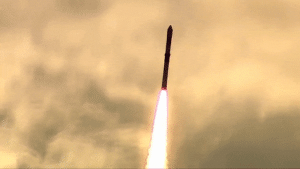
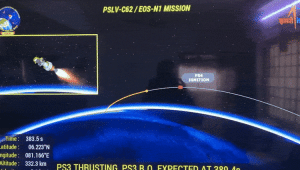
The Polar Satellite Launch Vehicle lifted off successfully from Sriharikota at 10:18 am IST on January 12. However, a sudden disturbance during the third-stage burn threw the rocket off course, preventing it from reaching the required orbital velocity.
What Went Wrong?
The anomaly occurred near the end of the third-stage operation. ISRO reported an unexpected twisting or rolling motion, disrupting the precise trajectory needed for orbit.
To stay in orbit, a spacecraft must achieve a specific speed—around 7.6-7.7 km per second at 400 km altitude, like the International Space Station. The PSLV-C62 fell short of this critical velocity.
Fate of the Satellites
With insufficient speed, the rocket’s path curved back toward Earth. Within hours of launch, the upper stage and all attached payloads re-entered the atmosphere.
Intense atmospheric friction likely caused them to burn up completely, similar to a shooting star. Any surviving fragments would have fallen harmlessly into the ocean.
Mission Payload Lost
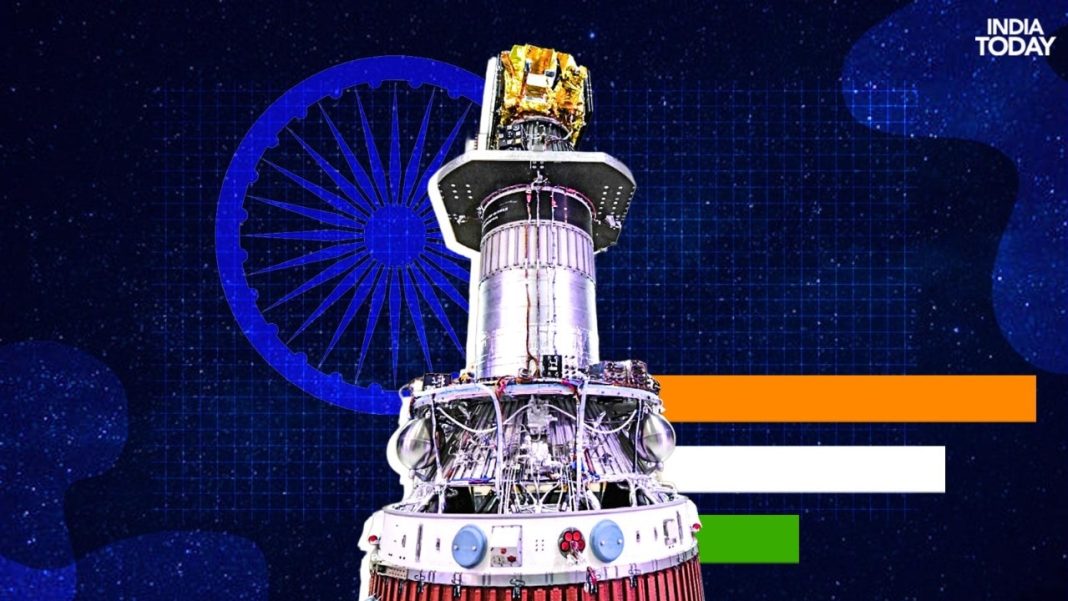
The primary payload was the EOS-N1 (Anvesha) satellite, intended for defence, agriculture, disaster management, and mapping applications.
Approximately 15 smaller satellites from Indian startups, universities, and international partners (including Nepal and Thailand) were also lost. These carried experiments in satellite refuelling and safe re-entry technology.
Investigation and Context
This marks only the fourth failure in the PSLV’s 64-flight history. Significantly, it is the second consecutive failure linked to the rocket’s third stage, following the PSLV-C61 anomaly in 2025.
ISRO has immediately convened a failure analysis committee. Experts will scrutinise all flight data, sensor readings, and footage to pinpoint the root cause. Potential issues being examined include uneven thrust, nozzle deformation, or pressure anomalies during stage shutdown.
Spaceflight remains a high-stakes endeavour where minor imbalances can lead to total mission loss. The setback is a disappointment for ISRO and the teams behind the satellites.
However, ISRO has a proven track record of learning from failures and implementing robust corrections. A thorough investigation is expected to pave the way for the programme’s return to reliability.
(Manish is a solar energy and spacecraft solar panel expert with extensive experience in managing critical space missions, including Chandrayaan-2 and Mangalyaan.)