
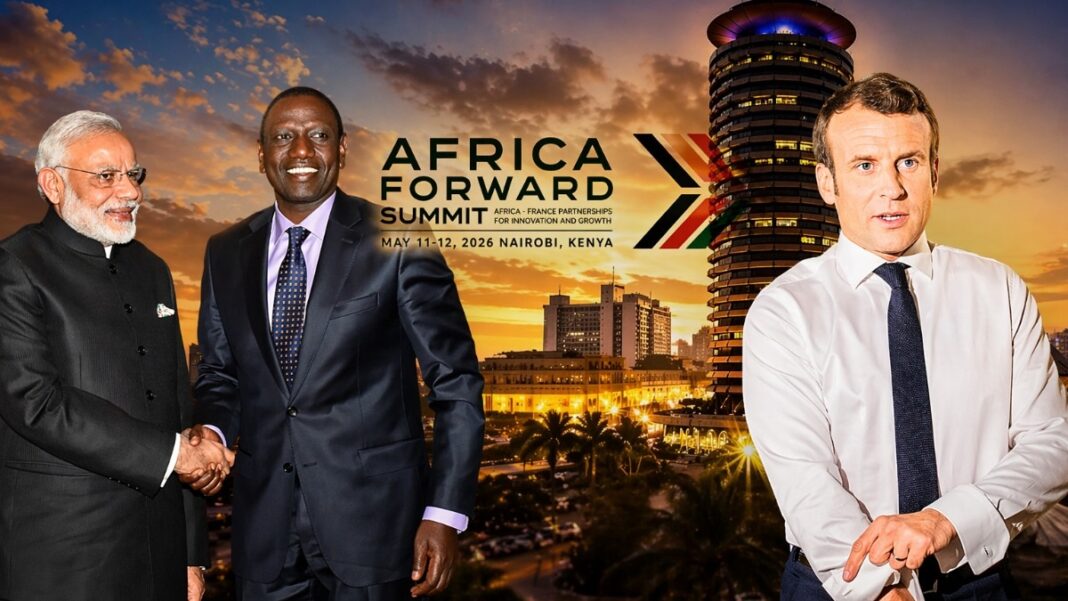
On the 11th and 12th of May, the Kenyan capital Nairobi will host one of the most consequential diplomatic gatherings on the African continent in recent years. The Africa Forward Summit 2026 — formally titled “Africa-France Partnerships for Innovation and Growth” — is co-hosted by French President Emmanuel Macron and Kenyan President William Ruto. African heads of state, over 1,500 global business leaders, and senior policymakers will convene at the Kenyatta International Convention Centre to forge a new architecture for Africa-Europe engagement. India has been personally invited. As of writing, New Delhi has not confirmed its attendance. That silence deserves far more scrutiny than it has received.
An invitation with strategic weight
During President Macron’s official visit to India in February 2026 — his fourth visit to the country — he recalled the joint invitation extended alongside President Ruto to Prime Minister Narendra Modi to participate in the summit. The India-France joint statement noted that Prime Minister Modi thanked Macron for the gesture and reaffirmed India’s support in areas of mutual interest, citing energy transition, artificial intelligence, health, agriculture, and the blue economy. But a formal confirmation of attendance from India has not followed.
This matters because the Africa Forward Summit is not a ceremonial occasion. It is a deal-making platform structured around high-level roundtables spanning energy, finance, agriculture, artificial intelligence, the blue economy, health, and industrialisation. Its conclusions are explicitly designed to feed into the G7 Summit in Evian in June — a gathering to which Prime Minister Modi has also been invited as a special guest. In other words, what is negotiated in Nairobi will shape what is discussed at the highest table of Western-led multilateralism weeks later.
For India, which chairs the BRICS Summit this year even as France chairs the G7, the opportunity to present itself as a genuine bridge between the Global South and the developed world — on African soil, at a moment of global realignment — is both rare and potentially defining. An empty chair in Nairobi does not merely signal disengagement from a single summit. It signals disengagement from the very conversation through which Africa’s next chapter is being written.
The scale of what is already at stake
Any honest assessment of India’s Africa engagement must begin with the numbers. India is currently Africa’s third-largest trading partner, with bilateral trade reaching 103 billion dollars in 2024-25, representing a 17 per cent increase year-on-year. India has completed over 200 development projects across 43 African countries, extended concessional loans exceeding 12 billion dollars, and its cumulative investments on the continent surpass 75 billion dollars. A three-million-strong Indian diaspora further deepens this relationship in ways that no balance sheet can fully capture.
And yet, for all this scale, India’s Africa engagement has consistently been described by analysts and policymakers as insufficiently strategic — reactive rather than proactive, episodic rather than sustained. The fourth India-Africa Forum Summit, expected in New Delhi later this month, is itself arriving after a gap of nearly a decade since the last edition in 2015. That gap alone speaks to the inconsistency that has characterised New Delhi’s approach to the continent.
Attending the Africa Forward Summit in Nairobi would serve as a powerful and timely corrective. It would signal to African leaders, gathered in one room, that India’s commitment to the continent does not operate only on its own schedule or solely within its own institutional frameworks. It would demonstrate that India is willing to show up — even at a table set by others — because the stakes are too high to stay away.
The critical minerals imperative
Perhaps no dimension of India’s Africa calculus is more urgent than the race for critical minerals. Africa holds approximately 30 per cent of the world’s critical mineral reserves — lithium, cobalt, copper, manganese, and rare earth elements that are indispensable to India’s green energy transition, semiconductor ambitions, and electric vehicle manufacturing targets. India’s National Critical Minerals Mission, launched in 2025, has already identified Africa as a priority geography. New Delhi is reportedly exploring mineral asset acquisitions in the Democratic Republic of Congo, Tanzania, and Mozambique, and has secured exploration rights covering thousands of square kilometres in Zambia for copper and cobalt.
The challenge, however, is competitive intensity. China already occupies a dominant position across Africa’s mining and midstream processing sectors, having invested heavily through state-backed institutions over two decades. The Africa Forward Summit’s agenda covers precisely this terrain — sustainable financing, industrial partnerships, and supply chain development. India’s presence in Nairobi would provide a direct platform to make the case to African heads of state that it offers what China structurally cannot: technology transfer without debt dependency, democratic governance standards, and a development partnership grounded in the principles of South-South solidarity rather than geopolitical leverage.
This is not merely economic diplomacy. It is resource security for India’s future — and the window to secure it on favourable terms is narrowing.
The renewable energy opening
The summit’s renewable energy agenda offers India a second, equally compelling opening. Africa accounts for nearly 60 per cent of global renewable energy potential, and yet solar power contributes only approximately 3 per cent of the continent’s total electricity generation today. The gap between potential and reality is vast — and it is precisely the kind of gap that India has demonstrated, through its own transformation over the past decade, the capacity to close.
India’s International Solar Alliance, of which over 30 African nations are founding or partner members, gives New Delhi an institutional foundation for clean energy cooperation that predates and surpasses that of virtually any competing power. India’s journey from negligible solar capacity to one of the world’s largest installed bases within a single decade is the model African policymakers are actively seeking to replicate. Nairobi is the room in which that conversation will take place. India’s absence from it would be not merely a missed opportunity but a strategic failure of imagination.
A moment that will not repeat
The broader geopolitical context amplifies the urgency. The United States is recalibrating its global commitments. China is consolidating its African presence with characteristic patience and capital. Europe, unsettled by domestic pressures and the ongoing consequences of conflict in its neighbourhood, is seeking new partnerships built on more equitable terms — which is precisely the impulse behind France’s decision to host this summit in an Anglophone African capital for the first time.
India, uniquely positioned as a democratic power, a leader of the Global South, a technological innovator, and Africa’s long-standing development partner, has the credentials to occupy a central place in this emerging order. But credentials alone do not confer influence. Presence does.
The Africa Forward Summit is not a gathering that India can engage with retrospectively through statements and communiqus. Its value lies in the room — in the bilateral conversations on the sidelines, the partnerships forged between sessions, the signal sent to fifty-five African nations that India regards their continent’s transformation as its own strategic priority.
Prime Minister Modi has been invited. The agenda aligns with India’s strengths. The stakes could scarcely be higher. The only question that remains is whether New Delhi will choose to answer the call or allow this particular chapter of Africa’s future to be written without it.


