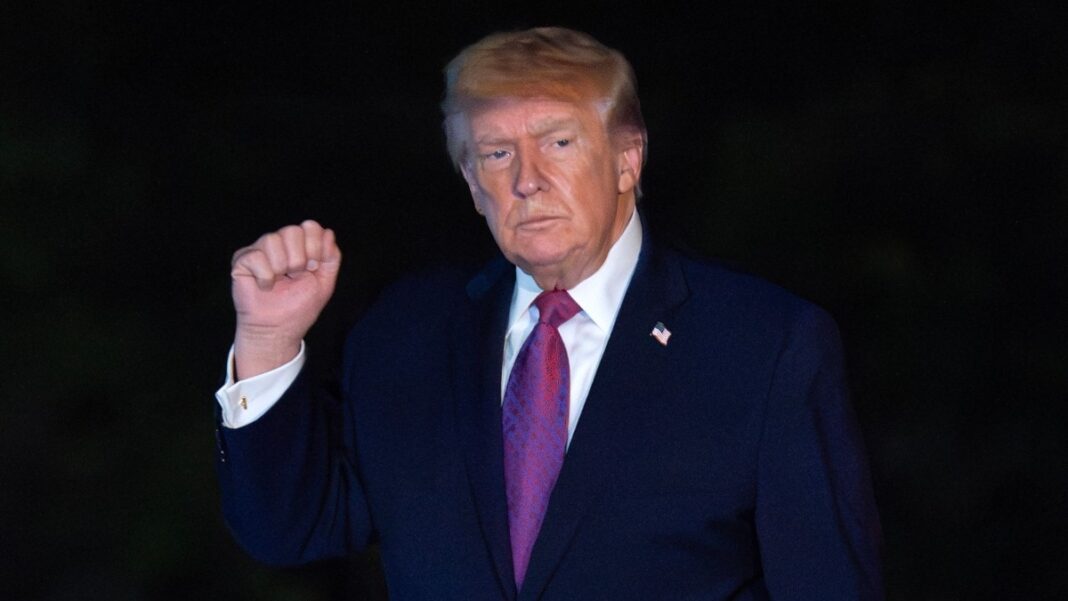
After failed negotiations between the United States and Iran in Islamabad, diplomacy remains on the table, but so does the threat of force. US President Donald Trump has warned Iran of sweeping strikes on its infrastructure if it fails to reach a deal. He warned that failure to accept what he described as a “fair and reasonable deal” would trigger a large-scale military response targeting Iran’s infrastructure.
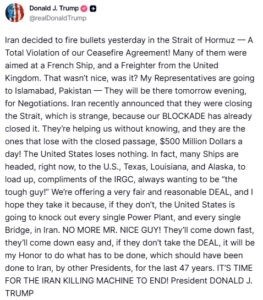
In his Truth Social post, he accused Iran of breaching a ceasefire agreement by opening fire in the Strait of Hormuz, claiming international vessels were targeted. “Iran decided to fire bullets yesterday in the Strait of Hormuz — A Total Violation of our Ceasefire Agreement! Many of them were aimed at a French Ship, and a Freighter from the United Kingdom. That wasn’t nice, was it?” he wrote.
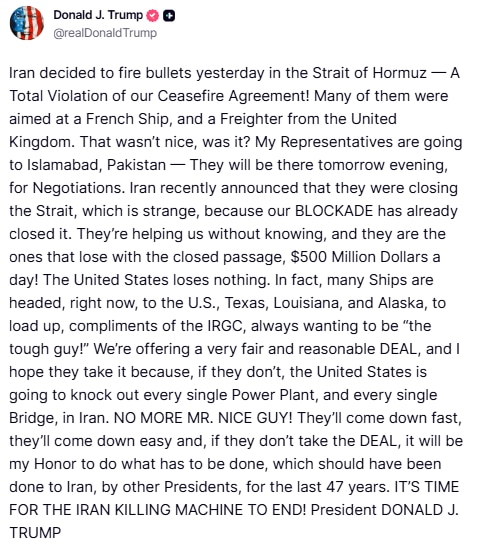
Trump also claimed that Iran’s actions were sabotaging its own economy with disruptions in the Strait of Hormuz. “They’re helping us without knowing, and they are the ones that lose with the closed passage, $500 Million Dollars a day! The United States loses nothing,” Trump claimed.
The US President further claimed that energy shipments were being redirected to American ports, adding: “Many ships are headed, right now, to the US, Texas, Louisiana, and Alaska, to load up, compliments of the IRGC, always wanting to be ‘the tough guy!'”
‘NO MORE MR NICE GUY’
Despite willingness to negotiate, Trump said: “We’re offering a very fair and reasonable DEAL, and I hope they take it because, if they don’t, the United States is going to knock out every single Power Plant, and every single Bridge, in Iran.”
“NO MORE MR. NICE GUY! They’ll come down fast, they’ll come down easy IT’S TIME FOR THE IRAN KILLING MACHINE TO END!” he added.
“My representatives are going to Islamabad, Pakistan — They will be there tomorrow evening, for negotiations,” the US President said in a post on Truth Social post. The first round of talks, held last week in Islamabad, collapsed after Iranian negotiators rejected US demand for immediate limitations on uranium enrichment. Following this, the US imposed a naval blockade in the Strait of Hormuz.
IRAN HITS OUT AT US OVER TALKS DEADLOCK
Speaking to The New York Post, Trump confirmed that his special envoys, Steve Witkoff and Jared Kushner, will arrive in Islamabad ahead of the next round of talks. “Steve’s going to be going there tomorrow night,” Trump said, adding that the discussions are expected to resume shortly after his envoy’s arrival.
Trump added that Vice President JD Vance will not travel to Pakistan. Earlier in the day, US envoy to the United Nations, Mike Waltz, and US Energy Secretary Chris Wright had indicated that JD Vance would lead the negotiations in Islamabad.
However, state media reported that Iran will not participate in a planned second round of talks with the US in Pakistan, blaming Trump’s “excessive demands, unrealistic expectations, constant shifts in stance, repeated contradictions”, and an ongoing US naval blockade of its ports, which it considers a breach of the truce.
to most vessels since the February 28 strikes by the United States and Israel, allowing only its own ships through. Although Tehran said on Friday that it would reopen the passage, the situation on the ground remains uncertain.
Earlier in the day, two liquefied petroleum gas tankers were seen heading towards the Strait, according to ship-tracking data. However, Iran’s semi-official Tasnim news agency reported that its armed forces turned them back. Marine traffic records showed little to no movement after midnight.
Now in its eighth week, the conflict has triggered an unprecedented shock to global energy supplies. Oil prices have surged as the Strait — which typically carries about one-fifth of the world’s oil — remains effectively shut. With an April 22 ceasefire deadline fast approaching, pressure is building on Iran, as the US has warned it could impose sweeping new sanctions — and even consider direct military strikes on Iranian nuclear and military sites — if no deal is reached.
With inputs from agencies