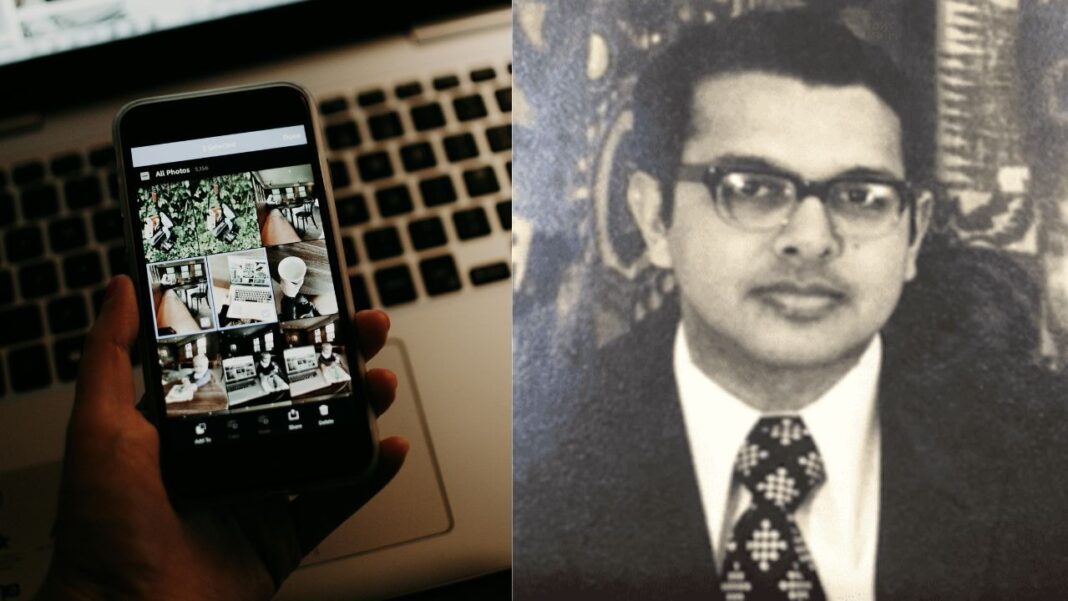
In today’s world, we scroll through countless photos, watch videos on our phones, and stream music without a second thought.
Behind this seamless digital experience lies a mathematical breakthrough by an Indian-born engineer that changed how we store and share media forever.
Nasir Ahmed, born in 1940 in Bangalore (now Bengaluru), grew up inspired by his grandfather, an electrical engineer who had worked in the United States.
After completing his bachelor’s degree in electrical engineering from the University of Visvesvaraya College of Engineering in Bengaluru in 1961, Ahmed moved to the US for higher studies and later went on to become a professor at the University of New Mexico.
SIMPLE IDEA REAPS REWARD
Back in the early 1970s, digital images and videos were a big problem.
A single high-quality photo created huge files that were difficult and expensive to store or send over slow networks.
Ahmed, along with his colleagues T Natarajan and KR Rao, came up with a smart solution in 1974. The trio proposed the Discrete Cosine Transform, or DCT.
In simple terms, DCT is a mathematical tool that changes image data from its original form of colours and brightness into frequency components. It basically breaks it down into patterns of waves, and thus, allows computers to identify and remove parts of the data that the human eye or ear hardly notices, making files much smaller without losing important details.
The team then published their work the same year.
At the time, experts were not immediately impressed. One funding reviewer even called the idea “too simple.” But Ahmed and his collaborators tested it thoroughly using old punch-card computers and proved its power. Their method could shrink image files dramatically while keeping them looking good to us.

POWERING THE DIGITAL WORLD
This breakthrough in the 1970s has since become the very backbone of everyday technologies we use today.
The JPEG format for photos relies heavily on DCT to compress pictures to about one-tenth their original size. Similarly, MPEG standards for video and MP3 for audio use variations of the same idea.
Without DCT, sharing photos on WhatsApp, streaming movies on Netflix, or listening to music on Spotify would be far slower and more data-heavy.
Before efficient compression like such, sending even a simple photo could take minutes or hours on earlier networks. Ahmed’s work single-handedly helped make the internet more visual and entertaining.

Today, thanks to DCT, we enjoy high-quality images and videos instantly on our phones.
The irony is that despite powering billions of technologies worldwide, Nasir Ahmed remains relatively unknown outside technical circles.
Now a Professor Emeritus, he has contributed to modern digital life from his base in the United States. His story highlights the global impact of Indian talent in science and engineering.
As we capture memories with a click or binge-watch shows, it is worth remembering the Bangalore-born mind whose clever math made it all possible. Ahmed’s legacy shows how one elegant idea can transform the world, proving that true innovation often works behind the scenes, making life simpler and richer for everyone.