
An iceberg twice the size of London lasted 40 years at sea. Its time is up

A trillion tonnes of ice that broke off Antarctica the same year Chernobyl exploded is nearing its end, dissolving in the warm waters of the South Atlantic after four decades of defying every prediction scientists threw at it.

The berg, known as A23a, once stretched across 4,000 square kilometres, nearly twice the size of Greater London, and spent over 30 years grounded on the ocean floor before quietly resuming its drift in 2020.

Now, battered by summer heat, warm currents, and its own crumbling weight, it is in its final weeks. Scientists say it will be gone entirely soon, and the world will lose the oldest tracked iceberg in recorded history.

WHAT WAS ICEBERG A23A, AND HOW BIG WAS IT?

In 1986, a massive slab of ice split away from Antarctica’s Filchner-Ronne Ice Shelf and dropped into the Weddell Sea.

That process, called calving, is a term used to define a phenomenon in which a chunk of ice breaks off a glacier or ice shelf and becomes a free-floating berg.

The colossus weighed nearly a trillion tonnes. At roughly 4,000 square kilometres, it was larger than many countries’ capital cities.
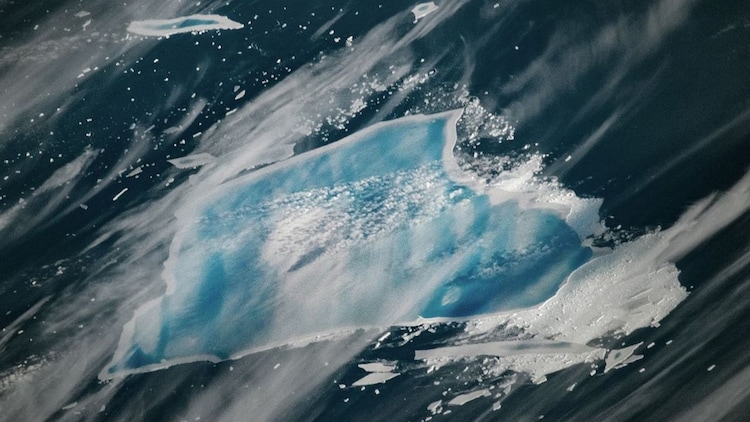
An iceberg that broke off Antarctica in 1986, weighed a trillion tonnes, and survived spinning ocean vortexes for four decades is finally melting away. Scientists say it has just weeks left. (Photo: Nasa)

An iceberg that broke off Antarctica in 1986, weighed a trillion tonnes, and survived spinning ocean vortexes for four decades is finally melting away. Scientists say it has just weeks left. (Photo: Nasa)

What happened next was strange. Instead of drifting off, A23a sank into the muddy seabed and stayed put for over 30 years, completely grounded, going nowhere.

Then in 2020, without much fanfare, it began to move. Scientists noticed, started tracking it, and quickly realised they were watching something extraordinary.

HOW DID THIS GIANT CHUNK OF ICE TRAVEL SO FAR?

Ocean currents pushed A23a northwards along a route researchers call Iceberg Alley, a pathway commonly followed by Antarctic icebergs moving into the South Atlantic.

Along the way, A23a got pulled into a Taylor Column, which is a rotating cylinder of ocean water that forms above underwater mountains. It is a giant natural whirlpool.
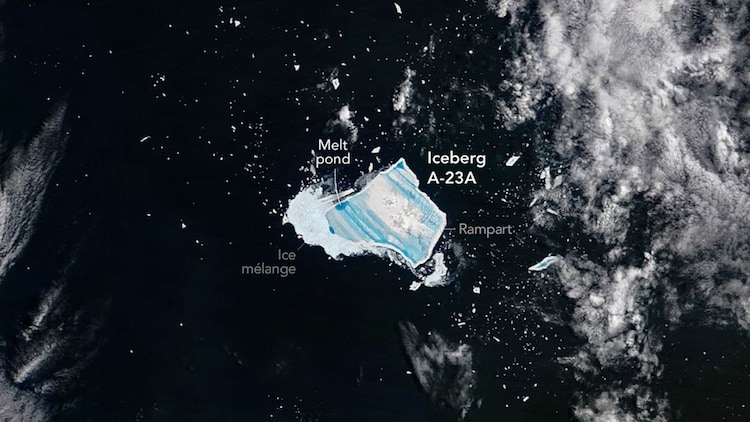
This satellite image from December 2025 shows vivid blue meltwater pooling across the surface of A23a. Scientists say the weight of this water forced cracks open from within, triggering the berg's rapid collapse. (Photo: Nasa)

This satellite image from December 2025 shows vivid blue meltwater pooling across the surface of A23a. Scientists say the weight of this water forced cracks open from within, triggering the berg’s rapid collapse. (Photo: Nasa)

The iceberg spent eight months spinning near the South Orkney Islands.

It then drifted towards South Georgia, a graveyard for most icebergs, broke free, and kept going north.

By early 2026, it had travelled further from Antarctica than any iceberg currently being tracked, sitting closer to the equator than London.

WHY DID IT SUDDENLY START FALLING APART?

In January 2025, its estimated area was 3,640 square kilometres, still the largest iceberg in the world. By September, it had shrunk to 1,700 square kilometres after several chunks broke away.

Then the Southern Hemisphere summer arrived and finished the job. By December, the berg was covered in pooling blue meltwater as it drifted between the eastern tip of South America and South Georgia Island. That vivid blue was not pretty. It was a warning.
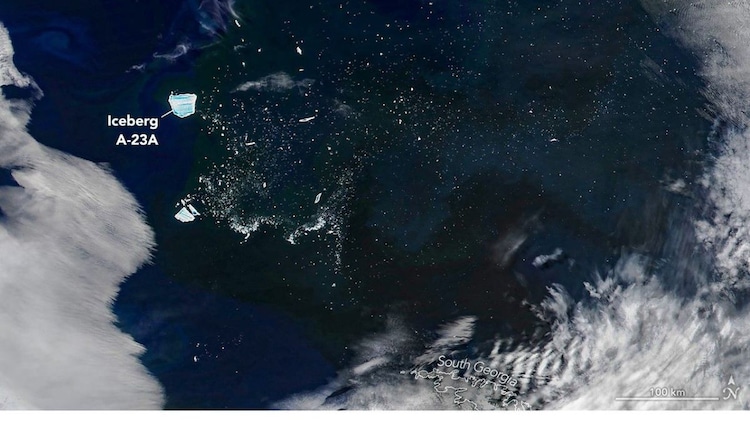
As they melt, large icebergs release nutrients like iron and nitrogen into the surrounding ocean, stimulating phytoplankton growth and feeding entire marine food webs. (Photo: Nasa)

As they melt, large icebergs release nutrients like iron and nitrogen into the surrounding ocean, stimulating phytoplankton growth and feeding entire marine food webs. (Photo: Nasa)

The disintegration was being driven by hydrofracturing, a process where meltwater pools on the surface exert enormous pressure on the ice, forcing cracks open from the inside until the whole structure gives way.

Ted Scambos, a senior research scientist at the University of Colorado Boulder, explained it to Nasa: “You have the weight of the water sitting inside cracks in the ice and forcing them open.”

WHAT DO SCIENTISTS HOPE TO LEARN FROM THIS?

The end of A23a is not just a spectacle. It is a laboratory. Researchers aboard the British Antarctic Survey’s RRS Sir David Attenborough conducted studies around the berg in December 2023 to assess its impact on marine environments.

Dr Laura Taylor, a biogeochemist with the British Antarctic Survey, said: “We know that these giant icebergs can provide nutrients to the waters they pass through, creating thriving ecosystems in otherwise less productive areas.”

As they melt, large icebergs release nutrients like iron and nitrogen into the surrounding ocean, stimulating phytoplankton growth and feeding entire marine food webs.
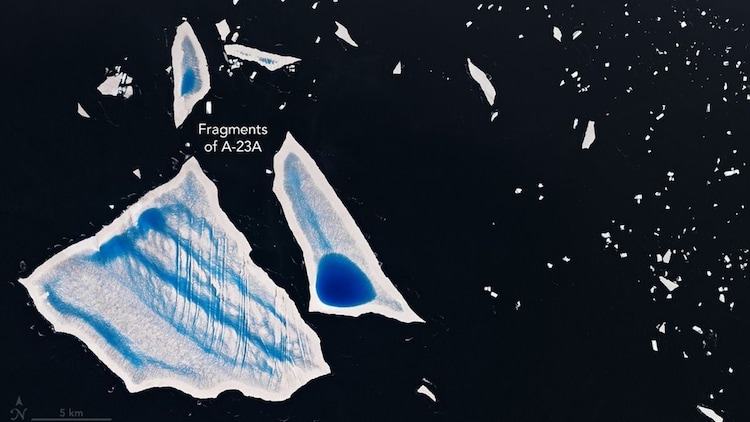
A23a calved from the Filchner-Ronne Ice Shelf in Antarctica. The process of calving, where a chunk of ice breaks off a glacier or ice shelf, created one of the most tracked icebergs in history. (Photo: Nasa)

A23a calved from the Filchner-Ronne Ice Shelf in Antarctica. The process of calving, where a chunk of ice breaks off a glacier or ice shelf, created one of the most tracked icebergs in history. (Photo: Nasa)

But scientists are watching for something bigger too. Antarctica’s ice shelves, the floating extensions of glaciers, are under increasing pressure from rising temperatures.

If they collapse, the glaciers behind them speed up, and sea levels rise. How A23a fell apart is giving researchers a clearer picture of how that could unfold.

WHEN WILL IT COMPLETELY DISAPPEAR?

China’s Fengyun-3D satellite, operated by the China Meteorological Administration, confirmed in January 2026 that the main body had shrunk to just 506 square kilometres, less than one-eighth of its original size.

It has kept shrinking since. According to the US National Ice Center, once it drops below roughly 70 square kilometres, scientists will stop tracking it altogether.
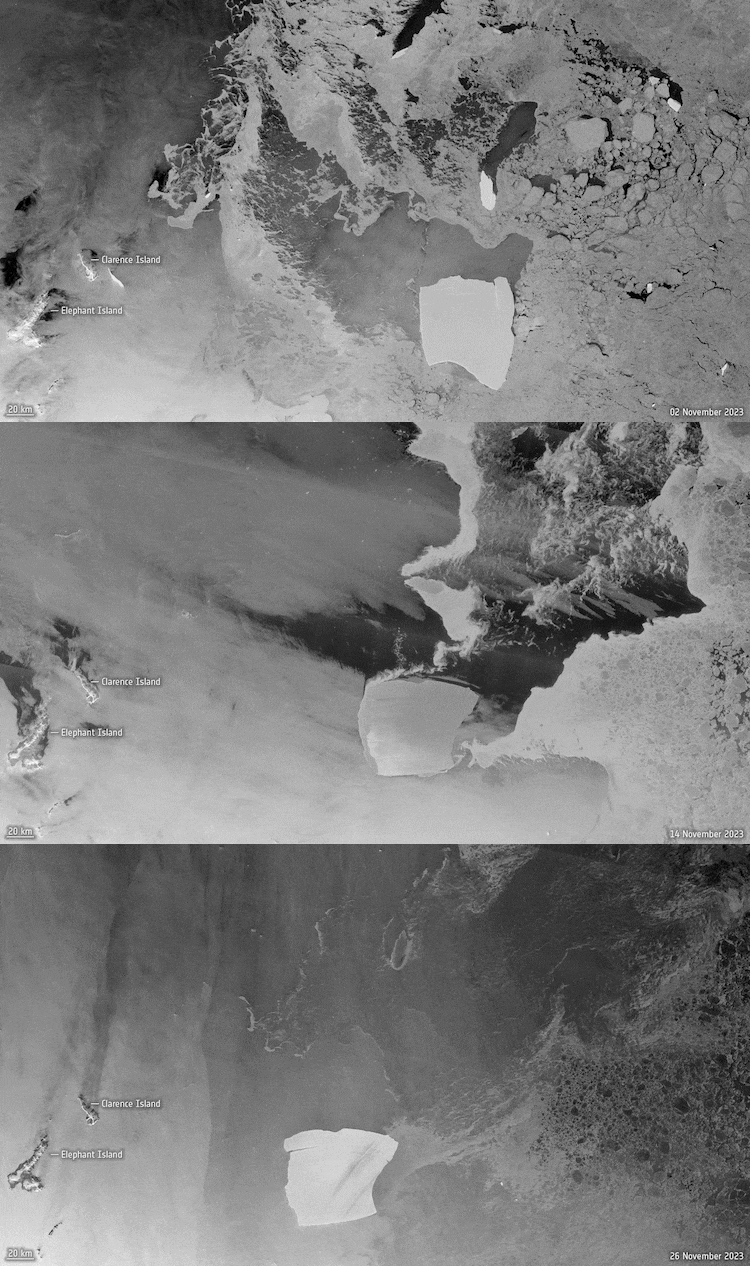
ESA GIF ICEBERG

Retired glaciologist Chris Shuman, formerly of the University of Maryland, Baltimore County, told NASA plainly: “I certainly don’t expect A-23A to last through the austral summer.”

That summer is nearly over. And so is the berg.

Latest

Delhi to hit 36 degrees on Monday, Himachal Pradesh on heat wave alert

Delhi is set to touch 36 degrees Celsius on Monday as the IMD warns of heat waves across northwest India and incoming snow in Jammu and Kashmir.

Why everyone wants Iranian oil: The chemistry behind Tehran’s liquid gold

Iranian crude oil has a rare chemical profile that neither American shale nor Venezuelan heavy crude can replicate, making it irreplaceable for refineries acros

North India heat to spike on Sunday, rain to hit eastern and southern states

India faces an early heatwave with temperatures soaring 12 degrees Celsius above normal in Jammu and Kashmir. The IMD predicts continued heat in Northwest India

Europe’s solar spy satellite has gone dark and nobody knows why

The European Space Agency (Esa) has lost contact with the Coronagraph spacecraft of its Proba-3 mission after a power failure caused it to enter survival mode.

It was not rain that caused the Dharali flood. Isro has found the real culprit

Isro scientists have discovered that a massive 69-million-kilogram ice patch collapse on Srikanta Glacier caused the Dharali flood in Uttarakhand. The study rul

Topics

Turkey deploys six F-16 jets to Cyprus as rising tensions in Middle East

The development followed an incident last week in which Iran launched two missiles toward Cyprus.

‘Dialogue and diplomacy should be pursued,’ says EAM S Jaishankar on West Asia tensions

Addressing the issues, EAM said India is committed to assisting the Indian community stranded in West Asia, in Rajya Sabha. Highlighted the efforts made by the

Who will decide when US-Iran conflict ends? Trump says ‘mutual’ decision with Netanyahu

Amid the ongoing tensions in West Asia, US President Donald Trump has reportedly said that the decision on when the conflict with Iran would end would be a mutu

US vows to secure Strait of Hormuz as tensions with Iran continue – What’s happening?

In a post on Truth Social, Trump argued that oil prices would drop rapidly once Iran's nuclear capabilities are destroyed. Meanwhile, US Secretary of War Pete

‘It is a matter of relief, no Indian killed in projectile strike in Saudi Arabia’, says Embassy in Riyadh

The General Directorate of Saudi Civil Defence said on Sunday that an Indian and a Bangladeshi national were killed after a projectile struck a residential area

Thrilled by Operation Sindoor, Poland eyes massive drone production in India – Is a game-changing partnership coming?

Poland has expressed interest in expanding defense cooperation with India, particularly in advanced drone technologies, following the success of Operation Sindo

Alysa Liu’s Olympic gold story hides painful truth as she recalls crying after every fall in strict childhood training

International Sports News: Alysa Liu’s Olympic gold medal may look like a beautiful dream to many fans. But the American figure skater says the truth behind t

‘Won’t tell who threw the bomb’: Laura Loomer attacks Mamdani after explosive device hurled at anti-Islam protest

US News: Far-right activist Laura Loomer lashed out at Zohran Mamdani after an improvised explosive device was thrown during a protest outside the mayor’s off
spot_img

Related Articles

Popular Categories

spot_imgspot_img

