Amid ambiguity over the second round of US-Iran talks and a fragile truce, US President Donald Trump has extended the ceasefire without a fixed deadline, saying it will hold until Tehran presents a “unified proposal,” keeping escalation risks alive. Especially as the US continues its blockade, a move Tehran has described as an “act of war.”
With no clear “endgame” in sight and uncertainty over what the next phase might look like, the war has now stretched beyond 50 days and is already taking a visible toll. Iran’s military capabilities have been significantly degraded, while the strain on US weapons stockpiles is becoming increasingly evident.
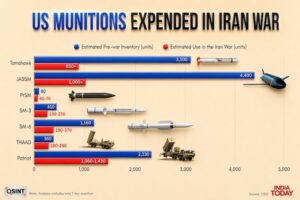
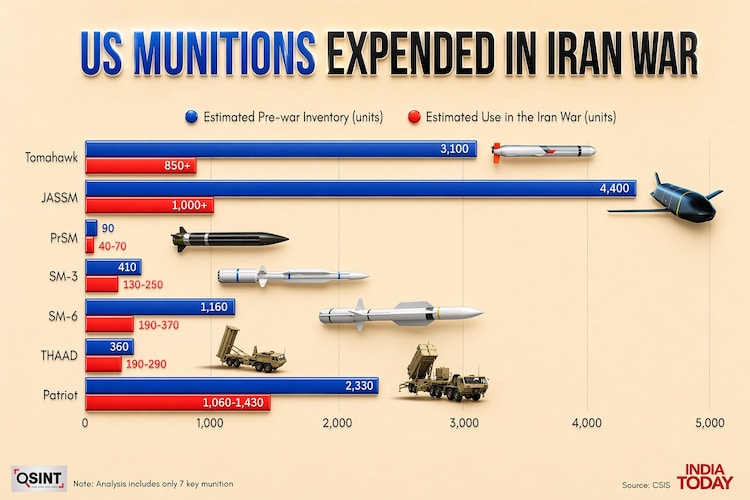
A Washington-based think tank, the Center for Strategic and International Studies (CSIS), citing government data, estimates that the US military has expended roughly 45% of its Precision Strike Missiles, over 60% of THAAD interceptors, and nearly 50% of Patriot air defence systems so far.
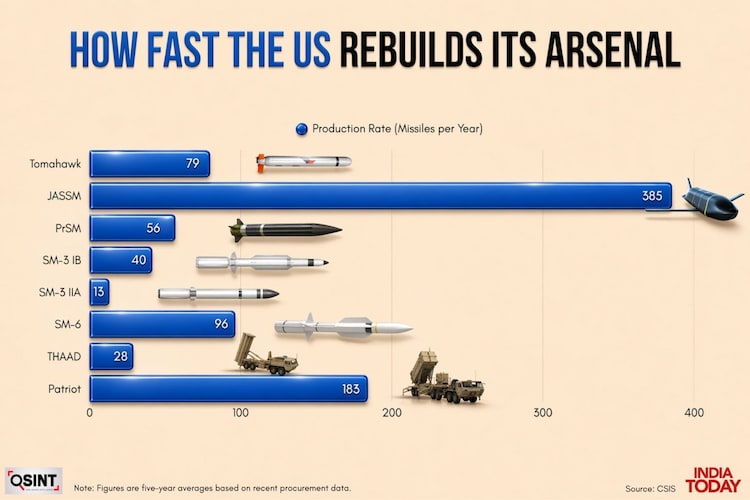
India Today’s Open Source Intelligence (OSINT) team analyses media reports and research documents to assess how key US munitions have been expended and how long Washington may take to restore its inventory to pre-war levels.
This analysis, however, focuses only on those munitions most frequently used, based on the pattern the Iran war has followed so far, and those likely to be deployed if the conflict re-escalates along a similar trajectory. If the escalation ladder shifts in a different direction, the US military possesses a far wider range of munitions that it can deploy depending on its operational objectives.
How much US firepower has been used?
Mark F. Cancian and Chris H. Park, in their CSIS report, argue that the United States has “enough missiles” to sustain the current war “under any plausible scenario,” but warn that the real risk, which will “persist for many years,” lies in future conflicts.
The analysis tracks only seven key munitions used by the US military in the Iran war, assessing their usage, depletion, and replenishment timelines. These include Tomahawk cruise missiles, Joint Air-to-Surface Standoff Missiles (JASSM), Terminal High Altitude Area Defense (THAAD) interceptors, Patriot Advanced Capability (PAC) interceptors, Standard Missile-3 (SM-3), and Standard Missile-6 (SM-6).
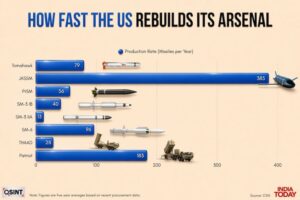
Tomahawk inventories stood at about 3,100 before the war, with more than 850 already used, leaving nearly a quarter of the stock depleted. Each unit costs roughly 2.6 million dollars, and with a 47-month production cycle, rebuilding these reserves is likely to be slow and gradual.
Tomahawk cruise missiles are long-range, precision-guided weapons, often described as “flying robots” for their autonomous navigation. Fired mainly from US Navy ships and submarines, they can strike targets over 1,000 miles away while flying at low altitudes to evade radar. Tomahawks have featured prominently in the Iran conflict, including last year’s US strikes, when two such missiles struck the Isfahan nuclear site.
On the other front, challenged by “cheaper” Iranian Shahed drones and cruise missiles, US missile defence systems are clearly facing a reserve strain, especially when factoring in the high cost and slow production rates of these advanced interceptors.
THAAD has seen a sharp drop in numbers, with 190 to 290 interceptors used out of 360, each priced near 15.5 million dollars, leaving only over 70 available, which reflects intense pressure on high altitude missile defence, and with a 53-month replenishment timeline, restoring this capability will take considerable time.
As per a US Congressional report from March 2026, at least three THAAD batteries are deployed in West Asia, including one in Israel and another in Jordan, while the location of the third remains undisclosed. Additionally, the UAE operates two of its own US-made THAAD batteries.
THAAD is a US missile defence system designed to intercept medium to intermediate range ballistic missiles at high altitudes, often outside the atmosphere, providing wide area protection.
Patriot (PAC-3), on the other hand, is a mobile air and missile defence system that counters short-range ballistic missiles, cruise missiles, aircraft, and drones at lower altitudes, protecting specific targets.
In the ongoing war, Patriot systems have been used most heavily, with 1,060 to 1,430 missiles fired from a stock of 2,330. At roughly 3.9 million dollars each, this leaves about 900 to 1,270 remaining, underscoring sustained defensive operations. Even with a relatively shorter 42-month production timeline, replenishment is expected to remain gradual.
Together, THAAD and Patriot systems form a layered shield, with THAAD handling high altitude threats and Patriot acting as the last line of defence closer to impact.
In January 2026, the US Department of War signed a framework agreement with Lockheed Martin, the world’s largest defence contractor, to ramp up production of THAAD interceptors from 96 to 400 per year, a nearly fourfold increase.
Additionally, over 1000 JASSMs were used from stocks of 4400, indicating about 25 per cent depletion.
The Joint Air to Surface Standoff Missile, or JASSM, is a family of stealthy, air-launched cruise missiles built to strike high-value, heavily defended targets from long distances. It has been used by the United States to hit hardened sites such as missile production facilities and command centres across Iran.
Launched from platforms like B-52 bombers, these missiles allow US forces to engage targets deep inside “enemy’s” territory without exposing aircraft or pilots to hostile air defences.
How quickly can the US “restore” its arsenal?
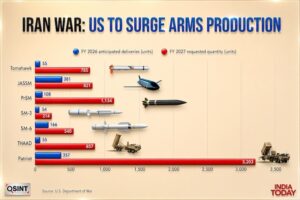
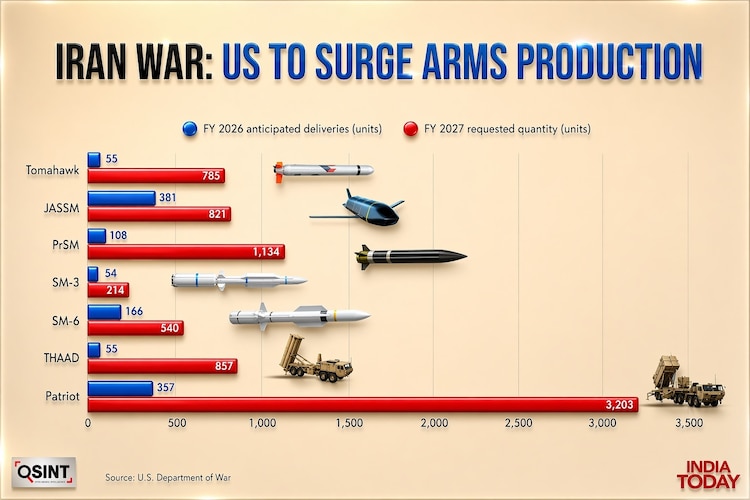
US Department of War budget data for 2027 offers a clear signal on how quickly Washington aims to restore its arsenal, contrasting FY 2026 planned deliveries with a sharp surge in FY 2027 requested quantities across key systems.
Tomahawk stands out, with planned deliveries at 55 in FY 2026 but a jump to 785 requested in FY 2027, indicating a rapid scale-up to rebuild long-range strike capacity after sustained depletion.
Missile defence sees the most aggressive push, with Patriot PAC-3 rising from 357 to 3,203 and THAAD from 55 to 857, underscoring the urgency to replenish critical air defence layers under strain.
Naval interceptors follow a similar trend, with SM-6 increasing from 166 to 540 and SM-3 from 12 to 136, pointing to a broader effort to restore depth in layered missile defence.
However, these trends do not necessarily signal urgency, but they do point to a clear intent by the US to restore its arsenal, which, if not depleted, is certainly under sustained stress. The focus is as much on rebuilding depth as it is on maintaining operational readiness.
At the same time, supply chains remain under pressure. The ongoing Russia-Ukraine war and NATO’s Partnership for Ukraine’s Reconstruction and Logistics (PURL) initiative are already stretching available inventories, complicating replenishment efforts.
A Reuters report further notes that US officials have informed some European counterparts that previously contracted weapons deliveries may be delayed, as the Iran war continues to draw heavily on existing stockpiles.