
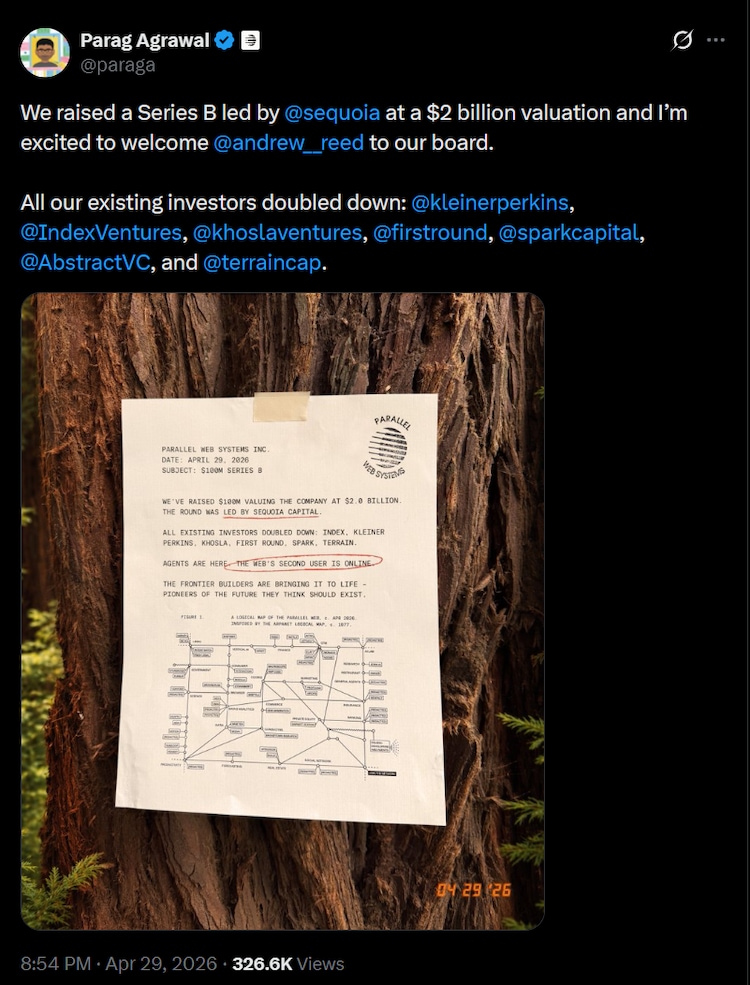
Parag Agrawal was the CEO of Twitter (now X) from 2021-2022. He had replaced founder Jack Dorsey himself who saw great potential in him to lead the company forward. However, Parag was unceremoniously fired soon after Elon Musk purchased Twitter for $44 billion. The news grabbed headlines. Many came out in support of Parag. But Parag chose to move out quietly, or rather gracefully. Now he is back in action with Parallel Web Systems, an AI startup which is drawing considerable interest after successfully raising $100 million in funding putting it at a valuation of $2 billion which is roughly Rs 19,020 crore.
The Series B funding round was led by Sequoia Capital, The Wall Street Journal reported. With the fresh investment, Parallel has now raised a total of $230 million. Kleiner Perkins, Index Ventures, Khosla Ventures and First Round Capital are others who have invested in it previously. Parag founded the startup in 2023. The money will go into expanding sales and marketing efforts and to double down on research and development, the report adds.
What is Parallel Web Systems?
So, what exactly is Parallel building, and why is it attracting this level of attention?
At its core, Parallel Web Systems is developing infrastructure for AI agents. These are autonomous software systems designed to perform tasks on behalf of users. It can work around anything from legal research to financial analysis. But instead of relying only on pre-trained data, Parallel is building tools that allow these AI agents to actively search the live web, extract real-time information and execute complex workflows.
The company offers a suite of APIs that allow AI systems to search websites, gather structured data, monitor updates and complete tasks online, covering everything from “deep research” and data enrichment to workflow automation.
The infrastructure by Parallel is already being put to use. AI agents powered by such tools are handling tasks like investment research, insurance claims processing, legal analysis and even navigating government contracts, work that once required humans to sift through vast amounts of online information. Parallel’s approach aims to make these processes faster, more accurate and far more scalable.
One example is legal AI startup Harvey, which uses Parallel’s infrastructure to better control how its AI agents access and interpret web data for legal research.
Despite being just about a year old, Parallel reportedly already has over 100,000 developers using its platform, including startups and large enterprises. Its customer base includes companies like Notion, Clay and Opendoor, along with banks, hedge funds and Fortune 100 firms.
The company currently has around 50 employees and is focusing heavily on enterprise adoption, a segment where demand for “long-horizon” AI agents is rising. These are systems that can operate in the background, retain context over time and complete multi-step tasks with minimal human input.