
Burtele Foot Mystery Solved: Lucy Had Company 3.4 Million Years Ago

Key Takeaways

  • Scientists identify 3.4-million-year-old ‘Burtele Foot’ as Australopithecus deyiremeda
  • This species lived alongside Lucy’s species (A. afarensis) in the same region
  • The discovery proves multiple human ancestors coexisted 3.5-3.3 million years ago
  • Each species had distinct walking styles and dietary preferences

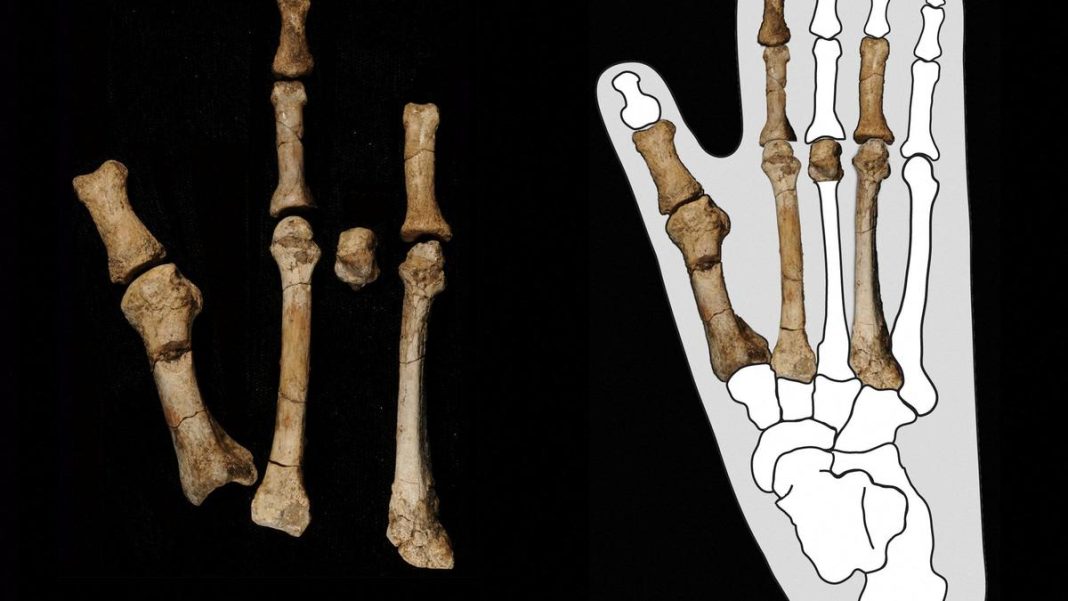
Scientists have finally solved the mystery of the 3.4-million-year-old ‘Burtele Foot’ fossils discovered in Ethiopia. The research reveals these bones belonged to Australopithecus deyiremeda, a human ancestor that lived alongside the famous Lucy’s species during a crucial period in human evolution.

Two Species, One Time Period

The discovery confirms that two closely related hominin species – Australopithecus deyiremeda and Australopithecus afarensis (Lucy’s species) – coexisted in northeastern Ethiopia’s Afar region between 3.5 and 3.3 million years ago. This challenges the previous assumption of linear human evolution with only one species at a time.

“They provide us with the most conclusive evidence showing that A. afarensis – Lucy’s species – was not the only human ancestor that lived between 3.5 and 3.3 million years ago,” said lead author Yohannes Haile-Selassie of Arizona State University.

Distinct Walking Styles

The Burtele Foot showed this species walked upright but with a crucial difference – it retained an opposable big toe similar to tree-climbing apes. While Lucy’s species had a human-like big toe, A. deyiremeda probably pushed off from its second digit when walking.

“It would definitely be less efficient walking on two legs when on the ground. However, it was more effective for tree-climbing – not a bad trade-off, especially in areas where there were large predators,” Haile-Selassie explained.

Different Diaries, Different Survival Strategies

Chemical analysis of tooth enamel revealed stark dietary differences between the two species. Lucy’s species was a generalist, eating grasses along with tree and shrub foods. A. deyiremeda, however, stuck exclusively to tree and shrub-based diets.

“These species were moving around in different ways. There were multiple ways to be human at this time,” said co-author Naomi Levin from the University of Michigan. “We can now associate these different ways of moving around on two feet with different diets.”

Solving the Coexistence Puzzle

The research raises intriguing questions about how these close relatives shared resources without direct competition. Their different locomotion styles and dietary preferences may have allowed them to coexist in the same environment.

“Now that we know they ate different things and that they moved around in different ways, we’re that much closer to solving this puzzle of co-existence,” Levin concluded. The study published in Nature represents a major breakthrough in understanding the complex branching of before Homo sapiens emerged.


Latest

Nasa astro’s Bihu in space goes viral. Assam CM credits PM Modi, gets fact-checked

A Nasa astronaut wore the traditional Assamese gamusa and performed a Bihu dance aboard the International Space Station, in a quiet and beautiful tribute to his

Scorching heat, heavy rain, zero relief: What’s in store for India on Monday

The IMD has issued heatwave warnings for Jharkhand, West Uttar Pradesh, West Rajasthan, Vidarbha, and several other states for Monday, April 20, with temperatur

Blue Origin launches, lands reused rocket with world’s biggest space antenna

Blue Origin launched its New Glenn rocket for the third time on Sunday and successfully landed its reused booster on drone ship Jacklyn in the Atlantic Ocean. T

Is that ship flying? The ghost, the myth and the physics of the Flying Dutchman

Videos of ships appearing to hover above the sea have gone viral, but the explanation is pure science, a rare phenomenon called Fata Morgana. Here is how physic

India to sizzle this week: Which states will heat up the most?

Large parts of India are expected to witness intense heat this week, with temperatures soaring to 45 degrees Celsius in some states. The IMD warns that no signi

Topics

Indian-origin iLearning execs held in US over fake AI revenue fraud case

Two Indian-origin executives, Puthugramam “Harish” Chidambaran and Sayyed Farhan Ali “Farhan” Naqvi have been accused of running a multi-year fraud with

Sensex, Nifty end flat after wild swings as market waits for clearer signals

Dalal Street navigates volatility with caution amid global tensions

After Nord 6, OnePlus to launch Nord CE 6 and CE 6 Lite in India, key specs revealed

OnePlus Nord CE6 series is set to launch on May 7 in the Indian market. The lineup consists of two smartphones, the OnePlus Nord CE6 and the OnePlus Nord CE6 Li

67-year ban on girls’ admission alleged at UP government-aided school

A Basti college is accused of denying girls admission for decades, citing toilet issues.

Airtel price hike alert, Rs 859 prepaid plan now costs Rs 899, benefits adjusted

Airtel removes its Rs 799 plan and increases the price of its Rs 859 plan, continuing gradual revision of its mobile tariff plans.

The legend of the white towel on sarkari kursi

The white towel on government office chairs may look like an everyday thing, but it carries a long history of colonial habits, heat, hygiene and hierarchy. Here

Tecno Pop X 5G launched in India with a 6500mAh battery and IP64 Pro-rated protection

Tecno launches Pop X 5G today in India. The smartphone is equipped with a suite of smart AI tools and a 120Hz display. Here is what we know so far.

India gets first advanced 3D chip packaging plant, Intel helping it set up in Odisha

India steps into advanced chip packaging with Intel partnership
spot_img

Related Articles

Popular Categories

spot_imgspot_img