
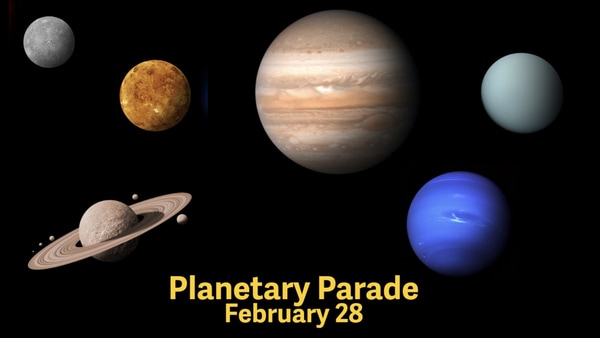
Skygazers will have the opportunity to see not one, not two, but six planets in the evening sky on Saturday, February 28, said NASA. Mercury, Venus, Neptune, Saturn, Uranus, and Jupiter will appear shortly after sunset.
This planetary parade occurs due to the alignment of the planets’ orbits around the sun, Heidi Haviland, a planetary scientist at NASA, told CNN in an email.
Haviland noted that this celestial event is a reminder of how planets orbit the Sun and how their positions relative to Earth vary.
2026 Planet Alignment: When and where to watch
The peak of this 6-planet alignment will occur on Saturday, 28 February 2026, though the planets will remain in a relatively tight formation throughout the first week of March.
Timing is everything — Haviland said stargazers must try catching this celestial event before sunrise or right after sunset.
The golden window
The best time to look up is 30 to 60 minutes after the local sunset – but being quick is key; some members of this cosmic parade, like Mercury and Venus, hug the horizon and will dip out of sight shortly after the sun disappears.
Haviland said that the planets need to be roughly 10 degrees or higher above the horizon to be visible. “If they are too low, they will be obscured by Earth’s atmosphere.”
Finding the parade
To see the full lineup, you need a clear view of the western horizon.
The Western Cluster: Mercury, Venus, Saturn, and Neptune will all be bunched low in the west/southwest.
The High Ground: Uranus will sit higher in the southwest near the Pleiades star cluster.
The Anchor: Jupiter will be the “star” of the show, shining brilliantly high in the southeastern sky, positioned near the constellation Gemini.
How to identify the planets
Typically, Haviland said, Venus is the first one that pops up — It will be the brightest object in the sky after the sun and moon, and will have a steady, brilliant white glow.
Mars will show up as a red dot, and Saturn will have a yellowish hue. If you look high overhead, you will be able to find Jupiter.
Mercury will be the hardest to spot without visual aids, Haviland said. The smallest planet in our solar system will appear white and will be low on the horizon.
How to tell the planets apart from stars
The “Twinkle” Test
The most reliable trick is simple: Stars twinkle; planets don’t. Because stars are so far away, their light is easily distorted by the atmosphere.
Planets are much closer, so they appear as steady, solid points of light. If it’s flickering like a dying lightbulb, it’s a star. If it’s a constant, unwavering glow, you’ve found a planet.
Check the colours
Each planet has a distinct personality, which is reflected in its hue:
Venus: Unmistakable. It is the brightest object in the sky besides the Sun and Moon, glowing with a brilliant, silvery-white light.
Jupiter: A close second in brightness, appearing as a large, creamy-white or tan “star.”
Saturn: Look for a steady, yellowish-gold glow.
Mercury: Often appears as a faint, warm yellow but is difficult to spot because it stays so close to the twilight glow of the horizon.
Essential tips for stargazing
For the best view, avoid city lights and hope for clear skies, said Joel Wallace, public information officer at the Marshall Space Flight Centre in Huntsville, Alabama.
Go to a place with high altitude — a hill, a balcony, or a rooftop would suffice.
Avoid areas with light pollution — Other than Jupiter and Venus, the parade is easier to see from a dark park.


