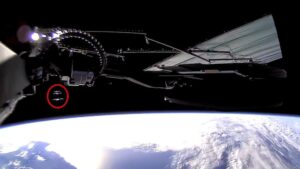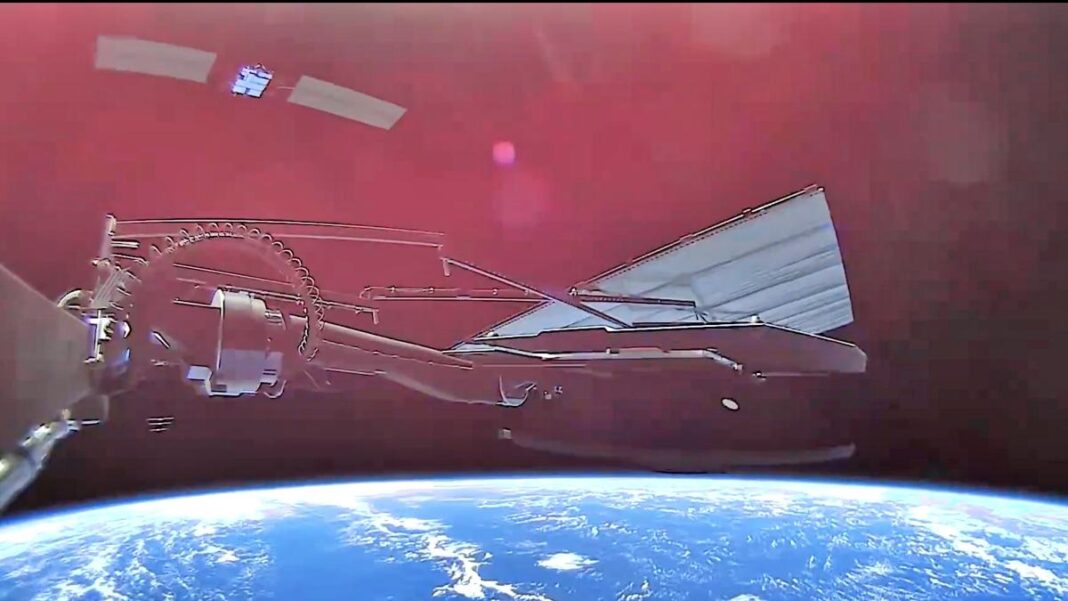
A striking video released by SpaceX offers a rare glimpse into the quiet choreography of satellites in orbit, showing one Starlink satellite capturing another as they glide through space during deployment.
The footage, recorded shortly after launch aboard a Falcon rocket, shows multiple Starlink satellites cruising together across a full orbit, passing through both sunrise and sunset as Earth’s curvature glows beneath them.
Gradually, the satellites begin to drift apart, marking a crucial phase in their post-launch deployment. The footage was shared on X by Michael Nicolls, Senior Vice President at Starlink.
WATCH STARLINK SATELLITES DEPLOY ABOVE EARTH
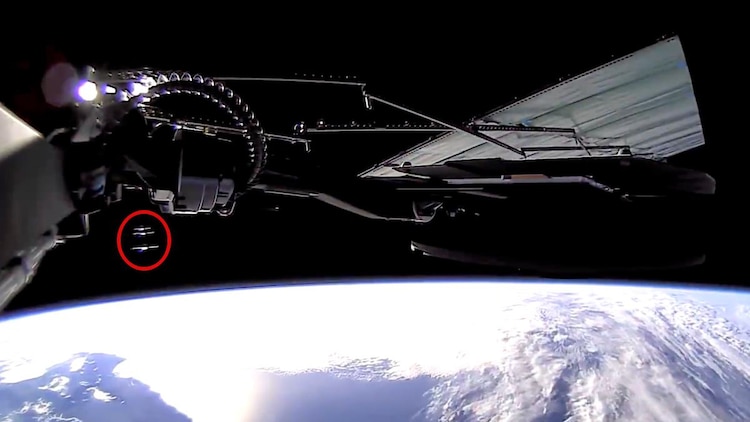
Unlike traditional satellites released individually, Starlink spacecraft are packed tightly inside the rocket in a configuration often compared to a “deck of cards.” Once in orbit, the Falcon rocket slowly spins while releasing the stack.
This controlled rotation imparts a slight difference in velocity to each satellite, allowing them to gently separate over time.
The process, known as deconfliction, ensures that the satellites do not collide as they begin their independent journeys. The subtle differences in speed cause the satellites to spread out naturally along their orbital path, forming the early structure of the Starlink constellation.
The video shows not just the precision of modern space engineering but also the elegance of physics at work in orbit. With no air resistance and only minimal forces acting on them, even tiny velocity changes can lead to significant separation over time.
After this initial phase, each satellite begins its orbit raise manoeuvre, using onboard propulsion to move into its designated operational altitude. From there, the satellites join the growing Starlink network, which aims to provide high-speed internet coverage across the globe.
SpaceX has launched thousands of these satellites in recent years, transforming low-Earth orbit into a hub of commercial activity. Yet, moments like this, captured on camera, offer a rare, almost poetic view of how these machines quietly organise themselves in the vastness of space.