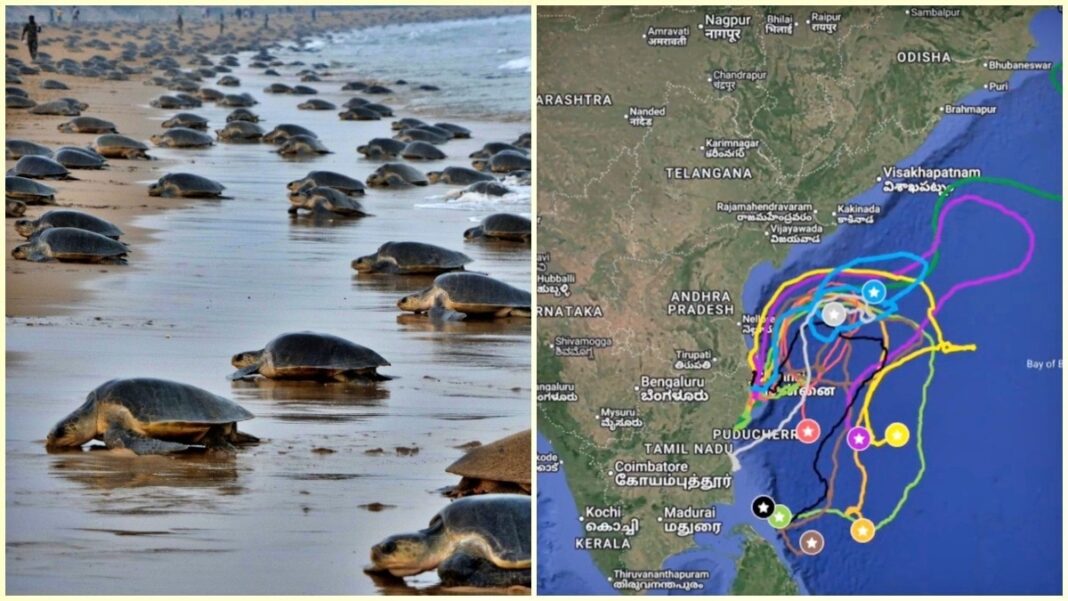
In a remarkable display of endurance and instinct, endangered Olive Ridley turtles are once again crossing vast stretches of the Indian Ocean, travelling from India’s eastern coastline to feeding grounds near Sri Lanka.
Early satellite tracking data has revealed that several turtles have already reached a little-known marine hotspot called the Sri Lanka Dome, a region teeming with life.
The information was shared by Supriya Sahu, Additional Chief Secretary, Environment Climate Change & Forests, Tamil Nadu on the social media platform X.
Scientists say what makes this migration particularly extraordinary is the convergence of turtles from distant coastlines. Individuals tagged along the shores of Odisha are also expected to arrive in the same waters, joining others from across the Indian Ocean.
This suggests that multiple populations of Olive Ridleys, separated by thousands of kilometres, are drawn to a single oceanic zone shaped not by geography, but by seasonal marine forces.
WHAT IS THE SRI LANKAN DOME?
The Sri Lanka Dome is formed by powerful oceanographic processes that occur annually. Between May and September, shifting winds and currents cause deep, cool, nutrient-rich waters to rise to the surface, a phenomenon known as ocean upwelling.
This triggers massive plankton blooms, creating a rich feeding ground that attracts a diverse array of marine life, from fish and seabirds to whales and turtles.
At its peak in July, the Dome becomes one of the most biologically productive regions in the Indian Ocean.
For Olive Ridley turtles, which are known for their long-distance migrations, this seasonal abundance provides a critical opportunity to feed and build energy reserves.
By September, as the upwelling weakens and productivity declines, the turtles begin their journey back, continuing a migration cycle that has likely existed for centuries.
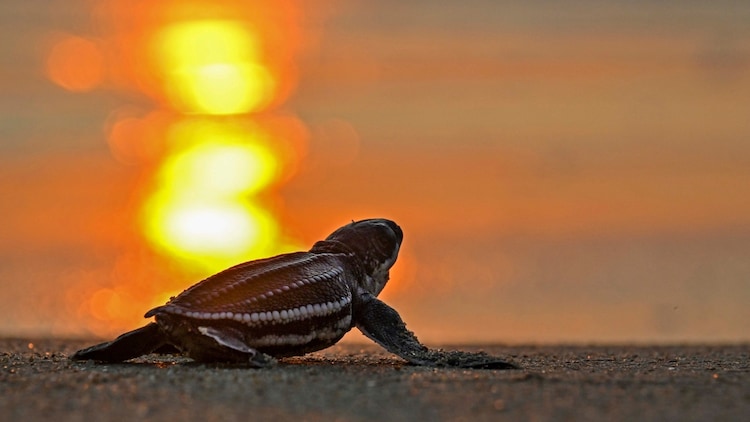
Marine biologists note that these journeys point to a vital ecological truth: turtles do not belong to a single coastline or country.
Their survival depends on an interconnected ocean system, where nesting beaches, migration corridors, and feeding grounds are all equally important.
Despite its ecological significance, the Sri Lanka Dome remains largely unknown outside scientific circles. Experts describe it as a “hidden engine” of marine biodiversity, an area that quietly sustains life across vast oceanic regions.
The migration of Olive Ridley turtles carries an important message for conservation efforts. Protecting nesting sites alone is no longer enough. As these animals traverse international waters and depend on shared ecosystems, conservation strategies must also cross borders.
Ensuring the survival of species like the Olive Ridley turtle will require cooperation between nations, stronger marine protections, and a deeper understanding of the ocean’s unseen but vital ecosystems.