
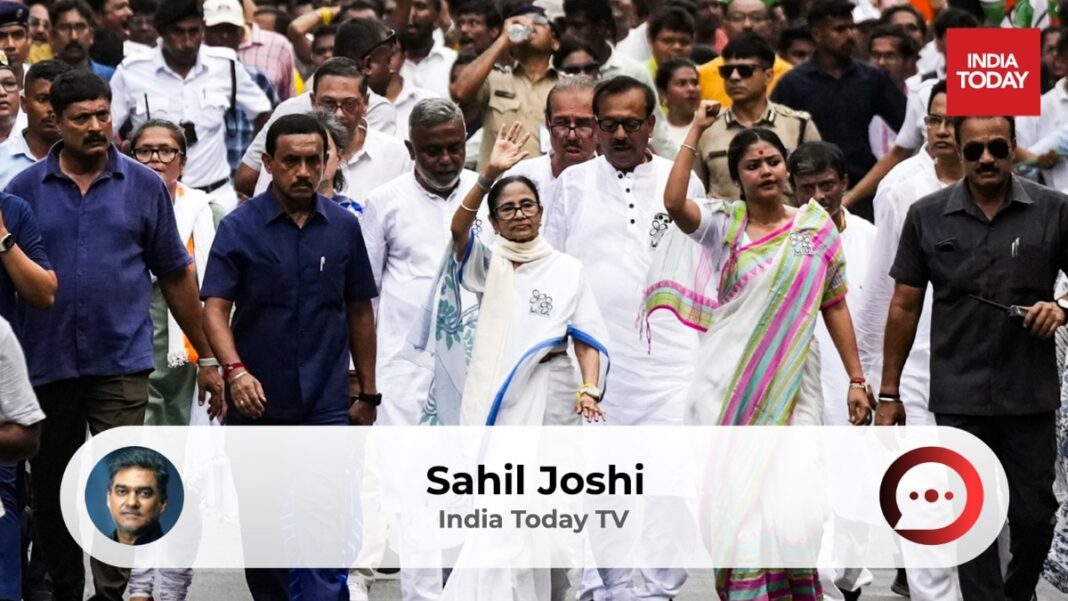
The 2026 West Bengal Assembly election was not just another state verdict. It was a political inflection point. For the first time in 49 years, a national party breached the last ideological fortress of regionalism in eastern India. The BJP’s victory in Bengal completes a pattern visible across India: the steady subsidence of regional satraps who once dictated terms to Delhi.
HOW BJP COUNTERED BENGALI ASMITA
For over a decade, the Trinamool Congress weaponised “Bengali Asmita” — Bengali pride — to paint the BJP as a party of “outsiders.” The narrative worked in 2021. Jai Shri Ram was countered by Jai Bangla. But by 2026, it had lost its sting.
The BJP flipped the script. Amit Shah declared early that the BJP’s CM would be “local and Bengali speaking,” defanging the outsider tag. More symbolically, BJP candidates and leaders campaigned with fish in hand, eating at local homes, signalling that the party had no issue with Bengali non-vegetarian food habits. The message was clear: the BJP was not anti-Bengali culture; it was anti-TMC misgovernance.
This was coupled with a hard campaign on corruption — SSC teacher recruitment scam, syndicate raj, and law-and-order failures in Murshidabad. Regional pride could not override lived anger over jobs sold and homes torched. Mamata Banerjee’s model of welfare + Asmita + minority consolidation finally cracked.
LARGER EROSION OF REGIONAL FORCES
Election after election, regional parties are being defeated, broken, or tamed. These were the same forces that, since the 1990s, held national parties hostage in Lok Sabha math. Coalition-era India ran on unequal agreements where Congress and BJP had little choice but to keep regional partners in dominant positions.
Both national parties tried to escape that shadow. Congress failed. The BJP, post-2014, has largely succeeded. The Bengal win is the symbolic completion of that project.
BJP PLAYBOOK: DEFEAT, BREAK, OR TAME
The party has used 4 distinct methods against regional rivals:
Break and absorb: Uddhav Thackeray’s Shiv Sena and Sharad Pawar’s NCP were split. Party names and symbols went to factions aligned with BJP. The offshoots now survive under BJP’s wings. The 2024 Maharashtra Assembly verdict confirmed it: the breakaway groups, with BJP, decimated the originals.
Counter the regional narrative: Against Mamata Banerjee and Naveen Patnaik, BJP didn’t deny regional identity. It co-opted it and layered Hindutva + development over it. In Odisha, Amit Shah cornered Patnaik by questioning his heir apparent VK Pandian — a Tamil bureaucrat. “Will Odisha accept a Tamil leading the state?” Shah asked in rally after rally. BJD’s regional pride pitch was turned against it. In 2024, BJD lost after 24 years.
Re-engineer caste coalitions: Against Samajwadi Party and RJD, BJP built a counter to the Muslim-Yadav formula. Hindutva became the glue, combined with aggressive consolidation of non-Yadav OBCs, EBCs, and Dalits. The Samajwadi Party was defeated twice in UP Assembly polls, while the RJD has largely remained out of power in Bihar except during brief coalition interludes.
Tame through power dependence: JDU and LJP survive today as BJP’s dependents. BJP won more seats than JDU twice in Bihar and eventually installed its own CM, reducing Nitish Kumar to junior partner. LJP operates as a parasite on BJP’s vote share. Same with TDP in Andhra — despite being the bigger partner, Chandrababu Naidu’s stature is nowhere close to his Vajpayee-era clout. BJP keeps him in check, not in shine.
Even AAP, despite national party status, was defeated in Delhi in 2025. The pattern: regional parties lose when out of state or central power. They struggle to sustain cadre without patronage.
WHAT REGIONAL PARTIES RAN ON
Their politics traditionally survived on four pillars:
- Regional sentiment — language, culture, and “outsider vs insider”
- Strong ground connect — local cadre and mohalla-level networks
- Caste and religious combinations — M-Y in UP/Bihar, minorities + Dalits in Bengal
- Control of state governments — welfare, jobs, and contracts to keep the machinery running
BJP has attacked all four. Regional sentiment is blunted by “double engine + local face.” Ground connect is matched by BJP’s booth-centric, Panna Pramukh model. Caste combos are fragmented by broader Hindutva umbrella. And losing state power, as seen in Odisha, Bengal, Maharashtra, leaves regional outfits exposed.
STRUCTURAL CRISIS FOR REGIONAL PARTIES
Three problems now haunt them:
Family-run structures: Most are one-family shows: SP, RJD, NCP, Shiv Sena, TMC, BJD, DMK, BRS. Succession fights and limited upward mobility for cadre create exits. BJP exploits this by offering “better opportunity” to second-rung leaders. Breakaways in Maharashtra, UP, and Bihar prove the point.
Fading regional sentiment: Aspirational voters, urbanisation, and pan-India digital media dilute linguistic chauvinism. Stronger Hindutva sentiment often trumps sub-nationalism. The Bengali voter angry over job scams chose BJP despite TMC’s Asmita pitch.
Unsustainable cadre model: Regional parties need constant agitation, new programs, and access to power to keep cadre motivated. Out of power, funds dry up and workers drift. BJD’s machinery collapsed within months of losing Odisha. TMC faces the same test now.
WHY BENGAL MATTERS MORE THAN OTHERS
Bengal was the last fort of “linguistic state Asmita.” Tamil Nadu has Dravidian pride, but DMK still aligns with national parties. Maharashtra’s regional pride was tied to Shiv Sena, now split. Karnataka’s regionalism is weak. Bengal’s Asmita was cultural, intellectual, and political — from Left to TMC.
Its fall forces a rethink. If Bengali Asmita cannot stop the BJP, what can? The message to the DMK, BRS, YSRCP, and the remnants of the TMC is stark: welfare plus identity politics is not enough when governance fatigue sets in and the BJP offers both a local face and national appeal.
END OF COALITION COMPULSION?
From 1989 to 2014, India’s prime ministers were at the mercy of regional satraps. Deve Gowda, Gujral, Vajpayee, Manmohan Singh — all ran governments where state leaders could pull the plug. Modi’s model of “total politics,” combined with saturation welfare schemes, has significantly reduced that compulsion.
The 2024 Lok Sabha election left the BJP at 240 seats, short of a majority. Yet regional parties did not dictate terms. The TDP and JDU joined the NDA, but largely on the BJP’s terms. There was no Common Minimum Programme and little scope for coalition-era bargaining. Bengal 2026 reinforces the message: the BJP no longer needs to bow to regional pride to win in eastern India.
WHAT NEXT FOR REGIONAL PARTIES
They face a binary choice: adapt or perish. Adaptation means moving beyond family-centric politics, building ideologies that transcend state borders, and delivering governance that can outperform the BJP’s “double-engine” pitch. Perishing means gradual absorption, as seen with the LJP, the Shinde-led Shiv Sena, and the Ajit Pawar faction of the NCP.
For now, the era of regional satraps as kingmakers appears over. Bengal was the final audit. The verdict suggests that India is moving from a federation dominated by strong state parties to a polity increasingly centred around national parties, with the BJP as the principal pole.
The question for 2029 is no longer whether regional parties can stop a BJP landslide. It is whether they can survive at all as independent political forces. Whether they can bounce back is now the real question.
(Views expressed in this opinion piece are those of the author)


