
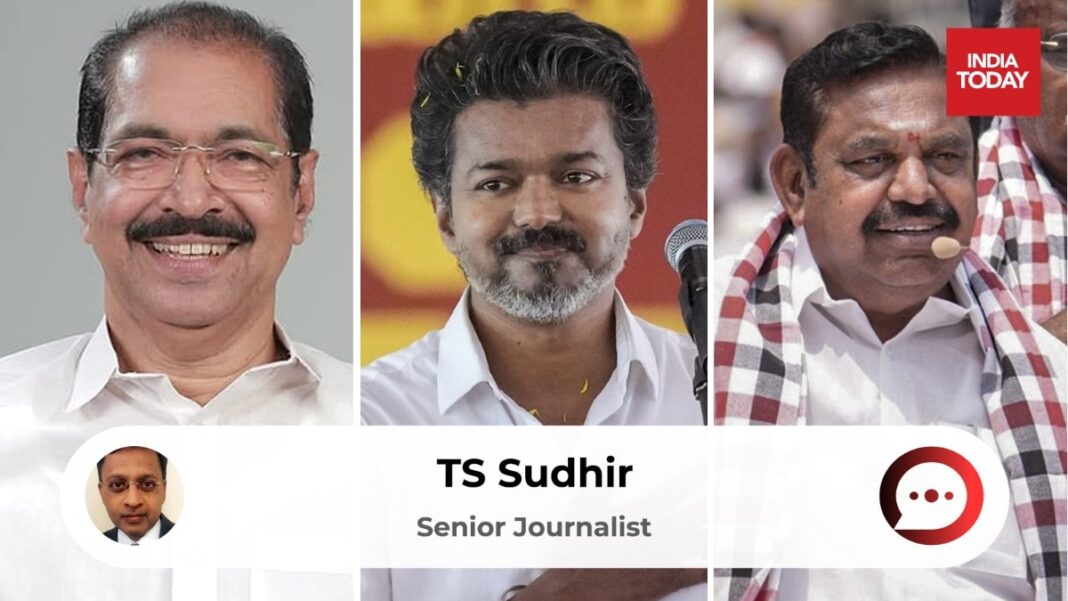
In the run-up to the elections in Tamil Nadu, back-channel talks between the NDA and TVK had reportedly explored the possibility of a pre-poll alliance. What stumped the NDA — of which the AIADMK is the leader in Tamil Nadu — was the TVK’s initial insistence on being the leader of the arrangement and if not, contesting a significant number of seats.
For Edappadi Palaniswami, who was looking to win back the chair of chief minister, these demands sounded outrageous, especially coming from a party that had no electoral track record. Vijay’s political venture was dismissed as a penny stock whose IPO was too risky to invest in. When nothing came of it, the NDA denied any talks ever took place.
May 4 saw the TVK electoral stock do a bumper listing, stopping eventually at 108 seats, 10 short of the majority mark +1 (118). Considering Vijay will have to resign from either Perambur or Trichy (East), the gap comes to 11 seats for the TVK. The Congress has declared support with its 5 MLAs, which leaves a gap of six seats. If the Left parties (4) and VCK (2) come on board, TVK’s numbers will be taken care of. The problem is that, so far, the CPI, CPM and VCK have decided to stick with the DMK but the door is not firmly shut on the TVK yet.
Ideally, the TVK would not need to look beyond the DMK’s allies for support now unless it wants to be extremely comfortable with numbers and lung power inside the House. But a section of the AIADMK has waded into these muddy waters. Many of its MLAs are reportedly keen to explore having a truck with Vijay. Another five years out of power is not a prospect the elected AIADMK MLAs relish and entry through the back door is an option they would like Palaniswami to explore. Their voice is being conveyed to EPS by former minister SP Velumani and CV Shanmugam.
The question is whether Palaniswami would like to go down that path. Going by his temperament before April 23, the day Tamil Nadu voted, he would not. Supporting the TVK from the outside or becoming part of the government, would mean playing junior partner which could hurt the ego of the leader of the 54-year-old party. It is not easy being an Eknath Shinde in politics.
The follow-up question is whether Palaniswami’s writ can run within the AIADMK, which has lost two Lok Sabha and two Assembly elections in a row under his leadership. A little difficult given that Shanmugam and Velumani are AIADMK strongmen and could force Palaniswami’s hand. The AIADMK won 21 of its 47 seats in north Tamil Nadu and the credit for many of those victories goes to Shanmugam and the alliance with the PMK. Similarly, 16 seats came in the Kongu belt in west Tamil Nadu where, apart from Palaniswami, Velumani is the other AIADMK heavyweight.
Officially, the AIADMK says the ball is in Vijay’s court. Should the TVK consider taking AIADMK’s support?
Ethically speaking, no. The verdict of May 4 was as much against the AIADMK as it was against the DMK. The electorate voted for a TVK government, not a TVK-AIADMK hybrid. To allow the AIADMK to be part of the power structure would be a subversion of the mandate. It is not the same as the junior partners of the DMK like the Congress and the Left parties. The national parties, in any case, have been known to play musical chairs with the two Dravidian parties and the Congress had come close to allying with the TVK before the elections.
Making the AIADMK part of the government would be committing harakiri because, instead of starting on a clean slate with many first-time ministers, Vijay will be compelled to carry the baggage of past deeds of AIADMK heavyweights who have been ministers before.
Should outside support be an acceptable option in that case?
Yes, but it will be subject to conditions. Given that the TVK has branded the BJP as its ideological enemy, it would expect the AIADMK to snap ties with the BJP. Would Palaniswami be able to do that? Can EPS agree to being dictated to by Vijay? Even if TVK does not insist on the divorce, the Congress in its letter has made it clear that its support is subject to no tie-up with ”communal forces”.
Even for Palaniswami, aligning with the TVK is a potential political risk. This election saw Vijay capturing much of the women vote that would hitherto accrue to the AIADMK. Aligning with the TVK as a junior partner, numerically speaking, would make Vijay the hero and EPS a supporting cast. Politically, this could be suicidal in the long run.
How sensible it would be to provide support to a new party that has laid claim to the AIADMK icons of CN Annadurai and MG Ramachandran, is another aspect Palaniswami will have to bear in mind. He will do well to remember the example of the Congress in Tamil Nadu, which lost power in 1967, never to get it back.
The act of providing an oxygen tank to the new government should not leave the AIADMK out of breath before the next round of elections. Because even if EPS withdraws support later, his criticism at the time of the next elections will not sound as strident as that of the opposition DMK leadership.
What the fast-paced developments show is that the TVK has moved with dexterity on the Tamil Nadu chessboard. It has opened up a line between the VCK and the Left parties while setting the cat among the pigeons in the AIADMK. The DMK is having a meltdown over the ”backstabbing” by the Congress. So the verdict has not just brought the TVK to power but ruptured one alliance and threatened the continuance of another.


