
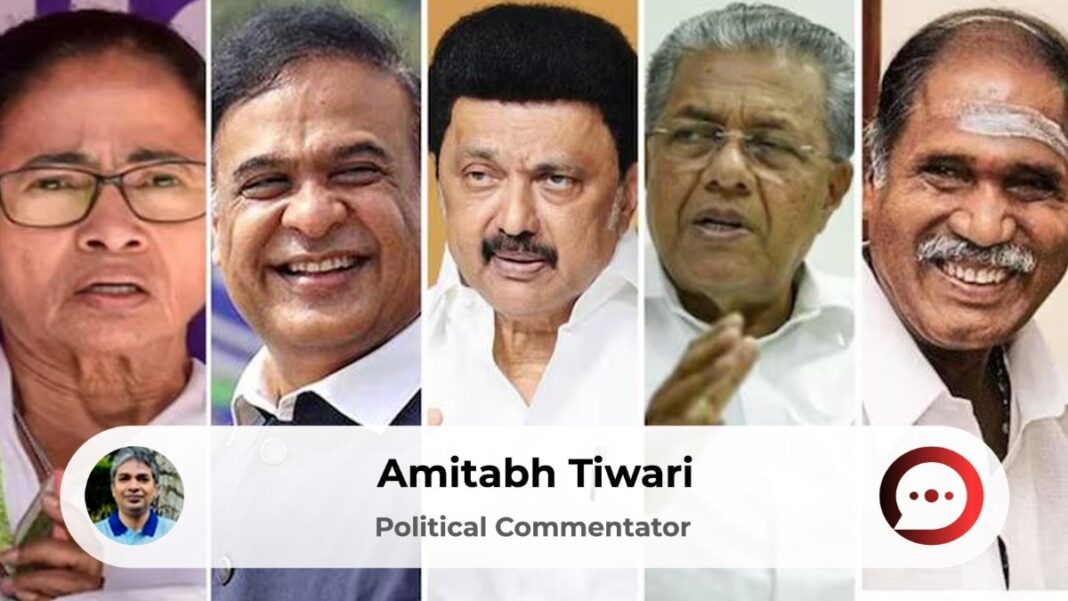
In the annals of Indian electoral history, incumbency has always been a curse — a millstone around the neck of any government that dares to seek re-election. But in a set of state elections that will be studied for years to come, the BJP has done something that was once considered near-impossible in Indian politics: it has converted incumbency into an asset, while the opposition has been swallowed whole by the very wave it once weaponised against others.
The results tell a story so stark it borders on the cinematic. The BJP retained Assam and Puducherry. The Trinamool Congress lost West Bengal — reduced to roughly 100 seats in a house it once dominated. The DMK, once the master of Tamil politics, is humiliated to third place in Tamil Nadu. The LDF in Kerala is not just defeated; it is demolished. The opposition did not merely lose. It was annihilated.
THE INCUMBENCY PARADOX — AND HOW BJP SOLVED IT
The conventional wisdom in Indian politics is blunt: governments lose. Voters tire of familiar faces, accumulated grievances mount, and the opposition needs only to show up with a credible alternative. The 2024 Lok Sabha results, where the BJP itself experienced incumbency headwinds at the national level, seemed to confirm the rule. So how has the party managed, at the state level, to defy gravity?
The BJP’s formula in Assam is perhaps the clearest case study. Chief Minister Himanta Biswa Sarma has governed with a muscular, visible style — making himself synonymous with decisive action, whether on law and order, flood management, or land reform. Crucially, the government has maintained a relentless delivery narrative, ensuring that welfare schemes are not just implemented but loudly communicated. Every house built, every road laid, every beneficiary enrolled has been converted into a piece of political communication. Voters did not feel they were re-electing an old government. They felt they were continuing a project.
The BJP understood something its rivals did not: pro-incumbency is not about being liked. It is about being needed.
In Puducherry, the dynamics are different but the principle is the same. The NDA alliance leveraged central government schemes effectively in the Union Territory, anchoring the campaign in tangible benefits rather than ideology alone. The result was a consolidation of its southern footprint — modest in size, significant in symbolism.
THE FALL OF THE TMC
The scale of the Trinamool Congress’s collapse in West Bengal is difficult to overstate. A party that had won back-to-back majorities under Mamata Banerjee’s formidable leadership has been reduced to approximately 100 seats — a parliamentary rump. The anti-incumbency that gutted the TMC was not a whisper. It was a roar.
The reasons are well-documented but worth re-examining: widespread resentment over the cut-money culture, persistent law and order concerns, allegations of booth-level corruption that had calcified over a decade of rule, and a sense among ordinary Bengalis that the government had become complacent, even arrogant. Mamata Banerjee’s personal brand, once almost invincible, could not absorb the accumulated weight of ten-plus years in power. The TMC governed as though invincibility was permanent. The electorate disabused it of that notion with extreme prejudice.
TAMIL NADU’S STUNNING VICTORY
If Bengal’s result is a rout, Tamil Nadu’s is a shock. The DMK under M.K. Stalin entered these elections with confidence — a sizable parliamentary contingent, a strong Dravidian ideological identity, and a centralised party apparatus that had delivered well in the 2021 assembly elections. It exits in third place. Third. In Tamil Nadu.
The DMK’s collapse reflects several overlapping failures. The government struggled to translate its welfare schemes into felt reality for the Tamil voter. A series of administrative controversies, rising local-level discontent, and the perception that Stalin’s government was too focused on national opposition politics rather than Tamilian governance hurt the party badly. The anti-incumbency was compounded by an energised opposition and effective splitting of the DMK vote coalition. Finishing third is not a defeat — it is a humiliation that will force a wholesale rethink of the party’s ground strategy.
KERALA: THE LDF IS NOT JUST BEATEN — IT IS ROGERED
The LDF’s defeat in Kerala carries a particular irony. Pinarayi Vijayan had been celebrated as one of India’s more capable chief ministers — a technocratic, delivery-oriented leader who, many believed, had actually earned the right to a second chance. And for a while, he had it — winning re-election in 2021, becoming only the second Left government in Kerala’s history to return to power. But a second term proved one too many.
The rot set in through a combination of governance fatigue, several high-profile controversies — including cases that directly touched the Chief Minister’s office — and an opposition UDF that ran a disciplined, united campaign. The LDF did not just lose ground. It was swept. The comprehensiveness of its defeat signals that Kerala’s famous electoral pendulum has swung hard, and the Left will need years, not months, to rebuild.
WHAT THE OPPOSITION MUST RECKON WITH
The deeper story in these results is not just about individual governments losing. It is about the opposition failing to distinguish between losing and losing badly. Anti-incumbency, when it arrives, is supposed to be the opposition’s tailwind. In Bengal, Tamil Nadu, and Kerala, the anti-incumbent parties did not merely face a headwind — they were caught in a storm of their own making. Corruption, complacency, and disconnection from voters at the grassroots level transformed manageable defeats into historic routs.
The BJP, by contrast, has developed something close to a science of pro-incumbency. It rests on three pillars: relentless welfare delivery with visible credit attribution; strong, personality-driven leadership that creates a personal bond between the chief minister and the voter; and an organisational apparatus that treats election preparation as a continuous, four-year exercise rather than a pre-poll sprint. The opposition governs. The BJP campaigns — always, without pause.
NEW BENCHMARK IN INDIAN ELECTORAL POLITICS
These results establish a new benchmark. Incumbency is no longer automatically fatal for the BJP in the states it controls. And for opposition governments, winning power is now demonstrably harder than keeping it. The TMC, DMK, and LDF were not unfortunate victims of circumstances. They were governments that governed well enough to win but badly enough to be destroyed. That is the unsparing verdict of the Indian voter.
The BJP has cracked the code. The question — for the Congress, for the INDIA bloc, for every regional satraps who believe that anti-Modi sentiment alone can win them state elections — is whether they are even asking the right questions yet.


