
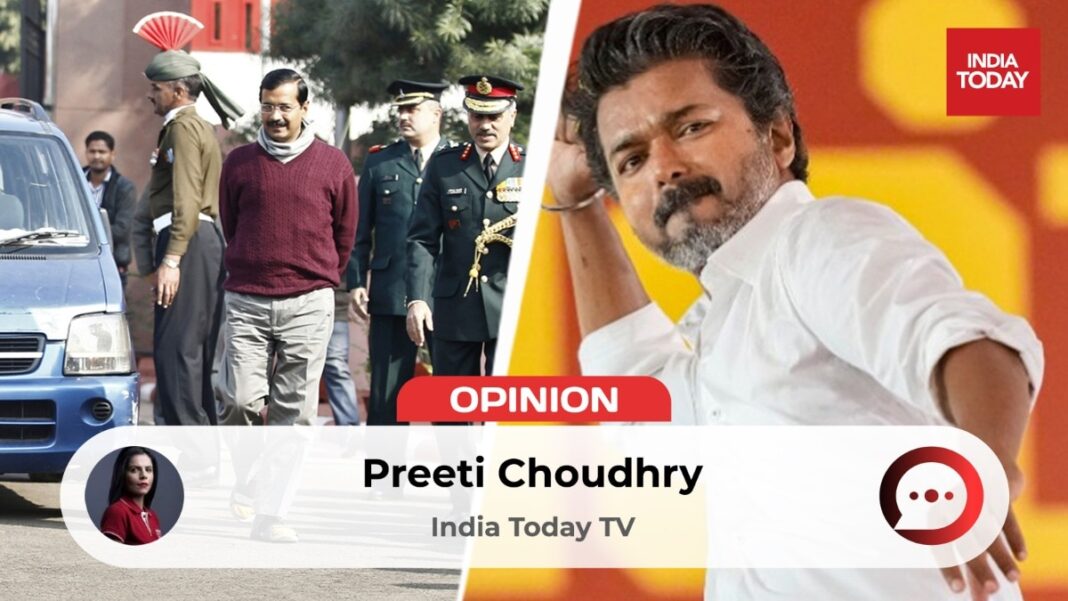
Here is a word I dislike – hope!
It demands emotional investment in a future that has offered no proof it will arrive. And when that future keeps stalling, hope curdles into frustration.
And yet, hope is what survives when everything else fails. Politics thrives on this very vulnerability! Hope that has curdled into frustration and the only solution will be a political messiah.
Tamil Nadu is a case in point.
For decades, its political landscape has been locked within the gravitational pull of Dravidian heavyweights. Power has alternated, rhetoric has evolved and fatigue has set in with its own trappings of power.
Enter Vijay and his party, Tamilaga Vettri Kazhagam (TVK).
He does not arrive with a tested political record or a governance blueprint. What he brings instead is disruption. And in a landscape weary of repetition, disruption is enough to ignite… hope.
On May 4, as the results began to firm up, it became clear that a new political disrupter was not just on the horizon… he had already arrived. In doing so, he defied every strand of conventional wisdom that insisted the euphoria surrounding him would not translate into votes. It did. And with it, a jaded ecosystem of television studios and seasoned political watchers found itself staring, almost spellbound.
This was Indian politics’ Hail Mary moment [well, Vijay is Christian :)] rare, electric, and disruptive. The kind that surfaces perhaps once in a generation: the sudden advent of hope, the tangible promise of change. The last time something similar unfolded was 2,500 kms north of Chennai in New Delhi, roughly a dozen years ago. A grassroots movement against corruption crystallised into a political force, giving rise to Arvind Kejriwal and the Aam Aadmi Party.
The parallels are inevitable. A meteoric ascent, a narrative powered by public disillusionment, and a leader positioned as an outsider challenging entrenched norms.
But do the similarities truly hold? And if they do, to what extent?
Let’s start with the similarities…
At a surface level, the similarities are striking.
Like Kejriwal’s Aam Aadmi Party (AAP) in its early days (2013–2015), TVK represents a ‘startup’ political experiment. An untested entity attempting to disrupt a system long dominated by entrenched players.
Both leaders tapped into the anti-incumbency sentiment. Kejriwal positioned himself as an alternative to traditional parties like the Congress and BJP in Delhi, while Vijay is appealing to voters dissatisfied with the existing Dravidian establishment helmed by DMK and AIADMK. The small difference: one was taking on national players, the other regional satraps.
Another common thread is both faced the uncertainty factor before result day. Just as early AAP faced unpredictable electoral projections, TVK’s prospects remained highly debated. Some projections suggested a modest debut as a ‘spoiler’, while others hinted at a surprisingly strong performance.
The point of personal charisma. Vijay commands a massive fan base built over decades in cinema – with most of his films positioning him as the anti-establishment underdog taking on the system, in a strange way similar to how Kejriwal leveraged public trust earned during the anti-corruption movement. Though at first it was Anna Hazare who was the face, Kejriwal didn’t take time to emerge from that shadow to project himself as the true champion of the Aam Aadmi. In both cases, popularity served as the initial political capital.
Both movements, AAP in Delhi and TVK in Tamil Nadu, emerged at moments shaped by public frustration with the political establishment and a conspicuous lack of compelling opposition.
In Delhi, the atmosphere was charged with anger. The incumbent government was mired in allegations of corruption, from the 2G spectrum controversy to the Commonwealth Games scandal, while the Nirbhaya case intensified public outrage and eroded trust in governance. Against this backdrop, Arvind Kejriwal and the Aam Aadmi Party were perceived as a refreshing alternative, an outsider force channeling widespread disillusionment into political action.
Tamil Nadu presents a different, though not entirely dissimilar, context. The discontent here has been less explosive but still palpable. A sense of voter fatigue has gradually set in, particularly amid the visible weakening of the AIADMK. While the emotional intensity may not match Delhi’s earlier upheaval, the conditions nonetheless suggest an opening for change. In both cases, the timing proved crucial. When established parties appear exhausted and opposition lacks imagination, even a relatively new or unconventional force can find fertile ground.
The possibility of another similarity – Kejriwal’s first govt where AAP scored 28 of 70 seats in 2013 was given outside support by the Congress – in Tamil Nadu the
Congress is in talks with Vijay to extend support.
Despite these parallels, the differences are substantial and decisive.
Origins and organisational DNA, Kejriwal’s rise was rooted in the India Against Corruption movement, which provided a strong political foundation centered on governance reforms and anti-corruption. His campaign was backed by activists, policy thinkers, and grassroots volunteers.
Vijay’s entry, by contrast, emerges from the world of cinema, fandom and the promise to translate his onscreen persona into off-screen politics. While his fan clubs offer a ready-made network, they are not the same as politically trained cadres or policy-driven volunteers.
Both Vijay and Kejriwal inherited dramatically different political ecosystems. Delhi differs significantly from a full-fledged state like Tamil Nadu. Delhi functions as a half-state with a legislative assembly of just 70 seats, only 7 Lok Sabha constituencies, and 7 cabinet ministers. Moreover, the powers of its Chief Minister and cabinet are comparatively constrained due to the shared governance structure with the Central government.
In contrast, Tamil Nadu operates as a full-fledged state with a dramatically larger political framework, comprising 234 assembly seats, 39 Lok Sabha constituencies, and a substantially larger cabinet of around 35 ministers. This structural difference highlights the contrasting scales of representation, administrative authority, and governance.
Difference in clarity and roadmap… many would suggest he has faltered, but Kejriwal initially entered politics with a sharply defined governance agenda focused on education, healthcare, and anti-corruption measures. This clarity helped AAP transition from protest to political policy.
However, AAP’s early trajectory also included a dramatic setback. After forming a minority government in Delhi in 2013, Kejriwal resigned within 48 days, following an inability to pass the Jan Lokpal Bill, a key anti-corruption promise. The resignation, reinforced the party’s identity around accountability rather than political expediency.
Surprisingly, this episode did not weaken AAP’s appeal. Instead, it strengthened its public narrative of integrity. In 2015, the party made a historic comeback, winning 67 out of 70 seats, recording then one of the most decisive electoral victories in India’s state politics.
Many view Vijay’s not entering into pre-poll alliances as a bold political move that earned him the trust of voters fatigued by traditional politics and transactional coalitions. His decision increased his appeal among those seeking alternatives to established political norms.
However, Vijay is still in the process of articulating a comprehensive political vision. The clarity with which he defines his governance priorities in the coming period will be crucial. It will determine how smoothly he transitions from mass adulation on the silver screen to sustained credibility and respect as a policymaker.
A key question that will shape the early political narrative around Vijay is how strategically he chooses his battles, and how distinctly he positions himself.
Vijay has already identified the BJP as his ideological adversary and the DMK as his immediate political rival in Tamil Nadu. This dual positioning reflects an intent to carve out both a national ideological stance and a regional electoral challenge.
However, this also comes with familiar political risks. The comparison with Arvind Kejriwal is instructive and builds in it a cautionary tale. Kejriwal’s early success in Delhi politics came from a sharply defined anti-corruption and governance-focused agenda, which helped dismantle the Congress in 2013. Yet his subsequent decision to extend his challenge nationally in the 2014 general elections most notably contesting against Narendra Modi in Varanasi along with fielding candidates across multiple states, resulted in a severe electoral setback. Many candidates lost their deposits, underscoring the limits of rapid national expansion without organisational depth.
Interestingly, Kejriwal later rebounded strongly, returning to dominate Delhi politics in 2015. Yet over time, critics argue that the persistent “David versus Goliath” framing with the Centre, while politically energising, may have diverted attention from long-term party consolidation and institutional strengthening.
This raises a central question for Vijay’s political trajectory: will he prioritise building a durable organisational structure and governance framework in Tamil Nadu, or will he be drawn into high-visibility confrontations that generate short-term attention but carry long-term risks? The durability of his politics may ultimately depend less on the intensity of his rivalries and more on the discipline with which he balances his aspirations.
While film stars have been accepted as newcomers in politics in the south – the North has been less generous to new political players. The time they both put in also differs, Vijay went all in only 2 years ago – Kejriwal was building his politics at the back of activism for a decade before he took the plunge.
However, while Vijay was largely ignored by his political rivals – Arvind was given legitimacy by the Congress when he was included in the Lokpal council before he formed a political party.
The other big difference – Vijay is an established hero – Arvind was the anti-hero – the Aam Aadmi that rose from the masses to change a system but rose with a rider that he would remain with the masses – no such expectation from Vijay – Vijay is today arguably one of the highest-paid superstars in India – in many of his rallies he himself has said that he is giving up a comfortable, cushy life of making 200 crores a film to get into public service.. there are no expectations of him to live a spartan Aam Aadmi life – as long as he delivers his luxurious lifestyle will never be questioned… his personal life will never be discussed.
Vijay might have shed his star image but the people are yet to see him as a politician.. the halo and adulation still persists – he will at least for a while escape the usual tropes and laments for politicians but that wasn’t the case for Arvind Kejriwal, was it?
The switch from a Wagon R to a Mahindra SUV.. from a dirty bush shirt to a branded one.. from even chappals to shoes was seen as a personal affront by his voters, leave alone what a switch from a modest flat in Kaushambi to a luxurious CM house with all the trappings that were usually associated with compromised politicians would have done – and add to it the final inevitable embrace of survival with political parties like the Congress – shaking hands with whom AAP itself deemed the enemy – all this fuelled the perfect storm of frustration to dislodge the same party that it had helped install – Vijay for now runs no risk of this, but the message is clear for him.
Vijay is not just entering politics, he is stepping into accumulated frustration.
And frustration is volatile.
It can elevate quickly. It can abandon just as fast.
(Views expressed in this opinion piece are those of the author.)


