
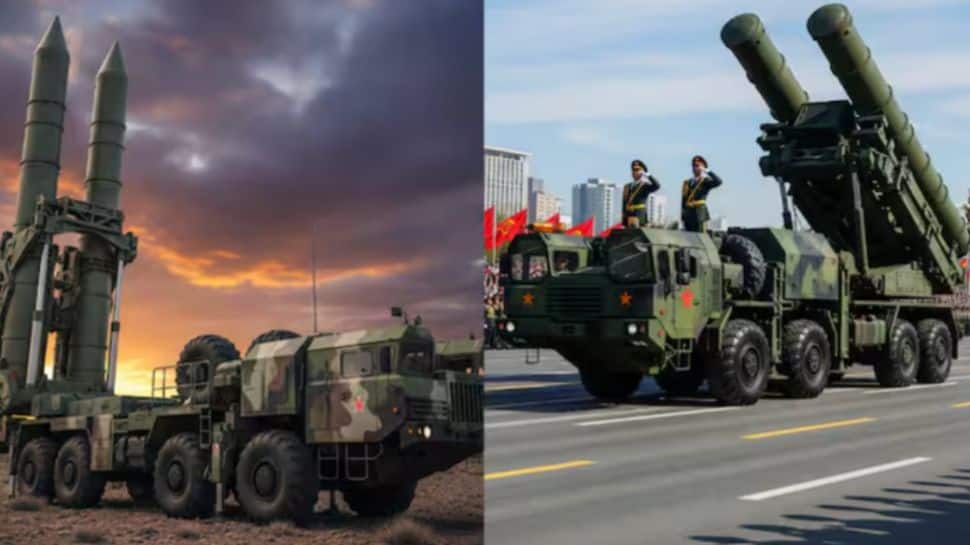
New Delhi: China is said to have moved its advanced HQ-29 missile defence system closer to the Indian border in Tibet, according to multiple reports. The development comes as India continues to build up its own military readiness along the border and has put a possible move to acquire Russia’s next-generation S-500 system on the table.
Reports suggest that Beijing has deployed the HQ-29 system near the border. Videos circulating on Chinese social media show defence equipment being transported by rail, which many believe includes components of this system. The HQ-29 was first revealed during a military parade in Beijing in September 2025, but official details about it are still limited.
According to a report by Defence Express, at least eight HQ-29 launchers along with 16 interceptor missiles were seen being moved via railway. Experts believe the system could have a range of up to 2,500 kilometres and may be capable of intercepting targets at an altitude of up to 850 kilometres. Some estimates place this interception range between 150 and 600 kilometres.
The speed of the missiles is believed to be between Mach 6 and Mach 10, which means roughly 7,350 to 12,250 kilometres per hour. There are also claims that the HQ-29 can intercept ballistic missiles, including intercontinental ballistic missiles, as well as hypersonic weapons. Some reports claim that it may even be able to target satellites in low earth orbit.
If these capabilities are confirmed, the HQ-29 could go beyond what Russia’s S-500 system offers. The air defence system has a range of up to 600 kilometres and can intercept targets at an altitude of up to 200 kilometres.
S-500 deal is back in debate
The idea of India buying the S-500 system has been debated for some time. The speculation picked up pace during Russian President Vladimir Putin’s visit to India in December 2025.
Interest in the S-500 also comes after the performance of the S-400 system during Operation Sindoor. The Russian-made S-400 successfully intercepted missiles and drones used by Pakistan during the military offensive.
Former Lieutenant Colonel JS Sodhi said that India had earlier trusted the S-400 system, which proved effective in May last year during Operation Sindoor by destroying Pakistan’s China-made missiles and drones.
There is now a view that India could consider moving ahead with the S-500 in the coming years.
Concerns over China’s strategic plans
Sodhi referred to a report submitted by the Pentagon to the US Congress on December 23, 2025. According to that report, Beijing has three core interests it is likely to target in the coming years. These include Taiwan, the Spratly Islands in the South China Sea and India’s Arunachal Pradesh.
He said that China could, after 2030, launch a two-front war against India in coordination with Pakistan.
India’s response
According to him, China has been increasing its military presence near Ladakh since Xi Jinping became the president in March 2013. He said that deploying systems such as HQ-29 in Tibet fits into the country’s military planning against India.
New Delhi has also stepped up its preparedness. It has deployed missiles from the Agni series and strengthened air defence with systems such as the S-400. Efforts to upgrade defence capabilities along the China border have continued.
After S-400, is S-500 the next step?
After Operation Sindoor, the S-500 began to be seen as a possible game changer. During that time, President Putin said in an interview that India is a trusted partner of Russia and that joint production of the S-500 could be explored.
Reports went on to claim that Russian defence firm Almaz-Antey is working with the Bharat Electronics Limited and the Bharat Dynamics Limited to set up a manufacturing facility in Nashik or Hyderabad, with up to 60 percent technology transfer under the Make in India initiative.
What makes S-500 different
India presently operates the S-400 system, which has been in service since 2007. It is built for theatre-level air defence and protects airspace along the border.
The S-500, which was inducted into the Russian military in 2021, has been manufactured to handle threats beyond that. It can target not only aircraft and missiles but also threats closer to space. While the S-400 can engage targets up to 400 kilometres away, the S-500 can neutralise ballistic missiles from as far as 600 kilometres.
Another difference is in the missiles the system uses. The S-400 uses missiles such as 40N6 and 9M96, which are built to target fighter jets and cruise missiles. The S-500 uses the 77N6-N series of hit-to-kill missiles, which are built to collide directly with and destroy hypersonic weapons.


