
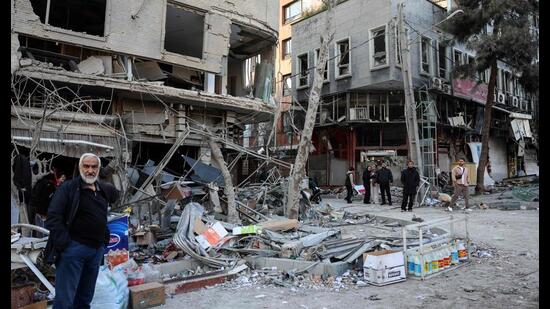
The assassination of Iran’s Supreme Leader, Ayatollah Ali Khamenei, in a joint strike by Israel and the US, underlined that the war aims have expanded beyond the issue of Iran acquiring nuclear capability to regime change. Iran has announced the formation of a three-member Guidance Council, including President Masoud Pezeshkian, head of the judiciary Mohsen Ejahi, and one jurist from the Guardian Council. The Islamic Revolutionary Guard Corps (IRGC) has launched fresh missile attacks on Israel and the US bases in the region. US forces have suffered casualties; Abu Dhabi and Dubai airports have been hit. Iran has shown a continued capacity to prosecute the war.
The joint attack came a day after Oman’s foreign minister Badr Al Busaidi told CBS that a “peace deal is within our reach”. Military action has pre-empted a diplomatic solution. This was a repeat of the events of last June, when Israel attacked Iran in the middle of US-Iran negotiations.
The US-Iran indirect negotiations were taking place against the background of a major US military build-up in the region, which included two aircraft carriers — USS Abraham Lincoln and USS Gerald Ford. In his State of the Union address, he stressed that Iran cannot have nuclear weapons. The Iranian foreign minister had already given this assurance. Israeli Prime Minister Benjamin Netanyahu defended Israeli actions as removing an “existential threat”. Trump justified US actions in terms of defending the American people against “imminent danger” from Iran.
How serious was the Iranian threat? Iran started enriching uranium beyond the level permissible under the nuclear deal of 2015, only after Trump had withdrawn from the agreement negotiated by his predecessor. A day before the strike, Al Busaidi had disclosed that Iran had agreed not to stockpile its enriched uranium. Without this, it is not possible to build a bomb. He added that Iran’s existing stockpile was to be diluted and converted into fuel. The Wall Street published an article citing a US intelligence agency that Iran did not have the missile capacity to threaten the American people.
The bombing campaign is predicated on the assumption that this will bring Iranian protestors to the streets again. The coming days will test this assumption. At the height of protests in December-January, Trump had said that “help is on the way”. This did not materialise. The protests were driven by an external catalyst — the US sanctions. Continued sanctions and military intervention do not necessarily endear the US or Israel to the Iranian people.
Before the Israel-US strike, nine heads of Arab governments wrote to Trump advising against military action. Saudi Arabia and the UAE have stated that in case of war, their land and airspace will not be used. The IRGC Navy had also carried out exercises in the Hormuz Strait to demonstrate its ability to choke off the waterway that carries 20% of the global oil supply. The events since have demonstrated that military action against Iran is bound to have major collateral damage on the neighbouring countries.
There is no alternative source that can compensate for the loss of 20% of the global oil supply in case the Hormuz Strait is closed. Since the beginning of this month, the price of Brent crude, an international benchmark, has gone up by $4.54 per barrel. After the war broke out, it jumped further by $5.59 per barrel. A one-dollar increase in crude oil price, if sustained, would translate into an increase of India’s annual crude import bill by ₹14,000 crore. Apart from crude oil, the supply of liquified natural gas (LNG) will also be affected in case of a flare-up in the Gulf. Fifty-five percent of India’s LNG supplies traverse the Hormuz Strait. An oil tanker in the Hormuz Strait has been set ablaze. The ARAMCO refinery in Saudi Arabia has been hit. Qatar Energy has halted LNG production following an attack on one its facilities. In case of any further attacks on oil infrastructure or shipping, there will be a sharper increase.
As the Indian ambassador to Iran, I had the privilege of negotiating the agreement for Indian participation in Chabahar port. However, at this stage, no development is possible. The project will remain important to us for future access to Afghanistan. Iran is the critical link to shorter access to Russia and Central Asia through the International North-South Transit Corridor (INSTC).
The first Gulf War to liberate Kuwait from Iraqi occupation was a war of necessity. The second Gulf War in 2002 was a war of choice. Though the military outcome was decided quickly in America’s favour, instability continued for more than a decade, draining America’s treasury and costing thousands of casualties to the US Army. It also led to the rise of ISIS. The governments in Baghdad were not necessarily of America’s choice.
Widening the war aim to regime change has made it difficult for the US to climb down without losing face. It could trap America in an open-ended conflict. President Trump has mentioned that the war could continue for up to four weeks. Will this be enough to bring about regime change or force Iran to accept US-Israeli terms?
Iran’s position has hardened. It is time to step back from the brink, accept an immediate ceasefire, and return to the negotiating table. Three rounds of negotiations between Iran and the US made progress and can be built upon. Under the nuclear deal of 2015, only the secondary US sanctions were removed. Lifting of all US sanctions could allow participation of American companies in Iran’s oil and gas sectors.
The next step could be a conference to discuss regional security with the participation of all countries, including Israel. A cooperative framework is always preferable to forever wars.
DP Srivastava negotiated the Chabahar agreement as India’s ambassador to Iran. The views expressed are personal


