
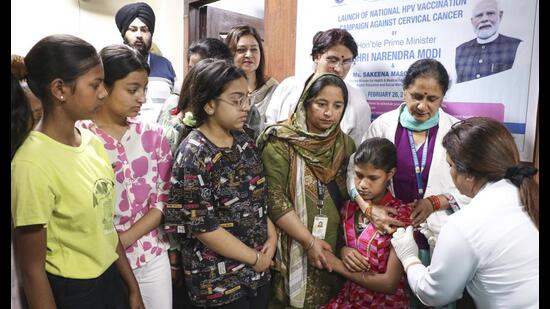
India is poised to roll out the Human Papillomavirus (HPV) vaccine for adolescent girls in the coming weeks. With this step, the country will incorporate all 13 antigens recommended by the World Health Organization (WHO) for national immunisation programmes. It is a milestone that signifies both culmination and transition — the completion of India’s childhood immunisation basket, and a decisive shift towards recognising adolescence as a critical window for preventive health.
The HPV vaccine will also be the first in India’s Universal Immunisation Programme to be offered exclusively to adolescents. Until now, national immunisation efforts have focused primarily on infants, young children, and pregnant women. This policy evolution signals a broader and more mature vision — one that acknowledges that prevention cannot, and should not, conclude in early childhood.
Yet, this imminent rollout is not merely an administrative development; it follows nearly 18 years of deliberation, controversy, and delay. The protracted interval between initial consideration and actual introduction offers instructive lessons for all public health initiatives.
The first HPV vaccine was licensed globally in 2006 and became available in India by early 2008. During 2008-09, an HPV vaccine demonstration project — led by PATH, an international non-profit organisation, in collaboration with the Indian Council of Medical Research and the respective state governments — was launched in Andhra Pradesh and Gujarat. The objective was to generate empirical evidence on the feasibility, acceptability, coverage, and cost of delivering the vaccine in diverse settings, for possible induction into India’s national vaccination program. Girls aged 10-14 years were vaccinated in Khammam district of Andhra Pradesh and Vadodara district of Gujarat, with different delivery models being tested.
However, reports of deaths among some vaccinated girls in 2009 triggered widespread alarm. Though subsequent investigations concluded that the fatalities were not causally linked to the vaccine, allegations of inadequate consent procedures and ethical lapses — particularly in vulnerable and tribal populations — fuelled public mistrust. The matter was vigorously debated in Parliament, became headline news, and, in 2010, the Union government suspended the project.
What ensued was a prolonged phase of policy inertia. HPV vaccination became enmeshed in wider debates concerning pharmaceutical influence, research ethics, and adolescent sexuality. Despite repeated recommendations from government-constituted but independent technical advisory bodies on immunisation, India refrained from inducting the HPV vaccine into its national programme. The episode demonstrated a sobering reality: Scientific evidence, however robust, is insufficient in the absence of public confidence.
The cost of this delay must be measured not merely in elapsed years but in forfeited opportunities. Entire cohorts of girls aged out of the optimal vaccination window. Meanwhile, many countries progressed with alacrity. By January 2026, around 164 countries had introduced the HPV vaccine and collectively administered over 500 million doses. Nations such as Australia and the UK are now on the cusp of eliminating cervical cancer as a public health problem, following sustained and comprehensive vaccination strategies.
In India, cervical cancer remains the second most common cancer among women, with an estimated 80,000 new cases and more than 42,000 deaths annually. Persistent infection with high-risk HPV types — particularly types 16 and 18 — accounts for the majority of these cancers. The vaccine slated for deployment in India, Gardasil, protects against HPV types 16 and 18, among others. HPV vaccines are non-live, incapable of causing infection, and have demonstrated impressive efficacy — ranging from 93% to 100% — in preventing cervical cancers attributable to vaccine-covered types. Since 2022, the WHO has endorsed a single-dose schedule for girls aged 9-14 years, enhancing affordability and programmatic feasibility. The global strategy aspires to achieve 90% vaccination coverage among girls by age 15, as part of a concerted effort to eliminate cervical cancer.
India’s inclusion of HPV vaccination is therefore both overdue and momentous. The controversy that delayed its introduction by nearly 15 years offers several salient lessons.
First, communication must be intrinsic to programme design rather than relegated to an afterthought. Communities require lucid explanations of why a vaccine is being offered, how it functions, and what safeguards are in place. Data alone cannot substitute trust. Even coincidental adverse events can destabilise programmes if institutional responses appear opaque or defensive. Prompt, independent investigations and transparent disclosure are indispensable for sustaining credibility.
Second, ethical standards in public health interventions must be visibly demonstrable, particularly when programmes involve adolescents or marginalised communities. Perceptions of exploitation can eclipse scientific merit. The events of 2009 illustrate how fragile trust can be — and how arduous its restoration.
Third, prevention demands political consistency. Unlike outbreaks, the success of vaccination is measured in terms of diseases that fail to materialise. This very invisibility can engender complacency. Enduring commitment, rather than episodic enthusiasm, determines lasting impact.
The forthcoming HPV vaccination, being offered free, will promote equity across socioeconomic strata. However, we need to remember that vaccination alone will not suffice to eliminate cervical cancer. Screening — through Pap smears or HPV testing — must continue, particularly for older women who remain unvaccinated. A comprehensive strategy integrating vaccination, screening, and timely treatment offers the most efficacious path forward.
Simultaneously, India must broaden its preventive horizon. Historically, India’s immunisation policy has focused on infants and pregnant women; institutionalising adult vaccination for high-risk groups and the elderly should constitute the next frontier of India’s preventive health architecture.
India’s decision to proceed with HPV vaccination is both a corrective and a forward-looking step. The delay in introduction serves as a reminder that scientific advancement can be impeded by mistrust, political contestation, and inadequate communication. Yet the eventual rollout also attests to institutional resilience and the capacity to learn from past missteps. If implemented with transparency, sustained political will, and meaningful community engagement, the HPV programme could emerge as another consequential public health achievement — shielding future generations of women from preventable malignancies and reaffirming the primacy of prevention in national health policy.
Chandrakant Lahariya is a practising cardio-metabolic physician, health policy expert, and specialist in parenting and child development. The views expressed are personal


