
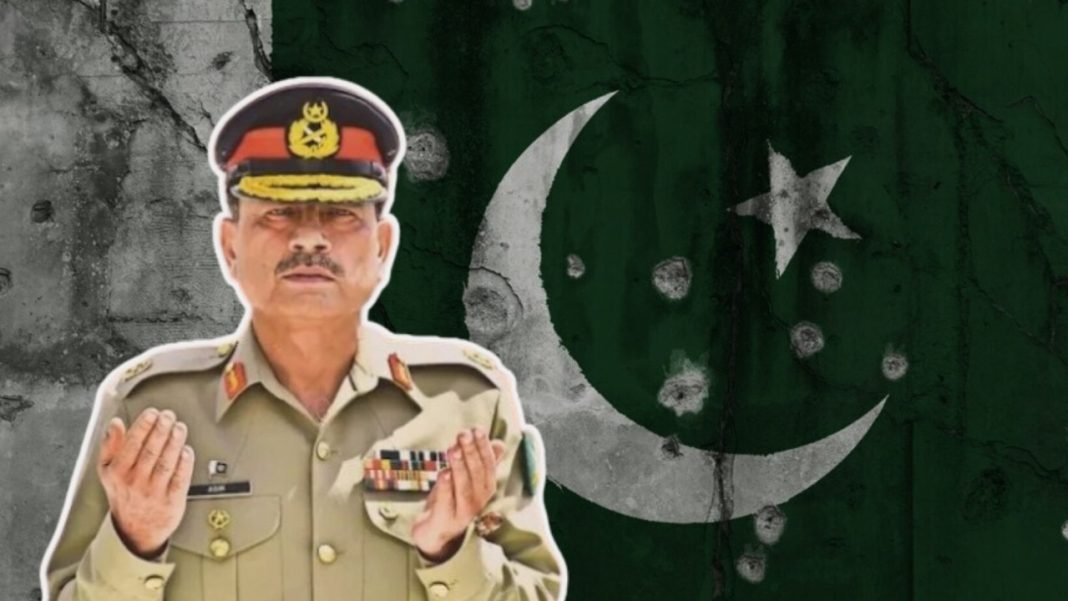
‘When sorrows come, they come not single spies, but in battalions.’ For Field Marshal Asim Munir, this line from Hamlet is truer today than at any time in the past year. Pakistan and Afghanistan, two Sunni Muslim states, are at war in the holiest month in Islam.
‘Our cup of patience has overflowed now it is open war between you and us,’ Pakistan’s defence minister Khawaja Asif posted on X on February 26 soon after Pakistan launched airstrikes on Kabul and Kandahar, killing several civilians. The Afghan Taliban retaliated by capturing eight Pakistani border outposts, killing several Pakistani soldiers, and launching one-way drone strikes on Pakistan.
On that day, several hundred kilometres to Pakistan’s east, an Indian Army strike corps commander, who has no operational tasks on Indian soil, warned of multi-domain strikes. “The preparations for Operation Sindoor 2 are quite extensive,” Lt. General Rajesh Pushkar, commander of the Ambala-based 2 Corps, told the media. “it will depend on how much damage we want to cause to the enemywhether from land, sea, or air.”
To Munir’s southwest, the 46-year-old Islamic regime in Teheran faces the biggest challenge to its 46-year rule.
A wave of air strikes by Israeli and US aircraft on February 28 targeting Ayatollah Khamenei and his generals was accompanied by an open call from President Donald Trump to the Iranian people to rise in revolt. An unstable 1,000-km Pakistan-Iran border means the spillover of refugees and the disruption of a lucrative but illegal border trade with Iran. With Saudi Arabia under attack from Iran, Munir might be forced to come to the aid of a country he signed a mutual defence pact with in September 2025.
The klaxons are going off in General Headquarters, Rawalpindi, the nerve centre that controls a nuclear-armed, flailing third-world country that lives on IMF doles and is wrestling with its worst economic crisis in two decades.
The root cause of Pakistan’s present polycrisis can be traced to the crushing grip of the military, which does not allow economic recovery. India’s political class invested in economic liberalisation in 1991 to build what is today the world’s fastest-growing major economy. The Pakistan Army invested in strengthening itself. It emaciated the civilian leadership—killing, jailing, and blinding opponents to create what is today the world’s only ‘army with a state.’ The equivalent of a nuclear-armed 21st-century Prussia.
It is possible to trace many of the causes of Pakistan’s polycrisis back to a single year, 1979. That year of global geopolitical avalanches saw China’s invasion of Vietnam, the start of Beijing’s disastrous One Child Policy, and Egypt’s peace treaty with Israel. But three other tectonic events that year marked the ascendancy of religion over state, consequences that the region is still grappling with. Iran morphed into a Shia theocracy, Saudi Arabia into a hardline Sunni Islamic monarchy, and Pakistan into a fledgling democracy overshadowed by an increasingly Islamised military.
JANUARY 16: IRAN’S ISLAMIC REVOLUTION
On January 16, the Shah of Iran, Reza Pahlavi, fled Teheran after a 37-year reign. On February 1, Ayatollah Ruhollah Khomeini returned to Iran after nearly 15 years in exile, ushering in a Shia Islamic regime, which was announced on April 1. His regime almost began a campaign of exporting its revolution to Shias in the Islamic world (what it now calls the ‘Axis of Resistance’).
This was also the year when Pakistan’s new military dictator, General Zia-ul-Haq, had begun the gradual Islamization of Pakistan, turning it into a majoritarian Sunni regime. Iran-backed groups and clerics dominated religious Shia activism in Pakistan, demanded greater autonomy, and endorsed the leadership of Ayatollah Khomeini. General Zia, fearful of Iranian encroachment, found allies in a string of violent Sunni Deoband groups like the Sipaha-e-Sahaba Pakistan and the Lashkar-e-Jhangvi, set up to butcher Shias. Iran’s revolution further deepened Pakistan’s Sunni-Shia divide, with Sunni groups massacring Shias they consider heretics. The most recent instance was the massacre of 45 Shia Muslims in the Kurram district in November 2025. Both Iran and Pakistan share an uneasy peace. Iran has accused Pakistan of sheltering a terror group, the Jaish-ul-Adl. Between January 16 and 18, 2024, both countries fired drones and missiles at each other. The Israel-US war against Iran and Tehran, which began with the February 28 air strikes, saw Iran lashing out with retaliatory missile strikes against US bases in the region. West Asia is now poised on the precipice.
NOVEMBER 20 – SEIZURE OF THE GRAND MOSQUE
On November 20, nearly 600 Saudi militants led by Juhayman Al-Otaybi seized the Grand Mosque in Mecca, the holiest site in Islam. The two-week siege ended with the capture and killing of the extremists. But the impact of the incident reverberated across the world. Mobs burned the US embassy in Islamabad after rumours spread of US-Israeli involvement in the siege.
Saudi Arabia’s King Khalid, already wary of a rising Iran to the north, enforced stricter Islamic law throughout the country to appease his powerful ulema, or religious clergy. General Zia-ul-Haq accelerated his Islamization of Pakistan and built a security alliance with an insecure Saudi Arabia. Saudi petrodollars accelerated the spread of rigid ideologies within Pakistan and, reports suggest, even funded Pakistan’s nuclear weapons program. This informal alliance was formalized into the Pakistan-Saudi Arabia Mutual Defense Pact in September 2025.
DECEMBER 25 – SOVIET INVASION OF AFGHANISTAN
“Oh Lord, help me, for I am innocent!”—those were the pitiful last words of Pakistan’s first democratically elected president. It was the early hours of April 4, 1979. Bhutto was led to the gallows and strung up after a kangaroo court found him guilty of murder. Pakistan was then a global pariah. General Zia ul-Haq had overthrown Bhutto in a bloodless coup in 1977, dissolved the constitution, and banned political activity. But a single incident eight months later catapulted the wily Pakistani dictator and his army into becoming the White House’s indispensable ally.
On Christmas Day 1979, the Soviet Union invaded Afghanistan, deposing Prime Minister Hafizullah Amin and replacing him with Babrak Kamal. Soviet forces occupied major cities of Afghanistan. US President Ronald Reagan teamed up with Pakistan and Saudi Arabia to set up an elaborate state-sponsored network to launch a proxy war against Soviet forces in Afghanistan. Tens of billions of dollars, from AK-47s to Stinger missiles, were pumped into arming and training the Mujahideen (as the anti-Soviet resistance fighters were called). Religion was weaponised and used against the Soviets. Thousands of copies of the Koran were printed and distributed. Special slip-off combat shoes were designed for the mujahideen fighters to enable them to pray five times a day. Thousands of Muslim radicals from the Middle East and North Africa, Saudi Arabia, Yemen, and Egypt streamed into the Afghanistan-Pakistan border. Among them was the wealthy scion of a Saudi Arabian construction tycoon, Osama bin Laden, brought in by the CIA for his expertise in building cave complexes for sheltering the Mujahideen.
The Soviets withdrew in 1988 after the bruising nine-year-long proxy war. But the bigger blowback of Operation Cyclone was borne by Pakistan. Millions of Afghan refugees, a drug and gun culture, and Islamic fundamentalism. As the state of Pakistan weakened, the military grew stronger. The US turned a blind eye to Pakistan’s covert nuclear weapons program. Pakistan’s military-run deep state turns its newfound prowess in waging proxy war against India, striking in Punjab, Jammu and Kashmir, and mainland India. (Over 20,000 Indian civilians died in terror strikes in Punjab, Jammu and Kashmir, and mainland India over the last four decades. India informed the UN on May 25, 2025).
On September 11, 2001, Osama bin Laden’s Al Qaeda carried out the world’s deadliest terror attacks, killing close to 3,000 US civilians. The US invaded Afghanistan, routed the Taliban, and then proceeded to stay there for two decades. The Pakistan Army, in this time, performed the astonishing perfidy of running with the hares and hunting with the hounds. The Pakistan Army supported the US-led coalition forces against the Taliban even as the Pakistan Army’s ISI aided and sheltered the Taliban. Osama bin Laden was killed by US special forces in 2011. He was found living a stone’s throw away from the prestigious Pakistan Military Academy, Kakul. Pakistan escaped with minor US censure, but on the eastern borders, India began raising the costs of Islamabad’s decades-old policy of fomenting terror.
Since 2016, India has gradually escalated the retaliatory threshold against terror strikes from Pakistan. From cross-border raids in 2016 to a single air force strike on a terror training camp in Balakot to nine air and artillery strikes on terror training infrastructure along the Pakistan border during Operation Sindoor. This operation culminated in a rampage by IAF jets on March 10, destroying Pakistani radars and airfields, forcing Islamabad to dial the US to mediate a ceasefire.
On May 12 last year, Prime Minister Modi signaled a strategic shift in India’s policy of restraint when he drew new red lines for Pakistan—any future terrorist attack on India will be treated as an act of war; there would be no tolerance for nuclear blackmail, no differentiation between terrorists and their state sponsors, and the government would consider terror attacks as an attack on India.
The still ongoing Operation Sindoor might have the Pakistan Army realize its geographical vulnerability. Pakistan’s maximum width is less than the distance between New Delhi and Mumbai. All its air bases and military installations are within strike range of Indian missiles.
To offset this disadvantage, the Pakistan Army craved ‘strategic depth’ in Afghanistan. The US exit from Afghanistan in August 2021 and the return of the Taliban were misread by the Pakistan Army as a victory. Disagreements with the Taliban, mainly over the Pashtun-origin Tehreek-e-Taliban Pakistan (TTP) sheltered in Afghanistan, have now spilled over into open conflict.
The Pakistan Army, which has never won a conflict in 78 years. It cannot hope to win against the resilient Taliban. Pakistan might be facing a polycrisis. But each crisis is another opportunity for Pakistan’s generals to bolster their relevance.


