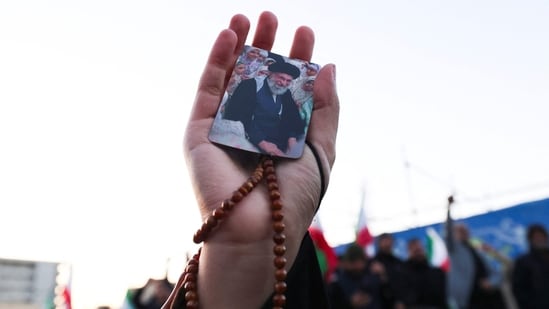
LATE LAST year protests broke out in Tehran over the collapsing value of Iran’s currency, the rial. By early January they had spread to most of the country’s 31 provinces. Ali Khamenei, the country’s 86-year-old supreme leader, warned that “rioters must be put in their place”. Several days later, after that threat failed, Mr Khamenei directed security forces to crush the uprising by any means necessary. That order worked: in the ensuing weeks, his thugs murdered at least 7,000 people, and probably many more (anti-government activists put the figure at more than 36,500).
Mr Khamenei will no longer be giving orders. On February 28th America and Israel began a bombing campaign, striking targets across Iran and aiming at its leadership. That evening President Donald Trump declared Mr Khamenei dead, denouncing him as uniquely evil. Iran confirmed his killing hours later.
All Access.
One Subscription.
Get 360° coverage—from daily headlines
to 100 year archives.
Full Access to
HT App & Website
Already subscribed? Login
He was in power for 35 years—a full quarter-century longer than Ayatollah Ruhollah Khomeini, who led the revolution that overthrew the shah and created the Islamic Republic of Iran in 1979. Mr Khamenei came from a modest background in north-eastern Iran, and was educated, like his father, in Qom, a centre of Shia scholarship. But he branched out beyond just religious education, professing a fondness for Victor Hugo’s “Les Misérables”, and translating the works of Sayyid Qutb, an Egyptian Islamist revolutionary, into Farsi. Old-timers remember his taking time out from seminary to debate with secular, opium-puffing Iranians in the park.
After the revolution he held senior positions in the defence ministry and Islamic Revolutionary Guard Corps, the country’s feared security forces. In 1981 he survived an assassination attempt by an opposition group that robbed him of the use of his right arm. That same year, with Khomeini’s support, he was elected president of the republic, a largely ceremonial post. He was re-elected in 1985. Four years later, after Khomeini’s death, he became supreme leader, even though he lacked his predecessor’s religious and revolutionary credentials. He also did not have Khomeini’s charisma or popular appeal. Ali Akbar Hashemi Rafsanjani, Khomeini’s crafty chief adviser, engineered his installation for precisely that reason, undoubtedly hoping he himself would accrue presidential power and use it to modernise Iran and its political system.
But Rafsanjani underestimated Mr Khamenei. Other opponents would, too. Khomeini was a firebrand who burnished his revolutionary credentials in exile; Mr Khamenei, by contrast, was reserved. Yet, despite being little more than the equivalent of a mid-ranking priest, he began issuing fatwas, or religious decrees. He proved a skilled political infighter, playing Iran’s ruling institutions against each other—the army against the Revolutionary Guard, the president against the Majlis, or parliament—making sure that these battles ended up at his doorstep, where he could decide the winner.
And unlike presidents, who are term-limited, supreme leaders serve for life. This allowed Mr Khamenei to patiently, steadily accrue power and sideline or co-opt rivals. He appointed, directly or indirectly, the 12 members of the Guardian Council, which vets candidates for elections. If they let an apparent moderate through, such as Mohammad Khatami, the president from 1997 to 2005, Mr Khamenei could—and did—limit their power. Meanwhile, the supreme leader’s office swelled. He had apparatchiks throughout the government and in every province, and controlled the million-strong Basij, a paramilitary group charged with enforcing ideological discipline.
Despite his modest appearance, he controlled billions of dollars in assets. Soon after his succession, Mr Khamenei took over the bonyads, religious charitable foundations that nominally provide social services but have expanded into construction, mining and other sectors. They easily outbid rivals for state contracts, both because they pay no tax and because sanctions block foreign competition.
As supreme leader, he expected others to come to him. He rarely, if ever, travelled abroad; even within Iran he kept public engagements to a minimum. Late in life he was reportedly frail, having undergone surgeries for multiple ailments. Yet he kept a tight grip on power, growing more unpopular as he squeezed. Protesters over the past month defied his goons and chanted for his death.
They have got their wish. The man who kept Iranians isolated from the world for more than three decades, who ruined their economy and who, when they dared speak out against his misrule, ordered them slaughtered by the thousands, is gone.