
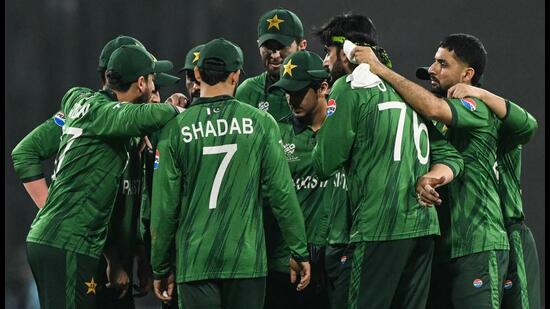
Can we infer that in sports, a team’s performance reflects, in some sense, the psychic health of a nation? I ask this question after watching the India-Pakistan T20 World Cup cricket match played on 15 February. It was impossible, watching Pakistan’s hapless batting collapse, not to wonder whether the problem lay merely in poor strategy or field selection — or in the malaise of a demoralised State. The manner in which the best Pakistani batsmen flailed around, swinging carelessly without thought of resolve or responsibility, seemed to indicate a palpable dispiritedness and diminishing of hope.
Over the past few years, Pakistan has stumbled from one crisis to another: An economy gasping for breath, a polity throttled by military dictatorship, and a citizenry that has learned to live with perennially diminished expectations. The country’s most celebrated cricketer, former Prime Minister Imran Khan, has been languishing in jail, an irony as bitter as it is revealing.
Whether or not one agrees with Khan’s politics, his imprisonment represents, for many Pakistanis, a moral wound. It signals a polity at war with its own icons and a system incapable of introspection. The cricket team’s limp performance, lacking cohesion or conviction, seemed almost a subconscious tribute to that paralysis.
A people humiliated in their civic life rarely rise to glory on the sporting field and play joyful, fearless, assertive cricket. A team, representing citizens reconciled to the inevitability of decline, will struggle to rise to the luminous theatre of international sport with the lightness of spirit and the clarity of focus that greatness demands. When internal decay corrodes a polity, it seeps into its collective psychology. Teams do not — and cannot — escape this osmosis.
It is not as though India does not have its discontents, its unfinished goals, its unfulfilled hopes, and its bitter internal differences, part of any democratic polity. It is true too that, cricket apart, our performance in international sports is far below potential. But India is far, far from being a failed State. By contrast, failure is writ large on the evolution and current condition of Pakistan.
When a nation subordinates its civic and moral imagination to authoritarian diktats, and allows democracy to be pulverised by the barracks, even its athletes begin to despair. The cricket field is not a parade ground, and batsmen are not infantry obeying orders.
To innovate, to improvise, to attack — the hallmarks of the great Pakistani cricketers of old, from Hanif Mohammad to Wasim Akram — requires an inner self-confidence.
That confidence withers in a climate of fear and apathy. Although Pakistan has the proven ability to play good cricket, its last performance against India mirrored the suffocation of its public life. The country’s cricket boards may change their coaches and captains, but unless the spirit of the land recovers its vitality, its sportsmen will remain shadows of their former heroes.
Besides, there is a psychological contract between sportsmen and their fans in the audience. Fans project their unspoken hopes onto players, and players draw strength from that collective faith. When the crowd believes, miracles do happen. But what happens when belief itself is eroded? When citizens are too weary, too disillusioned, to invest hope even in their sport?
The February 15 match, therefore, was not merely about 22 men and a white ball. It was about the moral metabolism of nations. It reminded us that success in any collective endeavour cannot be divorced from the inner equilibrium of a society. A nation that silences its thinkers and imprisons its heroes can — like China does — either produce soulless well-performing robots or, as Pakistan did, dejected and lethargic gladiators. Watching Pakistan’s performance, I distinctly felt that the ball, as it were, was not in the bowler’s hand — it rested uneasily in the conscience of a country that was visibly defeated in spirit. Excellence, whether in art, science, or sports, is not cultivated in isolation from the emotional and moral ecosystem that sustains it.
India must not, in triumph, gloat but reflect. For the same principle holds universally: A dictatorial, corrupt, or divided India too would one day falter on that same field. Sport, in the end, is not merely a spectacle but a mirror. And the image it throws back is often truer than any political speech or economic statistic.
Pavan K Varma is an author, diplomat, and former Rajya Sabha MP. The views expressed are personal


