
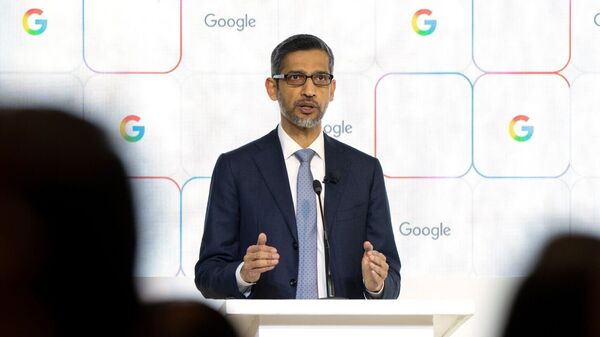
New Delhi: Google on Wednesday made a pitch to bring its cutting-edge artificial intelligence (AI) models and products to applications in the Indian government agencies. In an event, chief executive Sundar Pichai underlined the use of DeepMind’s AI in public services in the country.
“We have worked with multiple Indian companies, including the Indian government, as part of the global national partnerships programme. This will broaden access to frontier AI capabilities for nations around the world,” chief executive Sundar Pichai said.
Google’s partnerships will begin with Anusandhan National Research Fund (ANRF) and Atal Tinkering Labs (ATL), to give access to its AI tools, AlphaGenome, AI Co-scientist and Earth AI, to researchers and teachers, as well as 10,000 schools and 11 million students.
Demis Hassabis, founder and chief executive of DeepMind—Google’s AI research arm, added that “India could play a very leading role in the adoption of AI.”
“What I would say for India is to double down on the things you are already strong at, and are important to the country—perhaps it is agriculture, for example. Then, you can be the leader in applying AI to that space that you are already well leading in. For instance, agriculturally, I have been discussing with some ministers today on using AI in climate change analysis, and using (DeepMind’s) AlphaFold to help with that,” Hassabis added.
Google’s pitch for using its AI models in public services comes amid a race among Big Tech firms in the US to capture India’s nascent market. While the likes of OpenAI and Anthropic are racing to capture the consumer market, Google’s push comes in public and government services.
Deepening public utility
In public deployment, Google expects its AI adoption to expand across industries.
“Other places (of AI adoption) would be maybe in Bollywood and the creative industries, where making use of the latest technology will emerge as a key theme,” Hassabis added.
Hassabis is one of the world’s foremost AI scientists, having won the 2024 Nobel Prize in Chemistry for his research on AlphaFold, which was made available to ANRF and ATL.
Industry stakeholders said Google’s public-sector approach could give it significant soft power in India’s ecosystem. Kashyap Kompella, veteran tech analyst, said, “Google’s long-standing government relations and the prevalence of Android and other Google systems make it a trusted government partner for adding AI into public utilities.”
Earlier in the day, Hassabis also spoke at the India AI Impact Summit, discussing the negative effects of AI and its impact on public services.
“We’ve always worried about bad actors, human actors and individuals, but they could also be nation-states using AI and repurposing them for harmful ends,” Hassabis said, adding that generative AI will increase autonomy—thus necessitating guardrails.
“(So) that these systems do what we expect them to do and don’t veer off into areas that we hadn’t planned for and that could also be problematic,” he said, adding that true autonomy and artificial general intelligence would potentially emerge in five to eight years.
Artificial General Intelligence (AGI) means AI that can think, learn, and understand like a human across many different tasks—not just one specific job. AGI would be different. It would be able to learn new skills on its own, reason across subjects and adapt to unfamiliar problems.
Path to safety
In a bid to mitigate risks on the AI frontier, under DeepMind, Google is engaging in extensive external collaborations with subject-matter experts, such as chemical or biological experts, so that safety measures can be incorporated into the system during training and testing.
Others at DeepMind also reiterated Hassabis’s concerns. “There is not going to be one point in time that AI safety and reliability can be a resolved issue. The issue of AI security will be an ongoing journey throughout,” said Owen Larter, head of frontier policy and public affairs at DeepMind, at a side summit in New Delhi.
Other initiatives announced by Google include a partnership with Karmayogi Bharat, a civil services reform programme, to train 20 million public service officials across 800 districts. Pichai also said that Google’s $30-million global science fund for researchers will be opened to India as well.
- Google is prioritizing Business-to-Government and public utility AI over pure consumer-facing tools in India.
- Major partnerships with ANRF, ATL, and Karmayogi Bharat twitter-tweet Google tools into India’s research and administrative usage.
- Demis Hassabis estimates AGI is only 5–8 years away, heightening the urgency for national safety guardrails.
- Google is urging India to ‘double down’ on AI for agriculture and climate, rather than just chasing general-purpose LLMs.
- By training 20 million officials and reaching 11 million students, Google is ensuring the next generation of Indian workers is fluent in its ecosystem.


