Key Takeaways
- Timeline Rewritten: Large whale hunting began in Brazil 5,000 years ago, 1,000 years earlier than previously thought.
- Location Shift: Evidence from South America challenges the theory that complex whaling originated in the Northern Hemisphere.
- Active Hunting Proven: Specialised tools and butchering marks confirm active hunting, not just scavenging.
- Ecological Insight: Findings suggest a broader historical range for humpback whales, aiding modern conservation.
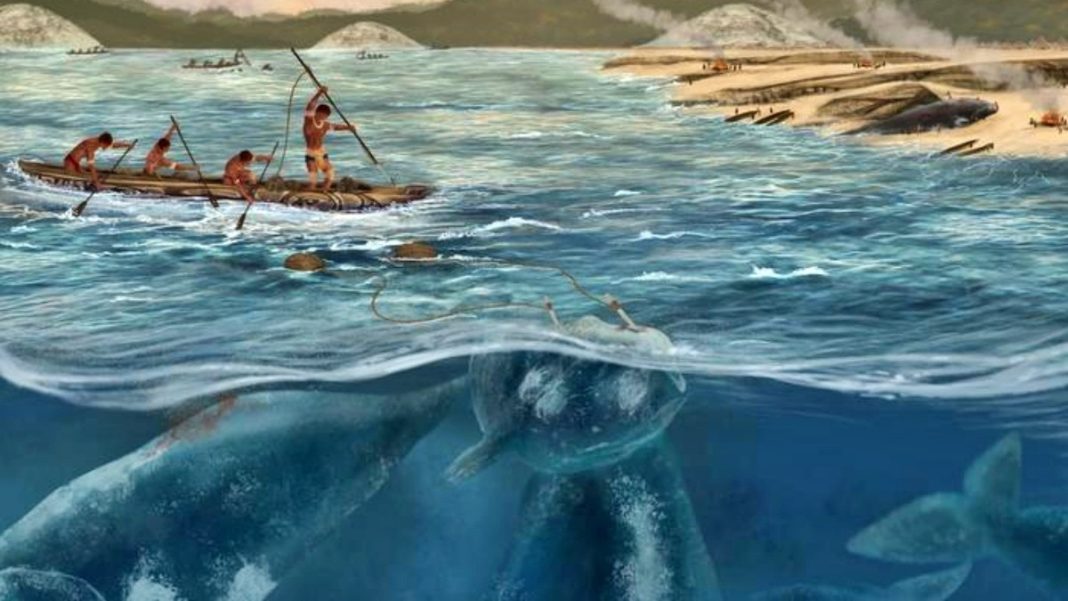
A groundbreaking study has pushed back the origins of large-scale whale hunting by a full millennium, revealing that Indigenous societies in southern Brazil were hunting whales 5,000 years ago.
Published in Nature Communications, the research reshapes our understanding of early maritime cultures and human interaction with ocean giants.
South America: The Unexpected Cradle of Whaling
The study focused on Indigenous communities in Brazil’s Babitonga Bay region. These groups built monumental shell mounds known as sambaquis.
Archaeologists discovered that they developed specialised tools and technologies for hunting large whales. This directly contradicts earlier theories that placed the origin of such complex practices in Arctic and North Pacific societies between 3,500 and 2,500 years ago.
The evidence firmly positions South American societies as early pioneers of advanced maritime traditions.
Evidence from Vanishing Archives
The research team, led by scientists from the Universitat Autònoma de Barcelona, analysed cetacean bone remains and tools from sambaqui sites.
Since many of these sites no longer exist, the collection at the Museu Arqueológico de Sambaqui de Joinville became a vital historical archive.
Using zooarchaeology and molecular techniques (ZooMS), the team identified bones from multiple species:
- Southern right whales
- Humpback whales
- Blue whales
- Sei whales
- Sperm whales
- Dolphins
Proof of Active Hunting, Not Scavenging
The findings provided conclusive proof of active hunting. Key discoveries included:
- Some of the largest whale-bone harpoons ever found in South America.
- Whale bones with clear, deliberate butchering marks.
- Whale remains placed in funerary contexts, indicating cultural significance.
- The identification of inshore species that would have been targeted by hunters.
“The data reveals that these communities had the knowledge, tools, and specialised strategies to hunt large whales thousands of years earlier than we had previously assumed,” said lead author Krista McGrath.
Implications for Whale Ecology and Conservation
The study offers crucial insights for modern ecology. The abundance of humpback whale remains suggests their historical distribution was broader than known.
“The recent increase in sightings in Southern Brazil may therefore reflect a historical recolonisation process, with implications for conservation,” noted co-author Marta Cremer. “Reconstructing whale distributions before the impact of industrial whaling is essential to understanding their recovery dynamics.”
Ana Paula, director of the Museu Arqueológico de Sambaqui de Joinville, emphasised the value of preserved collections: “The collections safeguarded at the museum… highlight the richness and vast potential of information on ancestral peoples that can still be explored in depth.”
This research not only rewrites a chapter of human history but also provides a deeper baseline for protecting whale populations today.