Key Takeaways
- Multiple earthquakes struck California’s Bay Area near Silicon Valley tech headquarters
- A magnitude 4.0 quake was felt over 60 miles away in San Francisco
- No injuries or major damage reported; airport operations normal
- Approximately 100 small earthquakes have shaken the region this month
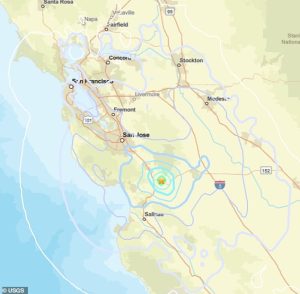
A series of earthquakes rocked California’s Bay Area on Wednesday morning, striking just miles from the headquarters of major tech companies including Google, Apple, Nvidia, Meta, and Netflix. The seismic activity began with a magnitude 4.0 tremor 23 miles south of San Jose at 9:16 AM ET, followed by a magnitude 2.7 quake two minutes later and a more significant magnitude 3.6 tremor at 9:20 AM.
Over 1,200 people near the epicenter east of Gilroy reported feeling the initial quake to the US Geological Survey. The shaking from the 4.0 magnitude event reached San Francisco, located over 60 miles away from the epicenter.
Impact and Response
The USGS classified the shaking as ‘weak’ or ‘light,’ with no injuries reported. San Jose Mineta International Airport continued normal operations according to Flight Aware and the Federal Aviation Administration. Earthquakes between 2.5 and 5.4 magnitude typically cause only minor damage, such as objects falling from shelves.
This seismic activity follows another series of earthquakes that struck just north of San Francisco two days earlier, raising concerns in the seismically active region.
Geological Context
The Bay Area sits along the infamous San Andreas Fault system, an 800-mile plate boundary responsible for much of California’s seismic activity. Wednesday’s magnitude 4.0 quake occurred about five miles from the Calaveras Fault, a major branch of the San Andreas system in Northern California.
The San Andreas boundary connects to multiple parallel and branching faults including the Hayward, Rodgers Creek, and Calaveras, which distribute earthquake risk across the entire region.
Historical Perspective and Current Activity
The last major earthquake along the Calaveras Fault occurred over 40 years ago – a magnitude 6.2 quake on April 24, 1984. USGS has warned that the San Andreas Fault could potentially generate earthquakes reaching up to magnitude 8.2.
Approximately 100 small earthquakes have shaken California’s Bay Area this month, prompting scientific investigation into the unusual burst of activity.
Sarah Minson, a research geophysicist with the US Geological Survey’s Earthquake Science Center, explained: ‘This has happened many times before here in the past, and there were no big earthquakes that followed.’
‘We think that this place keeps having earthquake swarms due to a lot of fluid-filled cracks, thanks to very complex fault geometry, unlike, say, the San Andreas Fault, which is this nice clean edge.’
Silicon Valley Economic Impact
The earthquake epicenter sits minutes away from Silicon Valley, where roughly 1.5 million people work in the tech sector. The region’s companies generate hundreds of billions in annual revenue, representing a significant portion of California’s $4 trillion economy through software, chips, and cloud services.