

Nasa team discovers secret ingredient that powered ancient life on Earth

A team funded by Nasa has discovered that some of Earth’s earliest life forms depended on the rare metal molybdenum more than 3 billion years ago, a finding that could reshape scientists’ understanding of how life evolved on the young planet.

The study, published in the journal Nature Communications, is the first to show that molybdenum played a biological role this early in Earth’s history, long before oxygen became abundant in the atmosphere.

Molybdenum is a trace metal that today sits at the core of enzymes responsible for major biological reactions involving carbon, nitrogen and sulphur.

These reactions are essential for sustaining life and maintaining planetary cycles such as the nitrogen cycle.

“Molybdenum sits at the catalytic center of enzymes that run major carbon, nitrogen, and sulphur reactions,” said Betul Kacar, senior author of the study and head of the Kaar Lab at the University of Wisconsin–Madison. “Asking when life began using molybdenum is really asking when some of the most consequential metabolic strategies became possible.”

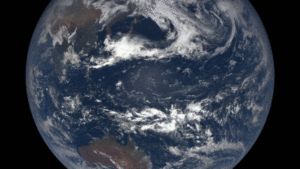
Earth

The discovery surprised researchers because ancient Earth had extremely low amounts of molybdenum in its oceans.

Scientists had long suspected that early organisms may have first relied on another metal, tungsten, which behaves similarly in cells and is still used by some microbes living in extreme environments today.

Instead, the new study suggests that ancient microbes were already using both molybdenum and tungsten between 3.7 billion and 3.1 billion years ago, during the Eoarchean and Mesoarchean eras.

That places the use of molybdenum well before the Great Oxidation Event about 2.45 billion years ago, when photosynthetic microbes dramatically increased oxygen levels on Earth.

To reach the conclusion, researchers reconstructed the evolutionary history of metal-using enzymes across the tree of life and compared it with geological records of ancient ocean chemistry.

The findings suggest that even though molybdenum was scarce globally, early life may have obtained it from localised environments such as deep-sea hydrothermal vents, where metals accumulated in usable concentrations.

“Even if Archean seawater held little dissolved molybdenum overall, localised systems such as hydrothermal vents could still have supplied usable amounts,” Kacar explained.

Scientists say the study could have implications far beyond Earth. Understanding how ancient organisms adapted to limited resources may help astrobiologists rethink the search for alien life on planets with vastly different chemical environments.

“Our Nasa ICAR shows that mapping the evolutionary history of bio-essential elements on Earth can help us predict what life on other worlds might use,” Kacar said. “Life detection should be metal-aware, redox-aware, and evolution-aware.”

Latest

Delhi will be hot and stormy on Thursday, temperatures to touch 38°C

The IMD forecasts thunderstorms across Delhi, Punjab, and Uttar Pradesh on Thursday, May 7, 2026.

Conservationist Krithi Karanth named National Geographic Explorer of the Year

Wildlife scientist Krithi K. Karanth has become the first Indian to win the Rolex National Geographic Explorer of the Year award for 2026.

Bright rainbow clouds light up skies in Indonesia. Know the science behind

A viral video from Bogor, Indonesia, shows a rare iridescent cloud shimmering with rainbow colours. Learn the science behind this atmospheric phenomenon and how

There is a Crocodile Bridge on Mars. Yes, you read that right

Nasa's Perseverance rover has photographed a rocky region on Mars called Crocodile Bridge, one of the most ancient landscapes in the solar system.

Nasa citizen scientists just discovered 3,000 new failed stars

Nasa’s citizen science project has used 2,00,000 citizen scientists to discover over 3,000 new failed stars, doubling the known total in the universe.

Topics

Canada’s Carbon Tax Hinders Pipeline Plans, Cenovus CEO Says

Alberta’s planned oil pipeline to the west coast requires Canada to shift away from stricter climate policies and toward promoting greater oil production from

Marandi Says US Sought Ceasefire After Battlefield Failure In Iran

In an exclusive interview in Tehran, Professor Seyed Mohammad Marandi said Iran holds the upper hand in the confrontation with the United States. He portrayed W

Income-tax returns: Received a tax notice from the I-T department? Here’s what you should do — Stepwise guide

Filing income-tax returns online has become easier, but first-time taxpayers may find it confusing. Income Tax notices can be issued for various reasons, here's

Dearness Allowance: DA for Pensioners — Who is eligible, how does it work? Here’s all you need to know

Retired central govt employees are eligible for individual or family pensions which are adjusted every time the CPC rolls out a DA hike or cut, depending on inf

Delhi will be hot and stormy on Thursday, temperatures to touch 38°C

The IMD forecasts thunderstorms across Delhi, Punjab, and Uttar Pradesh on Thursday, May 7, 2026.

8th Pay Commission 2026: Defence, railway stakeholder meetings in Delhi — check date, how to take part and more

The 8th Pay Commission will conduct stakeholder meetings in Delhi on 13-14 May to discuss pay and pension reforms. Interested parties can apply through the offi

NPS Vatsalya: Eligibility, investment choices for children, partial withdrawal and exit rules, explained

National pension scheme: The NPS Vatsalya Scheme allows children below 18 years to partially withdraw funds from their accounts under certain circumstances. We

Conservationist Krithi Karanth named National Geographic Explorer of the Year

Wildlife scientist Krithi K. Karanth has become the first Indian to win the Rolex National Geographic Explorer of the Year award for 2026.
spot_img

Related Articles

Popular Categories

spot_imgspot_img
