
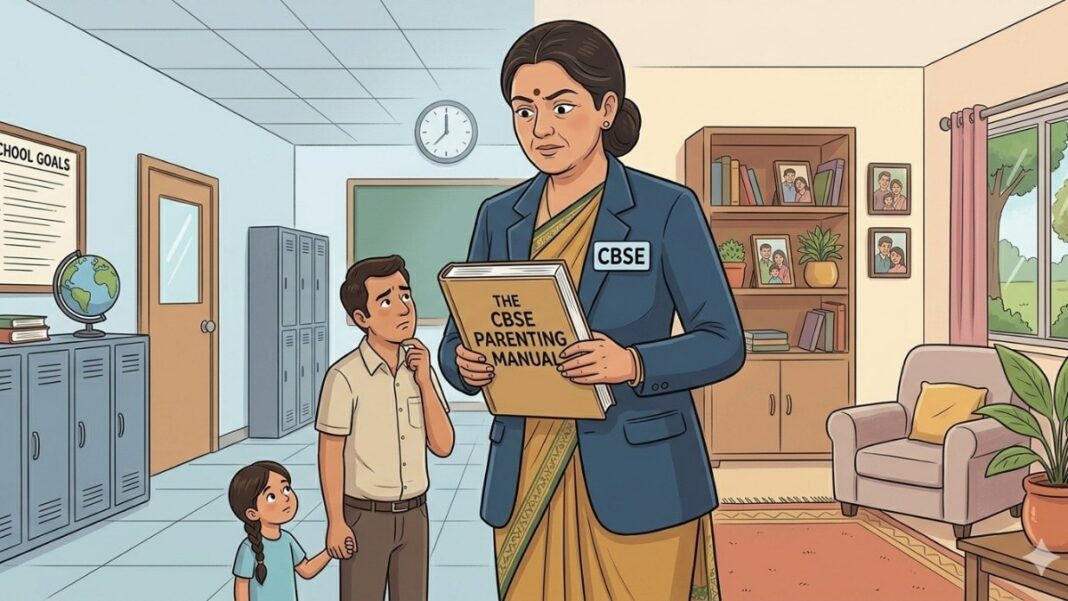
The Central Board of Secondary Education (CBSE) has quietly taken on a new role, not just educating children, but guiding how parents raise them too.
The Board’s Parenting Calendar for the 2026–27 academic session, a 60-page framework rolled out after a pilot last year, is meant to “strengthen the home–school partnership.” But read closely, and the document goes far beyond simple engagement. It begins to look like something else, almost like a playbook for parenting itself.
Most parents and experts we spoke to say this is no longer just about engagement. It is, in effect, a framework for parenting.
CBSE, of course, frames it differently. The board says the calendar is designed to move beyond routine parent-teacher meetings and create “purposeful collaboration” between schools and families.
That collaboration, however, is highly structured. It includes regular and need-based meetings with teachers and counsellors, workshops for parents on behaviour and mental health, and age-wise themes guiding how parents engage with children at different stages.
So what’s the problem? At the heart of it is a quiet but significant shift in how parenting itself is being positioned.
THE TEXT THAT SOUNDS LIKE PREACHING
Let’s start with the language.
“… where parents are not just spectators in their child’s education but active partners in their development.”
On the surface, this sounds collaborative. But scratch beneath it, and the implication is deeper. Parenting is no longer entirely private, it is being drawn into the institutional framework of schooling.
And that’s exactly where the discomfort begins.
“Schools do see patterns we may miss, especially around behaviour and mental health. But parenting is personal. CBSE can’t standardise it like a syllabus,” says Ankita Arora, a Noida-based parent.
WHEN HOME BECOMES CURRICULUM
The unease sharpens further when the calendar begins to define what parenting should look like.
“Bedtime rituals, mealtimes, stories, songs are not extras… They are the primary curriculum of early childhood.”
Calling home routines a “curriculum” is not just semantics, it effectively extends the idea of schooling into the household.
“… The parent’s job is to reduce noise — not add to it”, and “…The parent who understands this responds very differently from one who reads it as wilfulness to be corrected.”
This is where the tone shifts, from guidance to prescription, from suggestion to subtle judgement. “It’s not that the advice is wrong,” says Neha Kapoor, a parent in Gurugram. “I have a problem with the tone. It doesn’t feel like a suggestion, it feels like instruction.”
SO WHERE DOES GUIDANCE END AND OVERREACH BEGIN?
Here’s the thing. Parenting has never been seen as a standardised activity in India. It is shaped by culture, class, language, family structures, and lived realities. What works in a dual-income urban household may not necessarily work in a small-town joint family. And yet, this calendar reads like there is a single, ideal way to raise a child… one that can be documented, scheduled, and rolled out across schools.
It is here where the discomfort turns into concern.
Because when a central board begins to define bedtime routines, discipline styles, and even emotional responses, it isn’t just supporting parents, it is setting the norms. And once norms are set by institutions, they often become expectations.
FROM ADVICE TO PRESCRIPTION
The calendar repeatedly uses language that moves from suggestion to direction. It speaks of “reinforcing essential parenting skills” and equipping parents with “practical understanding” of developmental challenges.
The implication is a clear one. Parenting is something that can be taught, corrected and optimised with schools playing a central role. And that raises a larger question. If schools begin to define what “good parenting” looks like, where does that leave parents who choose differently?
“Many parents today are genuinely struggling, especially with screen time and mental health. Guidance is useful. But I’m not sure a board should define what good parenting looks like,” Sana Khan, a Mumbai-based mother, echoes the sentiment.
WHY CBSE SAYS THIS IS NEEDED
To be fair, CBSE is responding to real concerns. The calendar aligns with the National Education Policy 2020’s focus on holistic development and references a Supreme Court directive from July 2025 on mental health awareness among students.
With rising anxiety around digital exposure, emotional well-being and substance awareness, the board’s argument is a simple one. That schools and parents need to work more closely than ever before.
Experts agree with the intent, but caution against how far it goes. “Support for parents is important, no doubt. But once institutions start defining what good parenting looks like, it can become prescriptive. That’s a very fine line,” says Dr Meera Iyer, a child psychologist.
Education policy expert Prof Arvind Menon is more direct in his words. “This is institutional overreach. Schools are expanding into domains that traditionally belong to families.”
At the same time, not everyone sees it as entirely problematic. “The need is real,” says developmental expert Dr Shalini Gupta. “But the question is whether this is guidance or instruction.”
THE LARGER SHIFT
What the CBSE Parenting Calendar signals is a deeper change in Indian education. School is no longer confined to classrooms, it now extends into behaviour, emotions and family dynamics, and increasingly, into how parents themselves are expected to act.
For Ritu Sharma, a parent in Delhi, that’s where the line blurs. “Some parts are genuinely useful,” she says. “But when it starts telling you how to handle your child at home, it feels like overreach.”
The intent may be well-meaning, but the shift is hard to ignore. Because when a school board begins to define parenting, it isn’t just supporting families, it is quietly taking over a role that was never meant to be institutionalised.


