When Iran decided to choke the Strait of Hormuz, one of the busiest in the world, the uncertainty over this trade route created panic across the globe. The Strait of Hormuz controls 20–25% of the world’s oil supply; it ensures frequent supplies not only to eastern nations but also to many African countries, and to some extent, Europeans meet their oil needs through it.
You must be wondering why this has been discussed here.
The answer lies in the word “trade route”, as the routes of the world, for centuries, have been shaping global dominance as well as determining who controls the world. In history, we have witnessed the rise and fall of many routes that once formed the backbone of the ancient and medieval world.
Estimates suggest that a majority of the population survived on these trade routes. Here, we try to understand the importance of these ancient routes and where they were prominent in the world’s geography.
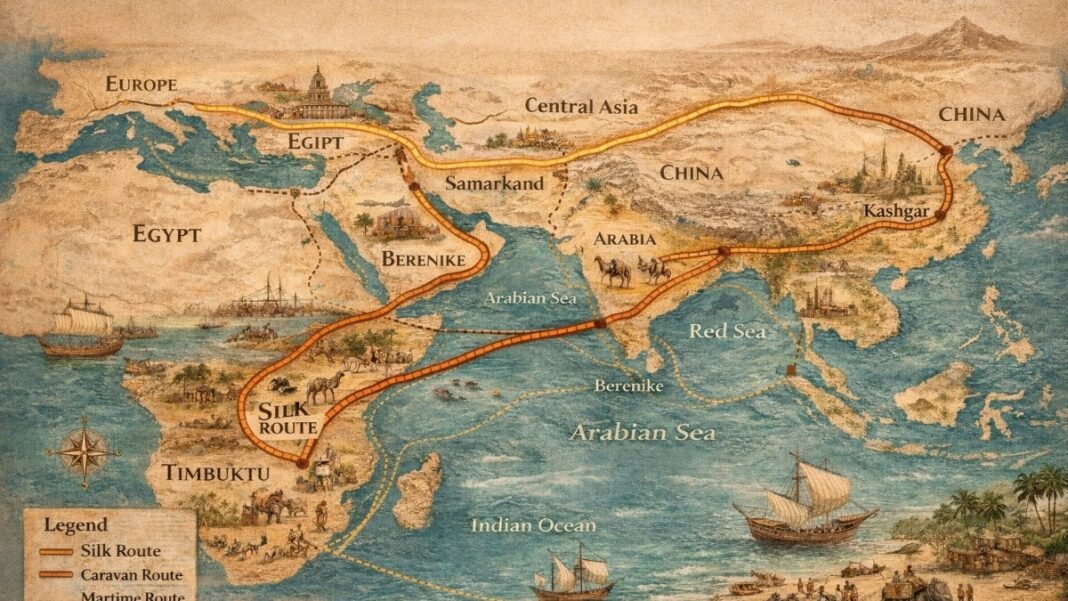
New findings suggest that Tamil merchants were present in Egypt, suggesting wider ancient trade links than previously understood. Tamil-Brahmi inscriptions in the Valley of the Kings include the name “Cikai Korran,” found in multiple tombs, pointing to travel beyond Red Sea ports such as Berenike.
The evidence suggests ongoing trade, with Tamil merchants exporting goods and likely engaging with Greek language and culture
Salt, spices, and essential commodities were all supplied across the major routes.
These routes became influential over time and witnessed cultural exchange in the centuries that followed, religion, science, and food travelled, and so did things that were not meant to, like bacteria, which caused millions of deaths.
1. THE SILK ROUTE
Many claims around the Silk Route emerged over time, and as William Dalrymple notes in The Golden Road, the route that came into the spotlight after the 18th century has been known for major exchanges across the world.
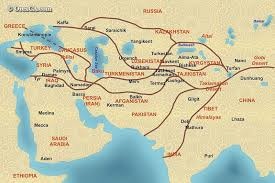
The Silk Road was one of the most predominant ancient trade route of the known world of that time, linking China with the Roman Empire. From the 1st century BCE, silk began moving westward and in return the route allowed the exchange of wool, silver, and gold.
Goods were not the only commodities exchanged along the route, but it enabled the exchange of ideas, technologies, religions, and art. Samarkand, the city in Central Asia popular as the origin city of the first Mughal emperor, Babur.
The route began in Xi’an and later covered the Great Wall, crossed the Pamir Mountains, and reached the Levant, where goods continued to Mediterranean ports.
Traders in a large number covered only parts of the 4,000-mile network.
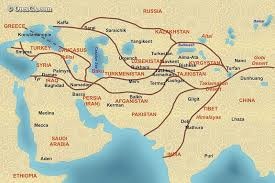
The decline of the Roman Empire also saw the fall of the trade route which later became unsafe and less profitable for the merchants. The route later revived under the Mongols in the 13th century.
Marco Polo later travelled this route to China. Some historians also suggest that trade along the Silk Road contributed to the spread of the plague-causing bacterium Yersinia pestis.
2. THE SPICE ROUTES
The Spice Routes ran across the seas, linking Asia with Europe.India played a key role. The Western Ghats produced pepper, which moved through ports along the Malabar Coast. Traders from Rome, Arabia, China, and later Europe all arrived here.
Black pepper, native to Kerala, was one of the earliest traded spices. Records suggest its use dates back to 2000 BCE. In the 14th century, traveller Odoric of Pordenone noted its abundance in the region.
Even today, old paths in Wayanad, Idukki, and the Nilgiris trace these routes. They reflect how spices shaped trade, movement, and contact between regions.
Kerala’s Muziris once stood at the centre of this network. Between the 1st century BCE and 4th century CE, it linked India with Africa, West Asia, and Europe, exporting spices and importing gold and grain.
South Indian empires like the Cholas and Pallavas influenced the world from west to east through these routes.
Pepper, cloves, cinnamon, and nutmeg were in high demand, but until the 15th century, Arab and North African traders controlled access, which ultimately led to high prices and making the commodities nothing less valuable to gold and silver.
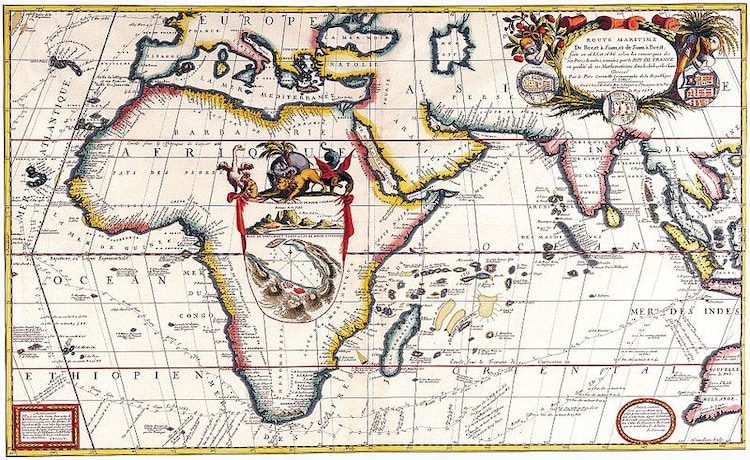
The situation changed when European sailors found direct sea routes.
From the 15th to 17th centuries, Portugal, the Netherlands, and England moved into trade, reaching India, Indonesia, China, and Japan. Control over spices led to wars, expansion, and new trade networks. Even Christopher Columbus set sail in 1492 partly in search of spices.
At the centre of this trade was Maluku, the only source of nutmeg and cloves at the time. Whoever controlled these islands controlled the market.
3. THE TEA HORSE ROAD
A 6,000-mile land corridor once linked China to Tibet and India through the Hengduan Mountains. Traders moved tea in exchange for Tibetan warhorses, often across steep terrain and river crossings.
The route saw organised trade by the 7th century, peaking during the Song dynasty. Records suggest thousands of horses were traded each year for large quantities of tea.
Its role declined with the rise of sea trade, but it returned during World War II when blockades cut off ports, turning it into a supply line between inland China and India.
4. GRAND TRUNK ROAD
The Grand Trunk Road has carried movement across the subcontinent for over two millennia. From the time of the Mauryan rule, the road played a major role in the supply of horses, food, spices, and armies.
Historians say that the success of the first Delhi Sultanate and later the Mughals depended on this route, as it allowed rulers easy passage as well as the smooth movement of large armies.
Rebuilt by Sher Shah Suri as the Shahi Road, it later became the GT Road under the British.
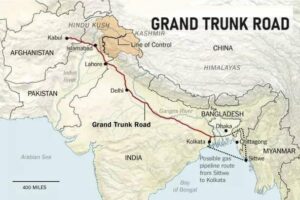
It linked Taxila to Bengal, moving traders, soldiers, and pilgrims. Today, its path still runs through north India and beyond, connecting Bangladesh to Afghanistan.
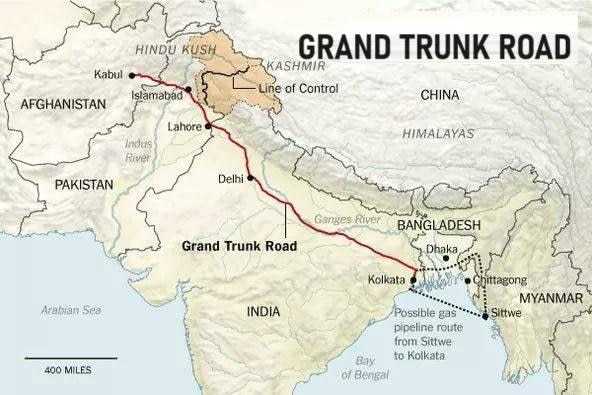
UNESCO data says the road begins in Chittagong in Bangladesh, passes through Howrah in West Bengal, stretches across the Gangetic plains of northern India to Lahore in Pakistan, and continues beyond the Hindu Kush to reach Kabul in Afghanistan.
5. ANCIENT CARAVAN ROUTE (INCENSE ROUTE)
The Incense Route connected southern Arabia to the wider ancient world. From around the second millennium BCE, traders moved incense, myrrh, and resins northwards for religious use.
To support this trade, kingdoms in Yemen built cities along the route. Over time, these stops became centres of exchange.
The route did more than carry goods, it linked cultures, leaving behind early signs of urban growth and cross-regional contact.
The International Spice Routes Conference, held from January 6–8, 2026 by the Muziris Heritage Project and Kerala Tourism, focused on the shared history of spice trade regions and their relevance today.
Seeing history through these routes offers a different perspective, where civilisations took new turns, merchants influenced nations, and religions gained importance. To some extent, the knowledge that travelled through these routes shaped history and led to many innovations.
If the Arab world had not restricted Europe’s trade with India and the east, these routes, or perhaps even the world, would neither have developed in the same way nor been colonised.
The knowledge of the Vedas spread through these routes, ancient science from Chinese civilisation reached Europe, and even the colonisation of the world became possible through them.