
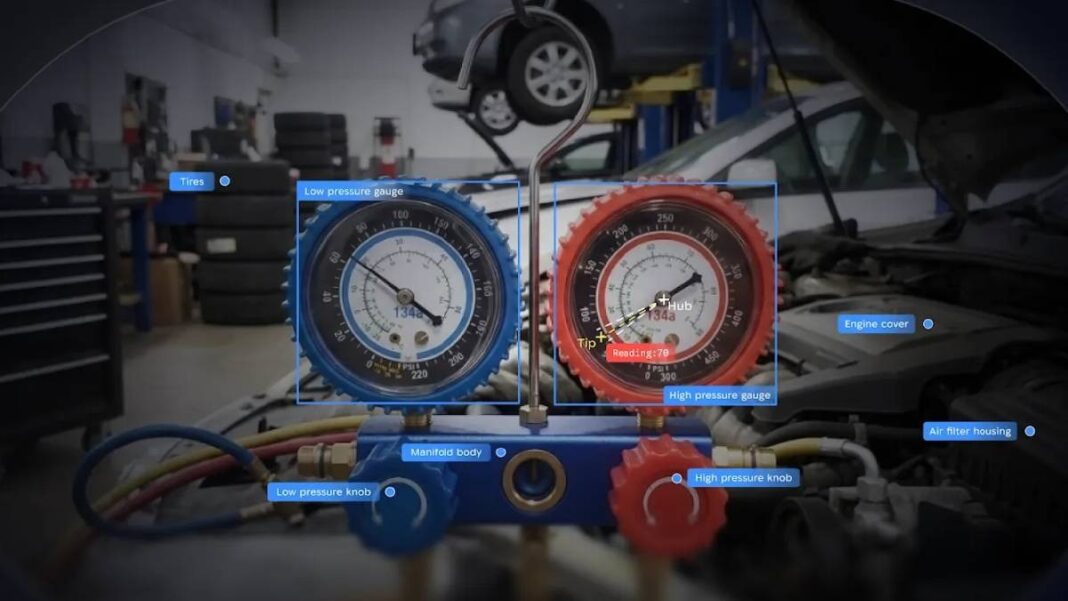
Robots have been around us for many years, but their use has been restricted to repetitive tasks because they lack reasoning for the real world, unlike humans, and are only good at following instructions. However, Google says it has designed a new system that will help robots better analyse and make decisions about the physical world. The tech giant claims its new Gemini Robotics-ER 1.6 can help a robot move around in a complex facility, read various gauges, and do much more. Robots get this capability as the model is better at reasoning and understanding multiple views of an environment.
The company says the new model offers improved visual and spatial understanding, enabling robots to plan and complete tasks. It adds that the model combines spatial reasoning, world knowledge, and agentic vision for different tasks.
Real-world task execution
The new model will make robots more suitable for real world application. Google says with the new system, robots can identify and count items. For instance, robots can identify the right tool in a cluttered workshop while ignoring items that are not required. In addition, with the new system, robots can determine whether they have completed a job or need to retry it. Google says robots get multiple views of tasks from cameras, and the model’s reasoning ability helps them understand the full scene.
Towards autonomous industrial robots
The new system also aims to make industrial robots autonomous and mobile. With this system, robots can move around facilities and read analog dials. Google says the model is autonomous in the sense that it understands physical constraints, such as avoiding liquids or items over 20 kg when carrying out instructions.
China’s different approach to robotics
While Google’s new model focuses on making robots capable of reasoning like humans, China is taking a different approach. Recently, a video went viral showcasing Unitree Robotics’ H1 humanoid robot reaching a sprint speed of up to 10 metres per second, marking a world record for a humanoid robot.
To provide context, Olympic medalist Usain Bolt’s record-breaking run at the 2009 Berlin World Championships had an average speed of 10.44 metres per second. Bolt completed the 100m run in 9.58 seconds.
This run was part of a test session ahead of the second Humanoid Robot Half Marathon scheduled for April 19, 2026, in Beijing’s Economic-Technological Development Area. As per Global Times, more than 70 teams have already conducted test runs.
Unitree’s H1 robot builds on previous achievements, including the H1 V3.0 Evolution model setting a Guinness World Record in March 2024 as the fastest full-sized humanoid robot, reaching a walking speed of 3.3 metres per second.


