
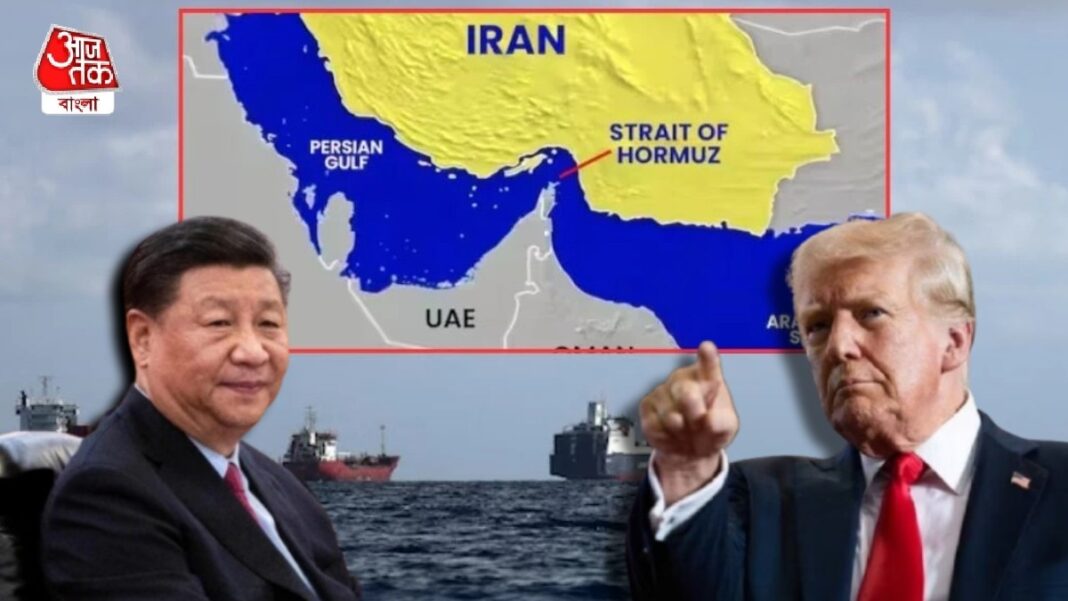
The United States has moved from threats to action. A full naval blockade of the Strait of Hormuz is now in place, enforced by the US Navy after nuclear talks with Iran collapsed in Islamabad. Within the first 24 hours, the impact was immediate and decisive. Not a single vessel made it through. Six ships turned back after encountering American forces, underscoring Washington’s intent to choke off Iran’s oil exports at the source.
For President Donald Trump, the blockade is both leverage and message. The breakdown in talks over uranium enrichment, sanctions relief and the future of Iran’s nuclear programme left little room for compromise. The result is a strategy that blends coercion with diplomacy. Military pressure on one hand, the possibility of renewed negotiations on the other.
But while the blockade is aimed at Tehran, its ripple effects land squarely in Beijing.
China is not a distant observer in this crisis. It is deeply entangled. Roughly forty percent of China’s oil imports pass through the Strait of Hormuz. Even more significantly, China purchases close to ninety percent of Iran’s oil exports. This is not just trade. It is structural dependence. The flow of energy through Hormuz is directly tied to the stability of the Chinese economy.
That reality explains Beijing’s sharp response. Chinese officials have labelled the blockade dangerous and irresponsible, warning it risks escalating an already volatile situation. More striking, however, is the language directed at Washington. China has made it clear that its commercial and energy arrangements with Iran will continue, and that it expects no interference.
This is not the language of quiet diplomacy. It is a statement of intent.
Yet intent and capability are not the same thing.
In the early hours of the blockade, a Chinese-linked tanker, the Rich Starry, managed to pass through the strait carrying methanol from a United Arab Emirates port. For a moment, it appeared to challenge the narrative of a sealed American chokehold. But the success was short lived. The vessel soon reversed course, heading back towards the strait under mounting US pressure. The message was unmistakable. The blockade may not be flawless, but it is effective.
For China, this creates a strategic dilemma. On one side lies economic necessity. A prolonged disruption in oil flows would drive up costs, strain supply chains and add pressure to an economy already navigating external shocks, including US tariffs. On the other side lies military reality. Directly confronting the US Navy in the Strait of Hormuz would be a high risk gamble, one that Beijing is not yet equipped to win.
China does have options short of confrontation. It could deploy naval escorts for its tankers, mirroring its anti piracy missions in the Gulf of Aden over the past decade. Such a move would signal resolve without immediately triggering conflict. It would also test Washington’s willingness to escalate against Chinese vessels operating under military protection.
However, even this step carries significant risks. The People’s Liberation Army Navy may be the largest in the world by ship count, but numbers alone do not determine power projection. The United States retains a decisive advantage in carrier strike groups, operational experience and regional positioning. More importantly, Hormuz is far from China’s strategic backyard.
This is why Beijing’s response, so far, has been calibrated rather than confrontational. Strong rhetoric, limited action and careful signalling define its current posture. China is pushing back politically while avoiding a direct military test.
The longer the blockade holds, however, the harder that balance becomes. Every disrupted shipment, every delayed tanker and every spike in energy prices increases the pressure on Beijing to act more decisively.
For now, China is watching, calculating and absorbing the shock. But the Strait of Hormuz is not just another geopolitical flashpoint for Beijing. It is a lifeline. And if that lifeline continues to be squeezed, the question will no longer be whether China responds, but how far it is willing to go.


