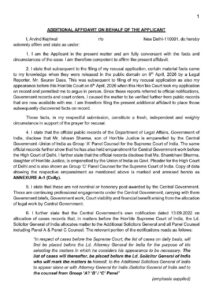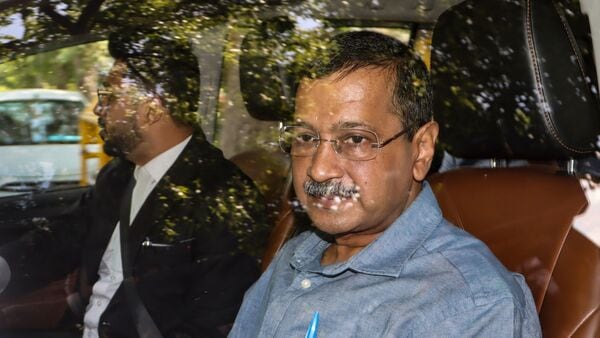
Former Delhi Chief Minister and Aam Aadmi Party’s national convenor, Arvind Kejriwal, has filed a fresh affidavit before the Delhi High Court, pressing for the recusal of the presiding judge, Justice Swarana Kanta Sharma, LiveLaw reported.
Kejriwal said in the affidavit that Justice Swarana Kanta Sharma’s son and daughter are empanelled as Central Government Counsel and that they are allotted work by the Solicitor General, who appeared for the Central Bureau of Investigation (CBI) before Justice Sharma. This, according to Kejrieal, created a reasonable apprehension of bias on the part of Justice Sharma, requiring her recusal from hearing CBI’s plea against the discharge in the liquor policy case.
Kejriwal has also contended that the structure governing the allocation of government legal work gives rise to a reasonable apprehension of conflict of interest in the excise policy case, news agency ANI said.
The Court has reserved its order for the recusal pleas.
In his affidavit, Kejriwal mentions the institutional process through which government cases are assigned to law officers and panel counsel. He said this mechanism creates a linkage between the prosecution in the present case and the professional engagements of the judge’s immediate family members.

Referring to official notifications and FAQs issued by the Ministry of Law and Justice, Kejriwal states that while the Attorney General chooses matters for personal appearance, other cases are routed through the Solicitor General to additional law officers and panel counsel.
According to him, this system establishes a continuing and structured professional interface with the Central Government.
Politically sensitive prosecution
Describing the matter as a politically sensitive prosecution involving central agencies against a prominent opposition leader, Kejriwal submits that the standard of judicial impartiality must be viewed not only in terms of actual fairness but also in its perception. He clarifies that no allegation of actual bias is being made, but maintains that the test for recusal rests on whether circumstances give rise to a reasonable apprehension of lack of neutrality.
During the hearing, Justice Swarana Kanta Sharma remarked that it was the first time she had been asked to recuse, observing that she had “learnt a lot about the recusal jurisdiction” and expressing hope of delivering a sound judgment, as the Court reserved orders after hearing all parties.
Opposing the plea, Solicitor General Tushar Mehta, appearing for the CBI, termed the recusal applications as frivolous and cautioned that entertaining such pleas could set a precedent enabling litigants to seek a change of bench by casting aspersions. He submitted that earlier observations of the Court were made in a distinct legal context and were only prima facie, and rejected arguments based on public perception or external commentary.
On the other hand, Senior Advocates Sanjay Hegde and Shadan Farasat argued that the issue must be examined from the standpoint of a fair-minded observer, submitting that prior judicial observations and surrounding circumstances could give rise to a reasonable apprehension warranting recusal.
The standard of judicial impartiality must be viewed not only in terms of actual fairness but also its perception.
The matter arises out of the Delhi Excise Policy 2021-22 case, in which the CBI has challenged the trial court’s discharge of Kejriwal, Manish Sisodia and others. The High Court has indicated that the question of recusal will be decided independently of the merits of the case.
(With inputs from ANI and LiveLaw)