A new study by scientists at Physical Research Laboratory, published in The Astrophysical Journal, has offered fresh insights into the Moon’s surface using data from Chandrayaan-3.
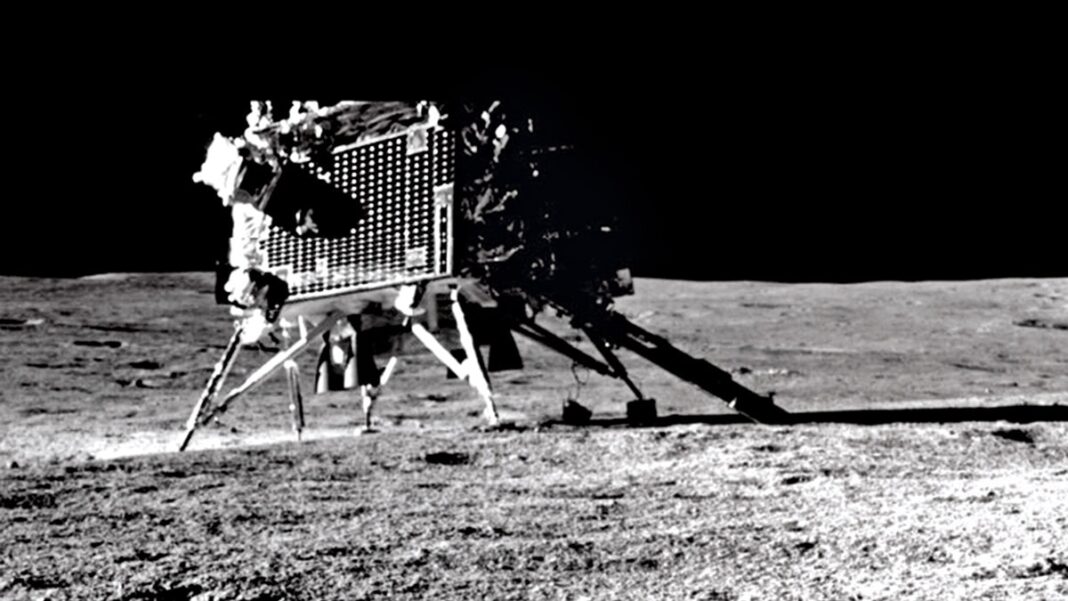
The research focuses on a unique experiment conducted during the mission’s final phase, when the Vikram lander performed a short “hop” on the lunar surface.
Chandrayana-3’s Vikram lander made a historic landing near the Moon’s South Pole and remained active for one lunar day, conducting multiple science experiments, a quick hop and revealing what’s hidden beneath the surface
The hop, achieved by briefly reigniting the lander’s engines, shifted Vikram by about 50 cm and slightly rotated its position. While modest in distance, the manoeuvre created a rare opportunity to directly study how the Moon’s soil, known as regolith, responds to rocket exhaust and to examine the properties of freshly exposed material.
According to the study, the engine plume blew away the uppermost layer of lunar dust, removing roughly 3 cm of regolith. This revealed a denser, slightly compacted layer beneath.
Scientists redeployed the onboard instrument, the Chandra’s Surface Thermophysical Experiment (ChaSTE), to record temperature changes during the transition from lunar day to night.
The findings point to a clear two-layer structure within the top 6.5 cm of the Moon’s surface at the new location. The upper layer, extending to about 3 cm, was found to conduct heat more efficiently.
In contrast, the lower layer showed reduced thermal conductivity, indicating differences in composition or packing.
“This layered structure suggests that even shallow depths on the Moon can show significant variation in physical properties,” the researchers noted. Such variations affect how heat is stored and released, which is critical for understanding the lunar environment.

The study also highlights considerable variability in soil strength and density. Measurements indicate cohesion values ranging widely, along with differences in how tightly the soil grains are packed.
These variations were detected through onboard sensors and thermal modelling, offering a detailed look at subsurface conditions.
Importantly, temperature models developed using three-dimensional simulations closely matched the actual measurements recorded by ChaSTE. The analysis also suggests that local factors, such as shadows and uneven terrain, play a major role in how temperatures behave on the Moon’s surface.
The findings point to the complex and heterogeneous nature of the lunar regolith, particularly in the Moon’s region, where Chandrayaan-3 landed. This region is of global interest due to the potential presence of water ice and its suitability for future exploration.
Scientists say the results will be crucial for upcoming missions, especially those involving human landings and in-situ resource utilisation. Understanding how lunar soil reacts to engine plumes and how it varies beneath the surface can help in designing safer landing systems and surface operations.
The study marks another milestone for India’s lunar exploration programme, demonstrating how even small manoeuvres can yield significant scientific discoveries.