
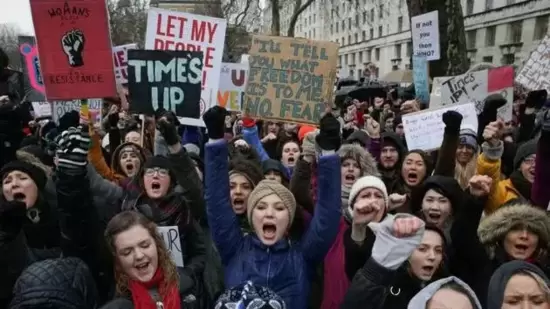
Has there ever been a better time to be a feminist? The question might seem strange at a time when women’s rights are arguably under their most serious threat in a generation.
Gains made over nearly a half century have been rolled back. In the US, president Donald Trump began his second term by abolishing federal policies on diversity, equity and inclusion. There are only two genders, he said in what amounted to a reversal of transgender rights. Gender studies are being excised from academic curricula; Texas A&M University has announced the end of its women’s and gender studies programme. And in Florida, schools are removing classes around gender identity.
Ongoing wars and conflicts have increased the vulnerability of women and girls. Rape continues to be used as a weapon of war, with reported cases of sexual violence rising by 87% in just two years, according to a new United Nations report.

In Iran,165 schoolgirls became collateral damage in the targeted February 28 bombing of a school by US-Israel forces, reports New York Times. Israel’s pulverisation of Gaza that began in October 2023 had by May 2025 claimed the lives of 28,000 women and children, according to the UN. In Sudan 11 million women and girls face dire food insecurity.
In 64 countries around the world, same-sex sexual acts are a criminal offense. In seven of these, including Brunei, Uganda and Yemen, they are punishable by death. Taking a cue from Russia which expanded a law in 2022 to ban the promotion of non-heterosexual relations, Hungary banned the Budapest Pride event.
Women hold just 64% of the legal rights of men, a March 2026 World Bank report finds. In practice the picture is bleaker with countries on average establishing less than 40% of the systems needed for full implementation. For instance, the reports states, in the 98 economies that have laws mandating equal pay for women, only 35 have adopted pay-transparency or enforcement mechanisms.

In 54% of the world’s countries, rape is still not defined on the basis of consent. France introduced the idea of consent into its rape laws only in October last year following the horrific rape trial of 52 men convicted of raping Gisele Pelicot.
“A justice system that fails half the population cannot claim to uphold justice at all,” UN Women executive director Sima Bahous said.
If it seems like we’re running in place, consider the newer threats of technology-facilitated violence. A new year flex by Grok, the AI arm of Elon Musk’s X, went on a digital stripping spree of real women and girls until global outrage and threat of legal action shut it down. Digital technology is widening the already existing digital divide. Online manosphere communities are able to connect and spread toxic ideas about masculinity and a woman’s place in that world.
Misogyny by design
These are not accidents but misogyny as official policy, dictated by the patriarchs who lead the world.

Nowhere are the horrors of officially-sanctioned misogyny more apparent than in Afghanistan which just last month made it legal to beat your wife, provided you don’t break her bones. The caveat is moot because even if you do, how will she prosecute? She cannot leave the house unaccompanied by a male guardian—in many cases the same person who gave her the government-authorised beating. How will she prove injuries since she cannot break modesty laws by revealing her body to strangers? How will she seek medical treatment, since it is haram for her to have a male doctor examine her? How will women qualify to become doctors if they are not allowed to study beyond secondary school?
Afghanistan is an extreme example. But please remember, in India it is perfectly legal to rape your wife, provided she is over 18. The government has told the court that criminalizing marital rape will destroy the sanctity of marriage. But what is the sanctity of a sexually violent marriage?

Tradition is the excuse most often trotted out to justify a variety of persistent problems. Arranged marriage is tradition and marrying outside caste and faith lines is subversion even though India’s Constitution guarantees the right to life and personal liberty under Article 21 and freedom of speech, expression and association under Article 19. These have been interpreted by Supreme Court to include the right to choose a partner.
Yet, as many as 12 states in India—13 if you include Maharashtra that cleared a bill earlier this week—have laws that ostensibly prevent forcible conversion to “protect daughters” but which on the ground make it virtually impossible to have interfaith marriages. In Karnataka where the law was originally passed by the BJP government, the current Congress government has shown no indication of repealing it.
In Gujarat a proposed amendment to marriage registration rules includes parental consent. In Uttarakhand, the first Indian state to enact a uniform civil code post-Independence, adult couples who choose to live together must register with local authorities via a 16-page form.
These restrictive, unconstitutional laws and rules are enacted in the name of ‘protecting’ women, because in 2026 we still vest ideas of family honour in their behaviour. The fact that honour killings continue tells us of the deep roots of patriarchy, and what supports it.
Earlier this month, the Allahabad high court was hearing a case of honour killing where the parents of a 15-year-old girl had murdered her after finding out she was pregnant. The trial court sentenced the murdering parents to life imprisonment and the Allahabad high court upheld that verdict. But in what sounded suspiciously like sympathy, the judges noted that a daughter’s pregnancy outside wedlock is a ‘nightmare’ for an average Indian that could invite an ‘uncontrollable’ often violent reaction from parents.
Another tradition, dowry, illegal since 1961, claims 17 lives a day, according to the National Crime Records Bureau. Many of these lives could have been saved if the families of women who complain that they are being tortured and abused at their marital homes stop counselling them to ‘adjust’ and tell them it’s ok to return home. Many of these lives would have been saved if parents focused on education and careers instead of marriage as the chief milestone of a daughter’s life.

Domestic violence accounts for 31.4% of all crimes against women in India. Two decades ago we passed a law against domestic violence that was designed to give an umbrella of reliefs from child custody to right to residence. These issues were to be resolved within 60 days.
Yet, while reporting on a two-part series on domestic violence, I found that the oldest case in one court in Delhi dates back to 2002. The infrastructure to support the law, including shelter homes and dedicated protection officers never came up. In Jharkhand, for instance, Anganwadi workers were given the additional job of protection officers. And the Delhi Commission of Women has been without a head since 2024.
Silver linings
Despite the grounds for pessimism, there are undeniable silver linings.
There are newer conversations on subjects that have been taboo for decades. Menstrual hygiene and, more recently, menopausal care, for instance. As state governments including Karnataka begin to grant menstrual leave for those who need it, Maharashtra earlier this year opened the country’s first dedicated menopause clinics. Within the first few days of opening, 22,000 women had visited one clinic in Pune.
Decades of work by feminist economists has led to far greater attention on the value of unpaid housework, one of the chief reasons that holds women back from paid work. The courts have taken note. In a maintenance matter last month, the Delhi high court noted that even if a wife is not employed, she makes a significant contribution to the home.
The global fertility crisis has led to policy makers and governments globally to ask what might enable greater willingness from women to have more children. There are discussions that range from enhancing paternity leave for a more equitable distribution of care work to allowing more flexibility for employed parents to accommodate jobs around family responsibility.
At a time when women’s representation in parliaments around the world seem stubbornly stuck from 27.2% in 2025 to 27.5% in 2026, according to the Inter-Parliamentary Union, India has passed a law that will earmark 33% of Parliamentary and assembly seats for women in future elections that will result in far greater representation.

There are already hints of accommodation. This month, Mamata Banerjee, one of two women chief ministers, nominated senior advocate Menaka Guruswamy as the TMC’s candidate for the Rajya Sabha. Guruswamy’s academic and professional credentials are excellent. She had appeared for petitioners in the Supreme Court case that decriminalized homosexuality in 2018 and also in the unsuccessful marriage equality petition of 2023. But as the first openly out LGBTQ member of Parliament, Guruswamy’s presence in Parliament make it more inclusive and representative.
Representation is also the demand of a group of senior women advocates, Indian Women in Law. Half the nation, half the bench is their demand. It seems reasonable enough. There is just one woman judge of 34 in the Supreme Court and in high courts women make up only between 13% to 14% of judges.
“Men don’t need to have conferences to demand their rights,” said senior advocate Shobha Gupta, one of the organisers. “But half this population needs to keep reminding the system that we exist and we are still being denied our rightful share.”
A generation of women, aspirational, confident and ambitious is aware that it can no longer be business as usual with men deciding how to run the world.

Girls have already bridged the education gap to a large extent thanks to government policies and the intervention and activism of non-profits. On the sports field, they are leaping ahead and the November 2025 World Cup cricket win by women was powered by grit and confidence.
Even the simple act of exercising voting rights once every five years is now a muscle flex. Women are not only voting in larger numbers than men, there is evidence that they are exercising their choice rather than meekly following family diktats on who to vote for. It’s an exercise that has paid off as male-dominated political parties across ideology and geography try and win loyalty through a slew of schemes from outright cash to free bus fares.
Nobody, but nobody, messes with the empowered woman. And that is exactly why, this could be the best time to be a feminist.




