
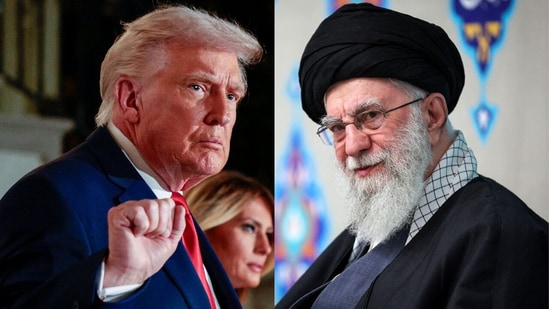
Iran has been constantly bombarded with strikes conducted by the US and Israel, as it also undertakes counterattacks on several US military bases. Top Iranian leaders, including the Supreme Leader Ayatollah Ali Khamenei has been killed in the conflict.
While US President Donald Trump has justified that the strikes were meant to eliminate the threat of Iran’s strikes, critics have claimed that the strikes are pushing the boundaries of Trump’s constitutional authority.
Lawmakers in the US Senate were set to begin voting on Wednesday on a bipartisan war powers resolution aiming to stop the military campaign against Iran and require that any hostilities against it be authorised by Congress, Reuters reported.
What Trump has said
In justifying the attack on Iran, President Donald Trump has said that he felt Iran was going to strike first and the attack was meant to eliminate imminent threats to the US. However, he did not provide details, and some claims were not backed by US intelligence reports.
Further, Trump claimed that Iran could obtain a nuclear weapon within one month, but he did not provide evidence, and this contradicted his claims in June that the US military had “obliterated” Iran’s nuclear program.
US Defence Secretary Pete Hegseth has also described that action as “the most lethal, most complex and most-precision aerial operation in history.”
What US constitution says about the power to declare war
Under the US Constitution, the presidential powers include the ability to command armed forces and direct foreign relations. However, the power to declare war resides only with Congress.
Legal experts say that the attacks on Iran may be pushing the boundaries of Trump’s constitutional authority. In the past, Congress has provided authorisation for large military opperations including President George W. Bush’s invasions of Afghanistan in 2001 and Iraq in 2003.
War Powers Resolution
The War Powers Resolution of 1973 acts as a check on presidential power.
Under the War Powers Resolution (WPR), the US president can deploy the military in an armed conflict only if Congress has declared war, granted specific authorisation, or if the country or its armed forces are under attack. The law also says that the president has to keep Congress informed through regular reports, a process the administration began on Monday.
Additionally, the WPR states that any military action without congressional approval must end within 60 days unless lawmakers agree to extend the deadline.
It also provides a procedure for Congress to withdraw the military from a conflict, and members of both parties have said they plan to put such legislation to a vote this week.
While it is unlikely that it will get two-thirds of the majority, lawmakers have argued that this would put members on the record in an election year.
What does international law say?
Legal experts reportedly say that the attacks will likely be considered unjustified by many countries under the United Nations Charter, since the charter states that member states must refrain from using force or the threat of force against other states.
Exceptions to this rule include when force is authorised by UN Security Council or is used in self-defence in response to an armed attack, neither of which applies. There is also the concept of pre-emptive self-defence, which would arguably allow the United States to attack Iran if it had proof of an imminent, overwhelming attack.
Was the killing of Khamenei legal?
Legal experts say that the issue is not straightforward. Reports state that Israel carried out the strike that killed Khamenei, while the United States provided intelligence and operational support.
In 1981, Republican President Ronald Reagan signed Executive Order 12333, which banned anyone working for the US government, or acting on its behalf, from carrying out assassinations. The order also prohibits the US intelligence community from participating in such acts.
However, experts note that while the killing of a leader may be considered assassination in peacetime, it could be viewed as a lawful act during an armed conflict.
In Khamenei’s case, the legal interpretation would partly depend on whether the US was considered to be at war at the time of his death and whether he was regarded as a military leader.
(With inputs from Reuters)


