
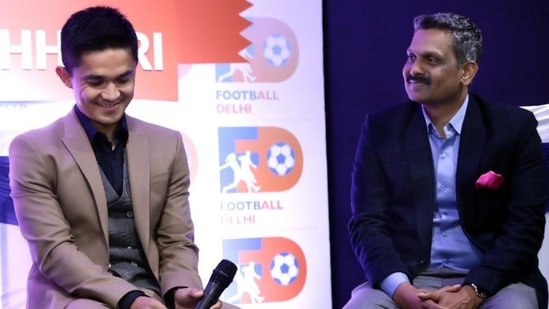
As the T20 World Cup frenzy grips the country, its timing has hardly helped the return of the Indian Super League, which only resumed after months of uncertainty. Up against cricket’s unmatched pull in India, football continues to fight for space and relevance in a crowded sporting landscape. The ISL’s challenges run deeper than scheduling clashes. After investing heavily over the past decade without sustained commercial returns, FSDL chose not to renew its partnership. When profits fail to materialise year after year, continued backing becomes difficult to justify. Hence, in the aftermath, the All India Football Federation (AIFF) stepped in to shoulder responsibility and keep the league afloat.
Former AIFF secretary general Shaji Prabhakaran discussed the association’s decision to manage the ISL, highlighting how months of doubts over the league had complicated matters for stakeholders and fans alike.
“It is not that AIFF have taken over, but I think it’s because they didn’t find a commercial partner. Commercially, the market for football is not very encouraging right now. So in that way, AIFF is fully managing it. I think they are planning to bid again for 20 years. That’s what I read. But commercially, the market must grow. A lot of work needs to be done in that space because the sport’s visibility must grow, and the national team’s performance must improve. This uncertain situation has also not helped secure the best brands and commercial interests. Maybe we will know the situation next season, how things go. Because this season is starting today in that way. And it is almost more than half the season gone. Let’s hope the ISL’s competitiveness will engage more fans. The fans’ energy and the kind of performances we will see will define the next season. That is what I think,” Shaji Prabhakaran told Hindustan Times.
Reflecting on the decade-long partnership between FSDL and ISL, Prabhakaran weighed in on whether the collaboration achieved its goals. While he acknowledged the significant investments and commercial efforts that helped professionalise Indian football, he mentioned that the ultimate success depends on nurturing local talent and building stars from the grassroots.
“I think all those who supported football as a brand, commercially supporting the sport, we need to thank them. They genuinely tried. They put their best interest and the best money possible into the game. If you look at how the sport has changed in terms of stadiums, training facilities, coaches, player salaries, and global branding, there has been progress. The problem is that the national team did not do well. That is where we must focus, on grassroots development and talent. We need more events and competitions at the youth level. Like what Athletic Fever has done, we need similar events 365 days a year. If that happens, we will see better talent because we need local stars. Unless we have local stars, we cannot compete for viewership and fandom. If football has a local star, fans will come forward. That is the focus — we need local stars. And they will only come with a robust competitive structure at the grassroots level,” Prabhakaran added.
Amid reports of player pay cuts and financial strain in the Indian Super League, the 53-year-old addressed concerns over the league’s sustainability, stressing that the current season has been far from normal. With clubs hit by sponsorship losses and prolonged uncertainty, players mutually agreed to salary reductions, but he emphasised that long-term stability would depend on commercial recovery, improved competitiveness, and renewed fan and brand engagement across the ecosystem.
“This season was not a regular season because of uncertainties. Clubs lost sponsors and did not have time to secure new ones. Players voluntarily agreed to pay cuts — it was mutual. But sustainability is key. If clubs keep spending without recovery, it becomes tough. Next season will define whether recovery has happened. We need greater competitiveness and fan energy in stadiums and digitally, so brands get excited again. All stakeholders must come together. We must protect and grow the game. From crisis, football must grow stronger,” he emphasised.
Recently, India hosted Lionel Messi, whose visit began with controversy in Kolkata but quickly gained momentum with successful events in Hyderabad, Mumbai, and Delhi. Although the tour lasted only a few days, its impact on Indian football was unmistakable. Prabhakaran noted that full stadiums, active brand participation, and widespread fan enthusiasm highlighted the sport’s popularity and commercial promise. Yet he emphasised that while Messi’s visit generated excitement, India’s football ecosystem still needs long-term strategic planning, stronger grassroots programs, and robust competitive structures to create lasting growth and develop local talent nationwide.
“The Messi event demonstrated that there is a craze for football. He did not even play a game, but the stadiums were full. That shows football has a big following in India. Brands came forward and supported it. Economically, it showed that football has commercial potential. But his coming is not going to change the fortune of Indian football. Absolutely not. At least discussions happened. For those few days, football was the focus in the country. It brought attention to the game. Some people may get motivated to invest. There were impacts, like the big project initiated by the Maharashtra government. That came because of Messi’s trip. In Hyderabad, too, the city looked like a football city. Projects were initiated. It encouraged people to do more for the game. But overall, we need a strategy for the whole country — how to engage children, create opportunities, and build competitive platforms,” he added.
“AIFF’s ‘Vision 2047’ was an honest approach”
The AIFF unveiled its long-term blueprint, ‘Vision 2047: The Indian Football Strategic Roadmap’, in 2023, outlining key development areas. Progress, though, has been limited, with Indian football showing little tangible growth since its launch.
Present at the unveiling of Vision 2047 in his role as AIFF Secretary General, Prabhakaran reflected on the plan’s intentions and challenges. He emphasised that the roadmap aimed for honest, annual evaluations, with clear goals across grassroots leagues, national team performance, women’s football, coach and referee development.
“It was an honest approach. Every year, it was meant to present what was achieved, what was not, and how to course correct. There were defined goals for the first four-year cycle, grassroots leagues, national team ranking, women’s football, coach education, and referee development. Hopefully, by the end of 2026, there will be a report showing what was achieved. To bring generational change, you need 15 to 20 years. There is no shortcut to excellence. Excellence means 360-degree improvement. Transparency and proactive communication are key,” he added.
Meanwhile, India has not been able to unearth a true superstar to lead the next phase of the game, after Sunil Chhetri. For years, Chhetri was the face of Indian football, its main goal threat and its biggest draw off the pitch. Still, the search for a successor, both as a poster boy and as a dependable No. 9, has come up short. A string of inconsistent performances in recent times eventually pushed the AIFF to bring Chhetri back from retirement, once again highlighting how heavily the team continues to rely on him.
When asked why India has struggled to find a replacement for Chhetri and how to address it moving forward, Prabhakaran highlighted the urgent need for a structured talent pipeline, continuous scouting, grassroots development, and a culture of excellence to consistently produce players of Chhetri’s calibre.
“We need more Sunil Chhetris, not one. In every position. Scouting must be 24/7. You cannot rely only on formal systems. You never know where you’ll find a diamond; you must keep mining. We need to empower clubs and organisations from villages to cities. Inter-college competitions like the Strikers Cup are important. You may not get a finished product, but you get raw talent you can shape. The problem is we don’t have a culture of excellence. That competitive environment must demand better performance. Sunil Chhetri carried Indian football for two decades. He came through his own desire, not by system design. Now we need to design that system,” he added.
The former AIFF secretary general recently attended the Strikers’ Cup, a major inter-college football tournament in Delhi that featured 24 leading colleges and over 600 athletes. Impressed by the scale, organisation, and growing commercial interest around the event, he praised it as a significant step forward for grassroots and collegiate football in the capital.
“Strikers’ Cup was good. In Delhi for college football, this is the best event. It’s even better than the inter-college. There were more than 24 teams and around 600 players from different universities, as well as from outside Delhi. It was a well-organised competition in that way. Overall, there was also brand presence. A few sponsors believed in this property. And I could see a lot of encouragement from the youth to be part of it,” he said.


