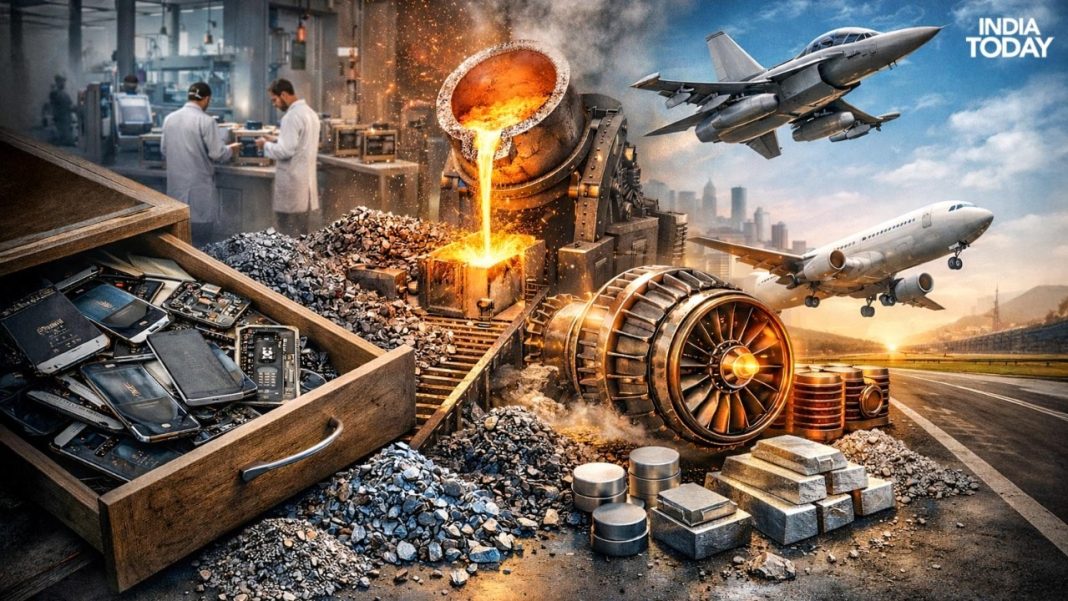
The strategic future of Indian aviation and defence is currently gathering dust in your bedside drawer.
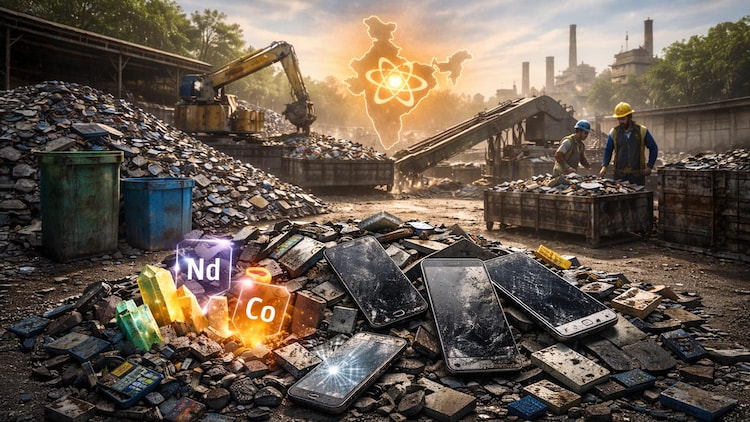
While the nation scans the distant horizon for critical mineral security, a silent, high-concentration mine exists right under our noses, tucked within the millions of discarded smartphones across the country.
But as the push for atomic sovereignty, which is the ability of a nation to control its own strategic-grade materials at the atomic level, intensifies, a sobering reality emerges: India is a nation with the world’s finest ingredients, yet it lacks the domestic kitchen to cook them.
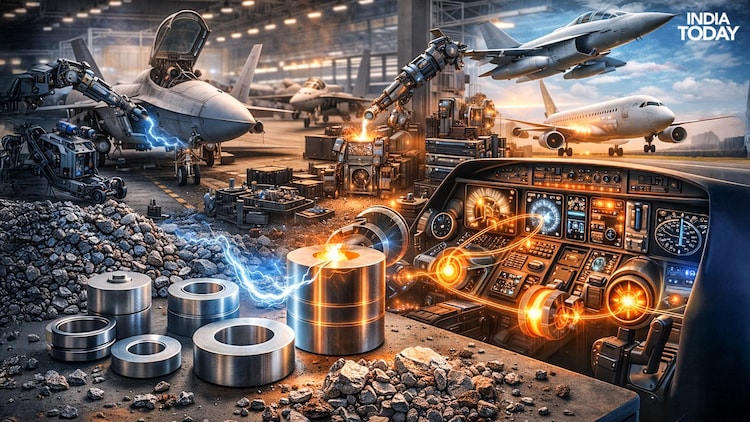
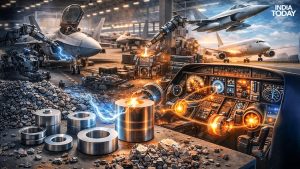
This is the alchemy of the modern age, where the atoms of a retired gadget have the potential to become the high-performance alloys of a fighter jet or the structural backbone of a commercial aeroplane.
It is a journey of extreme science, where microscopic impurities are the difference between a successful flight and a catastrophic failure.
Yet, between the junk drawer and the cockpit lies a massive industrial void that remains a far-fetched reality for the Indian supply chain.
IS YOUR SMARTPHONE A MINE OF URBAN GOLD?
To a scientist, a dead smartphone is not waste; it is a geological anomaly. Traditional mining involves crushing tonnes of rock to find a few grams of value, but e-waste provides a shortcut that is mathematically staggering.
“A typical cobalt mine yields just 1 to 2 kg of cobalt per ton of rock, while a ton of spent battery material can contain 50 to 80 kg of cobalt, making it roughly 40 times more concentrated,” Syed Gazanfar Abbas Safvi, Head of Recycling at Greater Noida-based Lohum, a lithium-ion battery manufacturer and recycler, told indiatoday.in.
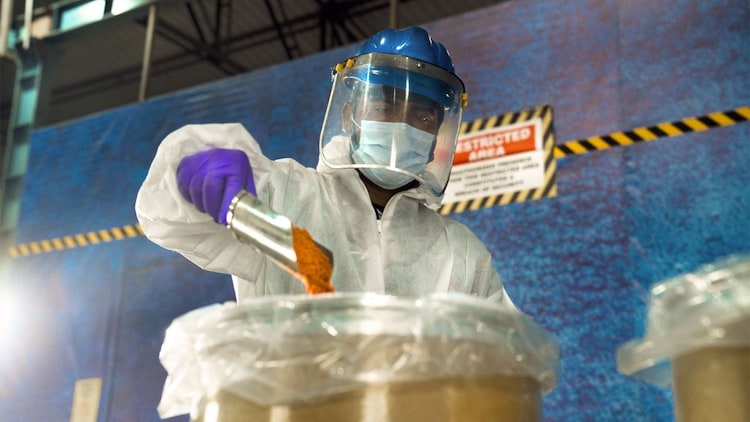
These devices are dense, human-made ore deposits that the planet already spent enormous energy extracting once.
Nitin Gupta, CEO and Co-founder of Noida-based Attero, an e-waste management and lithium-ion battery recycling firm, told indiatoday.in that almost all secondary sources are concentrated man-made minerals which have not been the focus in India yet.
CAN YOU MAKE AEROPLANES FROM OLD PHONES?
The process of reclaiming these minerals is less like traditional smelting, which is the technique of heating raw ores at very high temperatures and treating them with chemicals to extract pure metals, and more like high-stakes chemistry.
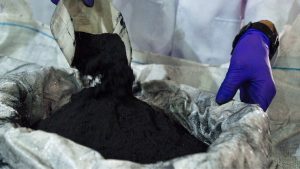
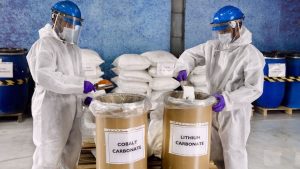
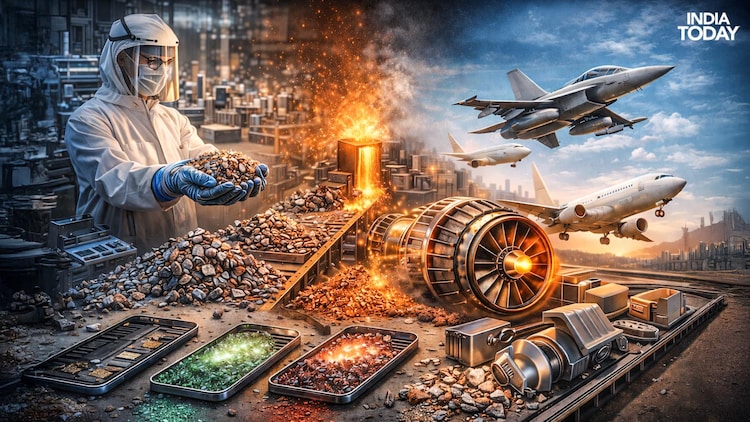
It begins with black mass, a gritty, dark powder that contains the irreplaceable elements of modern aviation: lithium, cobalt, and nickel.
These are the same materials used to create the lightweight, high-strength frames of aeroplanes and the heat-resistant parts of their engines.
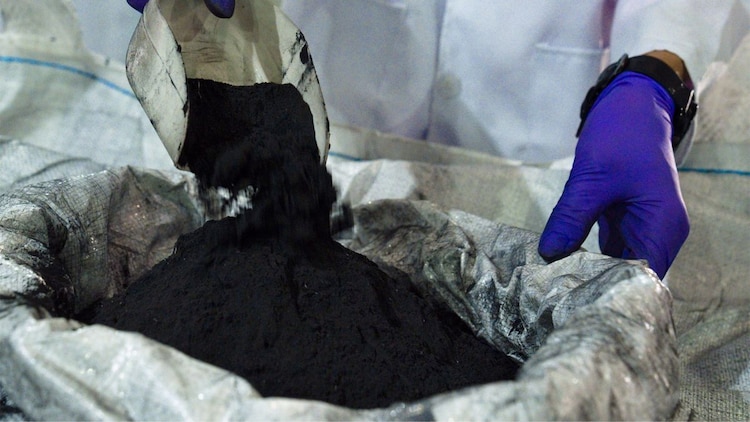
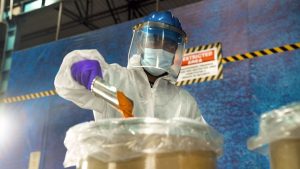
“We dissolve the black mass in carefully formulated acid solutions. It is like a chemical surgery where we pull out each metal individually,” Safvi explained.
While some firms utilise this acid bath, others are looking for cleaner shortcuts.
Manikumar Uppala, Co-Founder and Chief of Industrial Engineering at Bengaluru-based Metastable Materials, a chemical-free lithium-ion battery recycling company, told indiatoday.in that they primarily use a thermal and reduction-based approach.
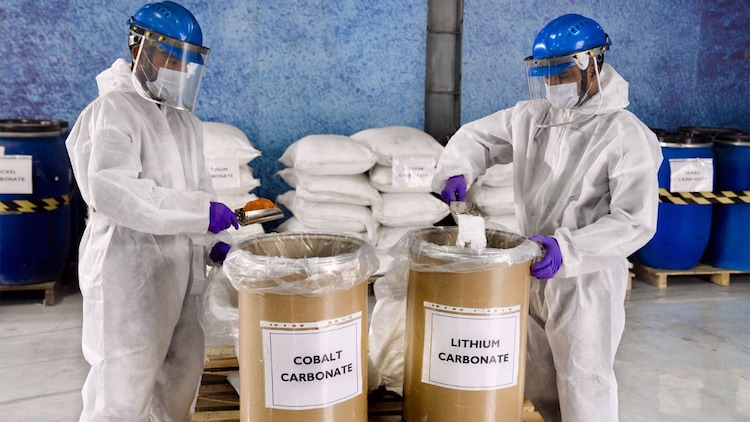
Instead of using acids to dissolve batteries, they use heat to trick atoms into separating through phase changes.
This chemical-free method allows them to recover minerals without the environmental burden of traditional acid-leaching processes.
WHY ARE RARE EARTH MAGNETS THE SILENT HEROES OF FLIGHT?
Rare earth magnets, such as those made of neodymium, are the invisible muscles of an aeroplane. They are essential because they provide immense magnetic strength with very little weight, a trade-off that is vital for anything that needs to stay in the air.
In a modern aeroplane or jet engine, these magnets power the sensors that monitor fuel flow, the actuators that move the wing flaps, and the high-speed generators that provide electricity to the cockpit.

Without these magnets, the complex flight control systems that keep a plane stable would be too heavy and bulky to operate efficiently. They are the reason a pilot can adjust the plane’s trajectory with a simple flick of a joystick.
HOW PURE SHOULD METALS USED IN AEROSPACE BE?
The industry standard for recycled metal is 99.9 per cent purity, but in the world of aerospace, that final 0.1 per cent is where the danger hides.
“In aerospace and defence-grade use, that last 0.1 per cent isn’t small; it can be thousands of tiny contaminants that behave unpredictably under heat, vibration, and repeated stress,” Gupta told indiatoday.in.
Safvi provided a human perspective on this microscopic hunt: “Imagine filling 20 Olympic-size swimming pools with pure water and then dropping in a single teaspoon of ink. Our machine can detect that one teaspoon.”
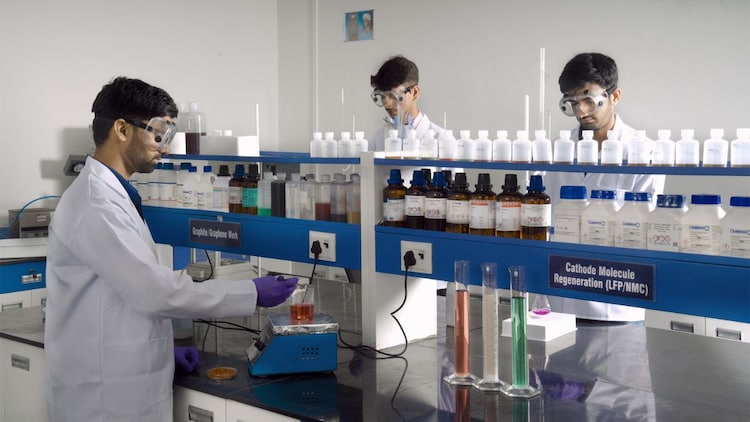
If cobalt used in a jet turbine or an aeroplane’s landing gear is dirty, foreign atoms disrupt the crystal lattice of the metal, creating microscopic weak points.
Gaurav Dolwani, CEO of Mumbai-based Lico, a clean-tech startup specialising in lithium-ion battery recycling, told indiatoday.in that this purity is vital because trace contaminants can become points of failure in high-stress environments.
HOW TO MAKE MAGNETS FOR FLIGHT SYSTEMS?
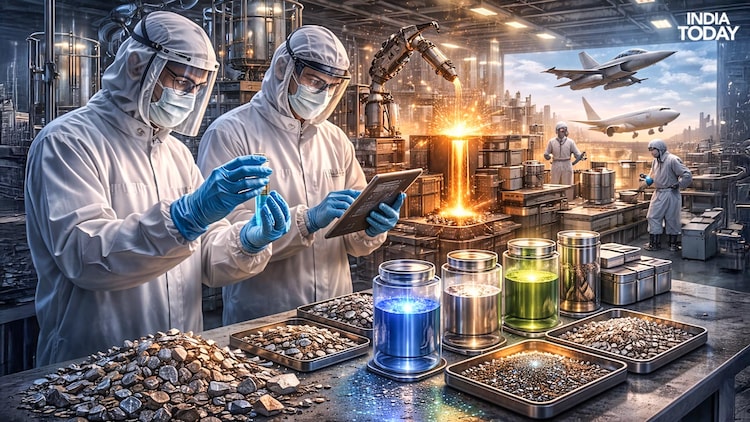
For the magnets used in flight systems, science enters the realm of fire-rebirth. Lohum uses specialised ovens to heat materials to 900 degrees Celsius to heal magnets from the inside, essentially attempting to restore their virgin strength.
“At 900 degrees Celsius, the neodymium-rich border turns into a liquid and flows into cracks, healing the magnet from the inside,” Safvi said.
However, the scientific community remains cautious about this 900-degree Celsius reset.
Rahul Singh, Business Head at Gurugram-based Exigo, an e-waste recycling plant, told indiatoday.in that 900 degrees Celsius is not about wiping the magnet’s memory; it is about full metallurgical reprocessing.
He warned that if the temperature is not controlled with absolute precision, the magnet oxidises into useless powder.
HOW TO CREATE A HEAT SHIELD FOR JET ENGINES?
Jet engines and aeroplane components operate in thermal hell. Standard magnets lose their power at a specific temperature known as the Curie point.
For neodymium, this is usually between 310 and 400 degrees Celsius.
To survive the heat generated by a jet engine, magnets need a secret ingredient: dysprosium.

“Dysprosium acts as an atomic heat shield, increasing coercivity, or the ability to resist damage, so the magnet resists losing its performance in high-temperature combat conditions,” Gupta explained.
This ensures that the sensors inside a hot engine do not fail mid-flight.
HOW DOES MASTERING THE ATOM SECURE NATIONAL DEFENCE?
The science of recovery is only half the battle. To truly move away from foreign dependence, India must master the entire material lifecycle.
Dr Sachchidanand Srivastava, Assistant Vice President and Head of R&D at Lohum, told indiatoday.in that reclaiming these metals is just the beginning of achieving true strategic autonomy.
“Mastering this entire chain is what turns a large economy into a genuine strategic power in defence, space, and clean energy,” Srivastava said.
He emphasised that for a country to be truly secure, it cannot rely on global supply chains that might be disrupted during geopolitical friction.
By refining materials to ultra-high purity levels domestically, India creates its own alternative supply pathways.
“We are building the capability to ensure that every critical atom recovered stays within our ecosystem to fuel our future,” Srivastava added.
WHERE IS THE MISSING LINK IN INDIA’S AVIATION SUPPLY CHAIN?
The most sobering reality is that India currently lacks the domestic kitchen to use the minerals it recovers. “Refining, recovery and purity at the level required by our defence is probably not achievable in India yet,” Dolwani noted.
The gap is in downstream consumption. India does not have commercial-scale cell manufacturing or rare earth magnet plants to turn these pure salts into aeroplane parts.
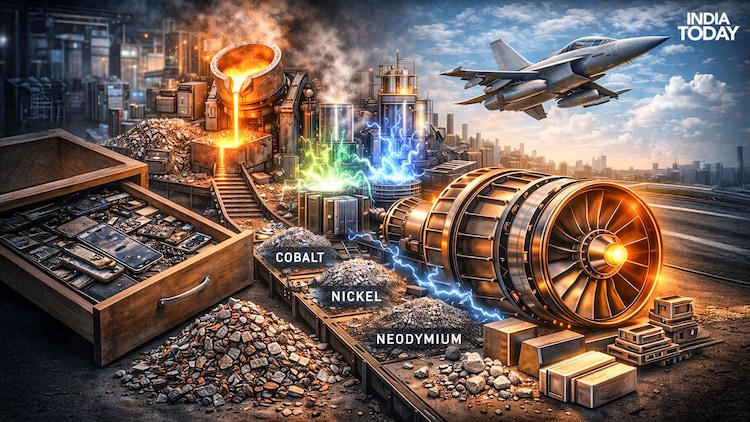
Consequently, the industry shreds batteries into black mass and exports 100 per cent of that material abroad. “China succeeded not because it recycled better, but because it closed the loop,” Singh explained.
WHY DOES INDIA STILL EXPORT ITS URBAN GOLD?
Because the middle steps are missing, the economic value is lost. Until India builds the gigafactories to absorb these purified atoms, our urban gold will continue to fly in foreign-made aeroplanes.
True atomic sovereignty is not just about having a 900-degree oven; it is about controlling the entire chain.
As Safvi concluded, “When India masters this full chain, it stops being a buyer in someone else’s supply chain and becomes a maker.”
For now, the minerals are here, and the science is proven, but the manufacturing bridge remains the missing link between your old phone and the future of Indian aviation.