
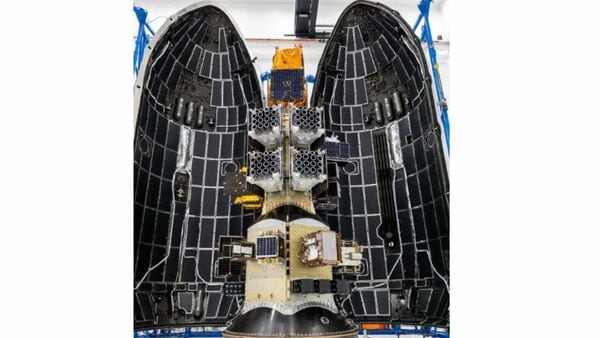
Prime Minister Narendra Modi hailed on Sunday the successful launch of the world’s first OptoSAR satellite as part of Mission Drishti. The mission launched on a SpaceX Falcon 9 rocket from Vandenberg, California, at 12:30 PM IST on May 3.
In a post on X, PM Modi said, “Mission Drishti by GalaxEye marks a major achievement in our space journey.”
“The successful launch of the world’s first OptoSAR satellite and the largest privately-built satellite in India is a testament to our youth’s passion for innovation and nation-building,” PM Modi’s post read.
The Prime Minister also congratulated and extended best wishes to the founders and the entire team of GalaxEye.
GalaxEye’s Synthetic Aperture Radar (SAR) was among the 24 payloads part of the ISRO’s PS4-Orbital Experiment Module (POEM-4), which was launched as part of the PSLV-C60/SpaDeX Mission in December 2024.
What is Mission Drishti?
Mission Drishti marks the debut of OptoSAR satellites in orbit. It’s GalaxEye’s first satellite mission.
The Bengaluru-based company says, “Mission Drishti is our first step toward a brand new way of seeing the Earth, where clear satellite imagery is reliable, ubiquitous and always actionable. A future where clarity is as accessible as connectivity.”
Suyash Singh, Founder & CEO, GalaxEye, said as per the official statement, “Mission Drishti marks our first mission and the culmination of over five years of sustained R&D to develop this breakthrough technology.”
Singh said, “With the satellite now successfully in orbit, our immediate focus is on completing its commissioning. As we move through this phase, we are already witnessing strong global interest in the differentiated datasets enabled by our OptoSAR payload.”
What is OptoSAR imaging satellite?
OptoSAR is an Earth Observation satellite, weighing approximately 190 kg. It’s India’s largest privately-built Earth Observation satellite, and the world’s first multi-sensor imaging satellite. This satellite uses “SyncFused sensor”.
What does it do? “Synthetic aperture radar gives us the ability to see through smoke, clouds and night-time, essentially helping us keep our promise of giving you all-time all-weather imaging, and its partner in prime is the multi-spectral payload built with glass, and it gives us clarity so that everyone can understand the image,” a co-founder of GalaxEye said.
What makes this satellite unique? The SyncFused sensor
The team took on the task of figuring out how to fuse two different kinds of payloads: an optical payload and a radar.
The question that arose was: “Can we fuse the best things of optical (intuitiveness) and the things of SAR, that is, availability…these two sensors come together and look at the same area is quite a task,” Suyash Singh, Co-founder and CEO, said in a video posted on YouTube.
The other challenge was to make sure that they are imaging at the same time as well. There was another step that ensured that the images are fused, said Kishan Thakkar, co-founder and VP-Engineering
“And do that we have to synchronise these two sensors at an electronic level and software level, because of this, I believe that it has not been attempted before,” said Denil Chwada, co-founder and CTO.
What is SyncFusion? The co-founder said this platform will bring time synchronisation and perspective synchronisation. “And that is where this technology also got coined as a term called SyncFusion with SAR,” they said.
In a statement, GalaxEye said, “It is the first satellite globally to integrate Electro-Optical (EO) and Synthetic Aperture Radar (SAR) sensors into a single operational platform, enabling all-weather, day-and-night imaging capabilities.”
“This integrated approach addresses long-standing limitations of conventional systems and enables more reliable and consistent data acquisition across diverse environmental conditions,” GalaxEye said.
“We are also one of the rare companies that will have the capabilities of doing edge computing on our satellite,” said Pranit Mehta, Co-founder and VP-Business Development.
When GalaxEye went to space first time
SAR Imaging Demonstration Payload (GLX-SQ), developed by GalaxEye Space Solutions Private Limited, was first sent to space as part of POEM-4 on December 30, 2024.
It demonstrated the generation, capture, and processing of Synthetic Aperture Radar (SAR) images in a space environment.
The payload aimed to complete image processing and compression in under 10 minutes, reducing 400 MB of raw data to less than 1.5 MB.
“By showcasing the effective combination of hardware and software components, this technology demonstration mission lays the groundwork for future SAR + EO missions, advancing the field of remote sensing with innovations,” ISRO said in a statement in December 2024.


