
I don’t think I’ll ever forget my sense of shock when I heard Andrew Mountbatten-Windsor has been arrested. I belong to a generation that used to refer to him as Prince Andrew. He was said to be the late Queen’s favourite child. More importantly, he’s the younger brother of the reigning monarch. And at the time of the Falkland’s War, he was a national hero. As Mark Antony said in a different context, “O, what a fall was there, my countrymen!”
Something similar would be unimaginable in India. We treat the privileged, the wealthy and the influential as special people. The laws and rules that apply to ordinary mortals often circumvent their lives. The police protect them – often from the rest of us – and rarely, if ever, arrest them.
Think of the rich kids in expensive cars, often driving without a licence and usually below the age limit, who have run over innocent people and how slow the police are to respond with effective action. It would be very different if the driver was just aam aadmi. Think of the communal slurs pronounced by senior politicians who are never held to account by their party leadership or the media. It would be very different if the offender was you and I.
No doubt this is why the news of Mountbatten-Windsor’s arrest was such a shock.
What was equally surprising was the response of King Charles. In a statement issued by Buckingham Palace not only did he say “the law must take its course” but, pointedly, that the process must be “full, fair and proper”, the investigation must happen “in the appropriate manner”, and, finally, it will have his “full and whole-hearted support and co-operation”.
Do you need me to point out that’s not how rich and powerful families would respond in India? We’re more likely to pay the police to hush it up. Or contact someone important to protect our erring child. Or even suggest the family driver was behind the wheel, and not the faulty son.
Our courts frequently proclaim “be you ever so high, the law is above you”, but is that really true in India? The powerful amongst us strive to ensure it’s not. But on Thursday, February 19, it was true of Britain. That’s why I admire the way they’ve handled this sad and sorry saga.
However, the truth is I don’t think the British expected this. They’re a country of privilege, with different standards for the high-born. People like Andrew don’t get arrested and, certainly, don’t end up in jail.
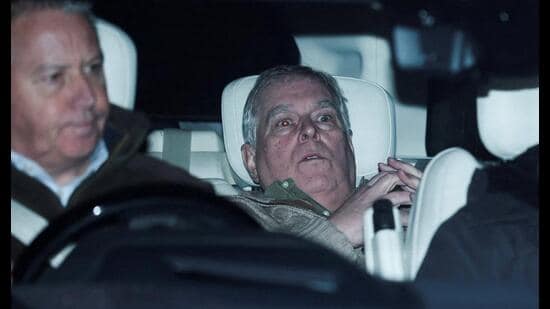
I dare say Andrew himself could never have believed this is what he would face. The photograph of him slumped at the back of a police car, shaken and shocked, reflects he can hardly believe what’s happened.
The response of the British media suggests a similar stupefaction. “Andrew Arrested” was plastered across the front page of The Daily Telegraph. “The Arrest of Andrew” was the headline in The Times. “The Prince and the Paedophile: A long, slow fall from grace” was the banner across pages two and three. Even the staid and stoic Financial Times carried the story on its front page.
Of course, we don’t know how this will end. Will he be charged? Could conviction follow? If he’s found guilty, what sort of sentence will he get? But the fact that these are credible questions is proof of how much changed that Friday morning, when the eighth in line to the British throne was summarily arrested, without warning and without any hint it was likely. Even the King had no foreknowledge.
The last time anything similar happened was in 1647 when Charles I was arrested. That was nearly four centuries ago.
Since then the British have placed their royal family on a pedestal and got used to looking up at them. Now to place the King’s brother on the floor of a prison cell is remarkable.
If the handling of the Andrew Mountbatten-Windsor case gives them a sense of pride, it’s well-deserved.
Karan Thapar is the author of Devil’s Advocate: The Untold Story. The views expressed are personal


