23 lakh students appeared for the IIT JEE last year, competing for 18,191 seats in the IITs. The largeness reflects the effort invested by students across the country. The pressure is not cramped to engineering. In NEET, the entry point to medical education, lakhs of candidates line up each year for a limited number of seats in AIIMS and other leading institutes.
The pipeline seems narrow; the demand is not.
Taken together, India’s top institutions offer close to 60,000 seats, covering IITs, IIMs, and NITs. These institutes account for roughly 2.6% of the student base each year, yet draw more than 50% of the total public funding allocated to higher education, as per Ministry of Education data. The system, by design or default, appears to privilege a small segment.
While over 650 universities, serving close to 97% of students, operate with less than half of the resources.
India’s higher education landscape is wider. The country has 1,338 universities and over 50,000 colleges, according to AISHE. Around 650 are publicly funded. Total enrolment stands at 4.46 crore, with 3.2 crore students in state public universities. This is where the bulk of the system operates, often with tighter budgets.
In contrast, about 10 lakh students study in IITs, IIMs, and NITs combined. These 75-odd institutions receive more than Rs 18,000 crore from the total higher education outlay in the 2026-27 budget.
For many public institutions, limited funding translates into gaps in infrastructure, faculty, and research.
Private institutions, in turn, depend on internal revenue, pushing costs onto students. The result is a fee spectrum that varies widely, often along the same lines as institutional hierarchy.
What is the bigger question now: 50% funds for 3%, or the negligence of 97% of students?
EDUCATION BUDGET HAS CROSSED 1.4 LAKH CRORE
India has raised its education budget for the current fiscal year, taking the total allocation to 1.4 lakh crore. The trajectory has been upward in recent years, with an 8.27% increase over the previous year.
Of this, the higher education department has been allocated 55,727.22 crore, as outlined in the Union Budget.
A sum of 8,292.40 crore has been earmarked for central sector schemes. Student financial aid stands at 2,160 crore, while Digital India e-learning initiatives have been allocated 670 crore.

The allocation for research and innovation is 418 crore, a figure that raises questions when placed against the scale of ambition often articulated. Central sector expenditure, including UGC funding, stands at 3,939 crore.
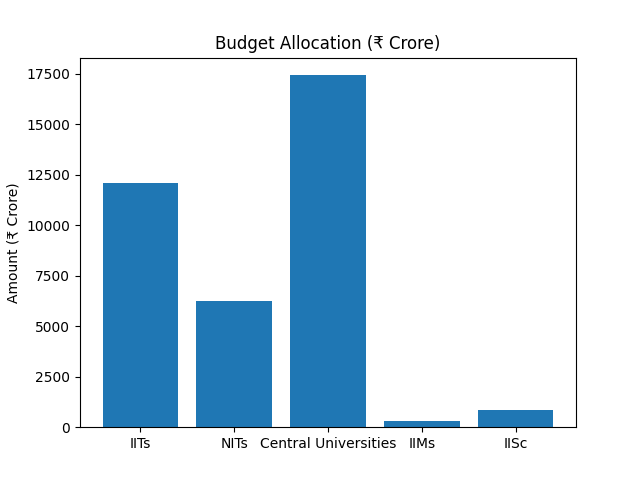
Central universities have been allocated 17,440.58 crore. There are 57 such universities, serving around 2.9 lakh students, according to the AISHE 2021–22 report.
The allocation for IITs stands at 12,123 crore for the 2026–27 fiscal year, while IIMs have received 292 crore. IISc Bangalore, with a consistent research output, has been allocated 845 crore, reflecting a decline over recent years. The 31 NITs together have been allocated 6,260 crore.
Funding for IISERs has been reduced to 1,319 crore, following allocations of 1,459 crore, 1,353 crore, and 1,357 crore in the preceding years. The pattern suggests a recalibration, though not necessarily an expansion.
“At the system level, India’s gross expenditure on R&D (GERD) has remained around 0.6–0.7% of GDP in recent years, specifically 0.66%, 0.66%, and 0.64% in 2018–19, 2019–20, and 2020–21 respectively. While this is below some global innovation-led economies such as the US, China, and South Korea, it also reflects the headroom and opportunity India has as it continues to scale its research ambitions,” said Dr. Pushpendra Singh, Project Director, ANNAM.AI at IIT Ropar.
He pointed out that higher allocations to IITs, in isolation, will not place India at the front of the AI and emerging technology race. Funding, in this case, is necessary but not sufficient. Competing globally requires a system, not just a set of institutions.
According to Singh, that system rests on four elements:
- Scale of investment
- Institutional structures
- Collaboration density
- Talent development and retention
On the question of funding beyond government support, he noted that there is both scope and urgency for institutions to diversify.
Industry partnerships, private capital, and international collaborations are no longer optional, they are structural requirements.
Government initiatives such as the NIPUN Bharat Mission, PM SHRI scheme, National Curriculum Framework, and National Credit Framework, along with funding reforms introduced in 2017, point to attempts at system-level intervention. Whether these translate into measurable outcomes remains to be seen.
THE EXPANSION OF THE EDUCATION ECOSYSTEM IN INDIA
While seats at IITs remain limited, the same holds true for IIMs and NITs. This scarcity exists alongside an expanding higher education system.
India now has over 70,000 higher education institutions across the country. Yet, the Gross Enrolment Ratio (GER) stands just above 31%, indicating that expansion in numbers has not fully translated into access.
This network includes universities, colleges, standalone institutions, PM Vidyalaxmi-linked initiatives, and research centres. Growth has been steady since 2014, but scale alone does not define capacity.
India’s presence in QS rankings has improved, rising to 54 institutions from 13 in 2015. The numbers suggest progress, but also raise a question: is the expansion keeping pace with the demands of a population of 1.4 billion?
In the past decade, India has added seven new IITs. Third-generation IITs such as Jammu, Goa, Dharwad, Bhilai, Palakkad, and Tirupati have entered the system.
Capacity has increased, but distribution and depth remain uneven.
A senior former UGC official told India Today that the expansion is largely driven by private capital. “Along highways, you now see a college every 30–40 kilometres,” he said. The spread is visible; the outcomes are less certain. The concern is not about the number of institutions, but about what they deliver. Top institutions remain limited, as they were earlier, and continue to carry the weight of expectations.
Another official involved in education policy pointed to the strain on state universities. With limited state funding, many have shifted to self-financing models. The implication is clear: public education is expected to sustain itself in a system where financial support is uneven.
Data reinforces this structural gap. A report by Unstop indicates that nearly 85% of engineering graduates do not secure placements. Among those who do, compensation often falls below expectations.
The Economic Survey adds another dimension, noting that over 80% of employees are not working in roles aligned with their skills. The issue, therefore, is not just employability, but alignment.
The gap extends to workforce capability. Only about 56% of the Indian workforce is classified as skilled. The pipeline is expanding, but the system is yet to align output with demand.
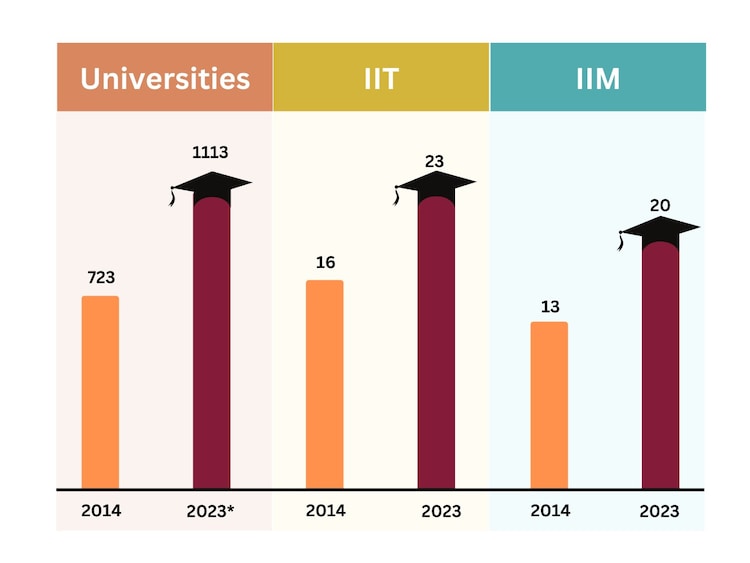
At the institutional level, growth has been significant. The number of universities has doubled in the past decade, reaching 1,409, according to AISHE data. IIMs and AIIMS have also expanded, increasing from 13 to 21 and from 7 to 20 respectively.
At the top end, institutions are stepping beyond national boundaries. IIT Madras (Zanzibar campus) and IIT Delhi (Abu Dhabi campus) have established international centres, signalling a move towards global positioning. The intent is clear. The question is whether the system beneath can support that ambition.
IITs, IIMs AND NITs ARE THE REAL WINNERS
The funding gap raises a key question. While prestigious institutions rely on central funding, many private and other institutions depend on their own resources, leading to higher fees.
This affects access for middle- and lower-income groups, which form a large part of the population.
18,675 crore has been allocated to IITs, IIMs, and NITs. These institutions serve less than 3% of students. The remaining 97% receive the other 50% of funds.
State-funded and private universities manage funds independently. State universities often face limitations as states prioritise primary and secondary education.
Alternative funding sources such as industry partnerships, philanthropy, endowments, international collaborations, and startup equity are suggested as possible solutions.
The question of equal funding is often raised. If funding were equalised, would institutions perform at the same level?
The existing infrastructure at the prestigious institutes is now ageing, says IIM Sambalpur Director Professor Mahadeo Jaiswal.
He adds: “There is a need to strengthen the existing infrastructure of IIMs to support teaching, research, and executive education. A better infrastructure helps more students to get into IIMs, learn from the top B-schools of the country and become better and more responsible leaders and contribute to the country’s growth”.
The government’s approach appears aligned with focusing funds on a limited number of institutions. This creates a hierarchy within higher education and shapes perceptions about quality.
Even within IITs, funding varies. RTI data shows IIT Bombay received 896.22 crore in 2023–24, compared to 747.57 crore for IIT Delhi and 838.97 crore for IIT Kharagpur.
New IITs receive significantly less, with some like IIT Goa and IIT Mandi receiving 61.01 crore and 101.40 crore respectively. This creates differences within the system.
Two IITs, Bombay and Delhi, have been included in the Institutes of Eminence list, making them eligible for additional funding aimed at improving their global standing. This focus on select institutions has been part of policy direction for several years.
Earlier initiatives such as “Project Vishwajeet” were also designed to channel higher funding towards IITs with the aim of building globally competitive institutions.
At the same time, IIMs continue to receive policy support, particularly due to their operational autonomy in areas such as fee setting, faculty hiring, and institutional management.
However, the larger issue extends beyond selective funding. The focus needs to shift towards improving the overall standard of higher education across the system. With a large young population, the priority is to convert this demographic base into productive capacity through sustained investment in education.
The concern, therefore, is not limited to how funds are distributed among institutions, but to the overall level of public spending on education, which remains low as a percentage of GDP.
Strengthening the system will require increasing this broader investment rather than redistributing limited resources.