
A few years ago, I was attending a wedding in the family — a congregation of old relatives distributed across geographies, who attend such events out of reciprocity. “They came for our son’s wedding too, we’ll have to visit,” is the usual tenet put forth by parents. The multi-billion-dollar wedding industry survives due to this quid pro quo.
This bunch of relatives only meets at property-dispute court hearings, family weddings and funerals. There is always some attrition between two events. Covid led to a reduced headcount, but the ones who survived it, brought forth their renewed North Indian nosiness to this wedding.
One uncle asked a young looking guy point blank, “Beta, what’s your in-hand salary? Haath me kitna aata hai?”
“I am in college, actually,” the boy replied.
“Oh badhiya! Which college?” asked the uncle without missing a beat.
And thus begins the ritual humiliation, especially if the kid is attending some obscure private engineering college. The uncle claims complete ignorance of the existence of the institution, and extends some unsolicited sympathy for not cracking an entrance exam.
The age-old desire of students is to study at a place known to their relatives. Now, this was only possible earlier with top-tier government colleges and the IITs, NITs etc., which an average student usually does not qualify for. Or, a handful of private colleges such as BITS, where entry was similarly tough.
If the uncle’s offspring is attending one of these places, his natural course of action is to subtly shame you — especially when your parents are around. This is especially done by the parents whose kids are studying at an IIT. It’s a great baton to wield.
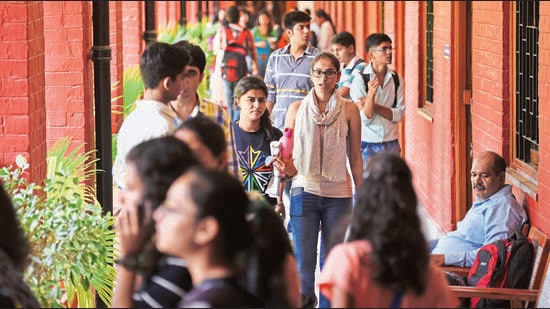
That’s where the new crop of private colleges such as Galgotiya, Sharda University, Lovely Professional University, etc, come in — they serve a specific need-gap. They solve the obscurity problem. They build great physical infrastructure, lavish buildings, state-of-the-art sports facilities, air-conditioned classrooms and hostels, among other things. Once constructed, they spend a lot of money on marketing to showcase the same. They are present at every touchpoint — TV, print, radio, social media, and outdoor hoardings. By the end of their marketing blitz, they have created a brand. Once the flywheel starts, reels of their annual cultural fest start doing rounds of the internet. If, by any chance, one of their students cracks a Big-Tech job, his face will be plastered across the city with the cost-to-company pay printed in the biggest font-size possible, given the space. These universities keep doing it, year after academic year. All of it attracts more and more students, who coax their parents to sell their ancestral land to pay tuition fees so that the kid can one day feed stray robo-dogs on campus.
Isn’t it a great business model? Students who couldn’t clear the tough entrance exams of the marquee colleges, can now study at a “well-known college”, paying chunky fees for it. Now, they can avoid the humiliation at weddings. Everybody has heard the name of their college.That’s enough. You can judge someone’s career choices, but only behind closed doors.
Remember IIPM? They churned out so many professionals who are gainfully employed and running multi-million dollar P&Ls now. All eight Ivy League universities in the US are private. By the law of averages, 10% of any class would be ambitious and hard working, and will eventually do well in life, college notwithstanding. So good students from the same university will eventually do well and feature in the prospectus — to attract the other 90%.
The issue arises when you over-market. And the carefully constructed brand image in the eyes of Tier 2 India comes crashing down because a communications professor miscommunicated. This is what happens when you bring a Chinese robo-dog to a global AI summit, and pretend it’s not Chinese. Thankfully, the dog wasn’t expected to bark in Mandarin — else, the facade would have come down on Day 1. Meanwhile, when the establishment that is so particular about India’s image abroad, and is especially careful about hosting events with the right PR, saw jokes being cracked at its expense by foreigners, it naturally came down heavily on the university.
The institute instantly became a meme. News channels picked it up. Nobody questioned why we just spend 0.7% of our GDP on R&D. Everybody was happy we found the real culprit — a robo-dog buying university. Problem solved. And the student who spent lakhs to be able to stand his ground against a judgmental relative at a family wedding got shamed again.
Abhishek Asthana is a tech and media entrepreneur, and tweets as @gabbbarsingh. The views expressed are personal


