
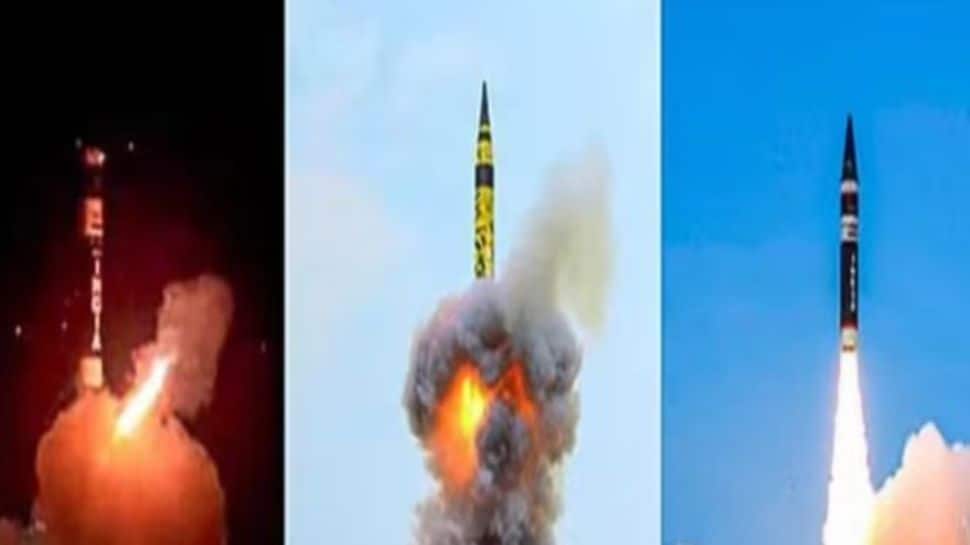
New Delhi: India today is one of the few countries with its own ballistic missile programme that stretches across short, medium and long ranges, including those launched from submarines. This range of missile technology has become an important part of India’s defence and security plan.
It all began decades ago when India chose to build its own guided missile expertise. The Defence Research and Development Organisation led this effort under a government programme set up in the 1980s. The aim was to end dependence on outside sources for advanced weapons and ensure India could respond credibly to regional security challenges.
India’s defence and security approach includes a policy that puts retaliation at its core rather than first use of nuclear weapons. In this approach, ballistic missiles are meant to ensure retaliation can be delivered reliably if deterrence fails. Because of this, emphasis has been placed on making missiles that are not just powerful but also fast to react, able to survive hostile conditions and dependable under pressure.
At the tactical level India deploys missiles like the Prithvi series and the newer Pralay weapon. The Prithvi family was the first to enter service in the mid‑1990s and includes several versions with ranges up to 600 kilometres and warheads weighing up to a tonne. These were among India’s earliest steps into missile capability with solid and liquid fuel designs.
The Pralay missile, whose production began in 2022, is the most advanced tactical ballistic missile in India’s inventory. It flies at speeds above six times the speed of sound, uses solid fuel for quicker readiness and carries warheads designed for different situations.
Indian officials say its ability to change course at the end of its flight makes it very difficult for defences to intercept.
Farther out on the map of India’s missile architecture lies the Agni family, which forms the backbone of the country’s strategic deterrence. Its range includes short-range missiles as well as long-range systems that can reach targets thousands of kilometres away.
Early versions such as Agni I and Agni II entered service in the late 20th century with solid fuel, mobile launchers and payload options that include conventional and nuclear types. Agni P is a more agile version designed for extended reach and precision. It can deliver multiple independently targetable payloads and uses advanced guidance systems for accuracy.
Agni III can travel even farther, carrying a heavy warhead over thousands of kilometres, guided by satellites and onboard navigation for accuracy. Agni IV adds even longer reach, and Agni V stands as India’s most potent member of the family – with ranges that stretch into intercontinental territory, according to some assessments.
This level of capability places India in a league with other major powers capable of deep‑strike deterrence.
Beyond land‑based missiles, India has built a third leg of strategic strength beneath the waves. Launched from submarines, the K‑4 missile brings India the ability to hold distant targets at risk from the sea. It travels thousands of kilometres, carries a large payload and uses a mix of guidance technologies to stay on course.
Submarine‑based systems are valued for their stealth and survivability that make them an important part of sustained deterrence.
India’s multi-layered ballistic missile programme shows decades of effort, experimentation and refinement.
From early tactical designs to long‑range strategic weapons and missile systems hidden aboard submarines, India has built an arsenal meant to reinforce deterrence and protect its interests far from home. Each system described adds capability not just to India’s military but to its overall position as a country confident in its defence technology and strategic posture.


