
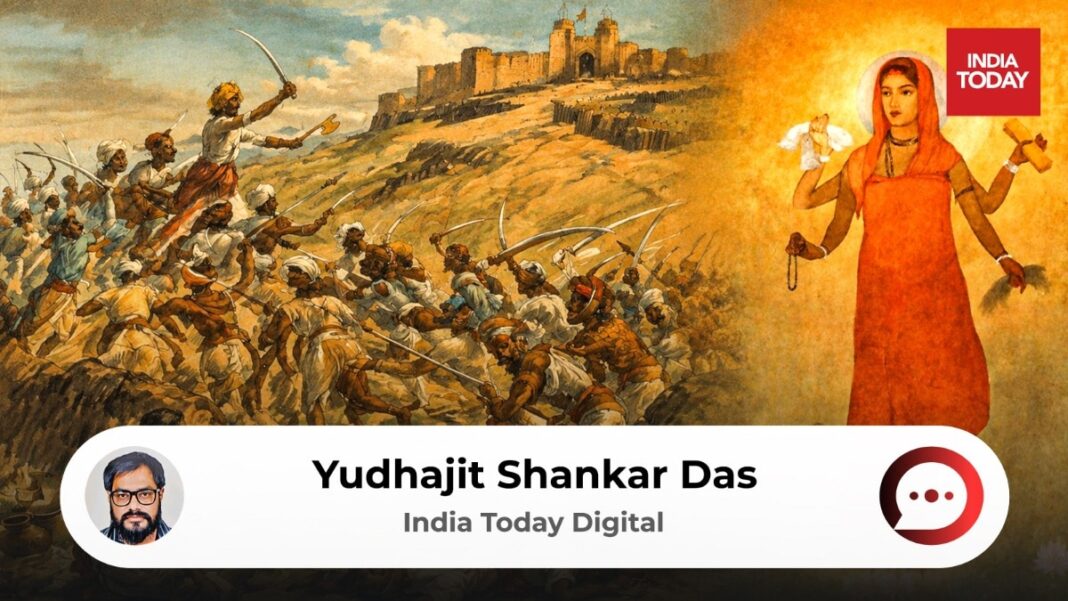
Memetic memory is crucial for any community’s sense of identity and survival. When written records are tweaked and physical evidence is wiped off, it is this collective memory that reminds people of who they were and what’s become of them. In West Bengal, that memory seems to have gone missing. From the tailored education and decades-long faux narrative to a clerical mindset, there could be multiple reasons for that.
As the results of the West Bengal Assembly election were declared on May 4, I saw a younger colleague from Kolkata’s Bhabanipur with a sullen face. “It is not about Mamata Banerjee or Trinamool Congress losing, it is about a non-Bengal party coming to power in West Bengal,” she said.
I had to explain to her why Bengal, of all places in India, is the spiritual cradle of the Rashtriya Swayamsevak Sangh (RSS) and the BJP. People of no other state should have organically claimed the BJP more than those from West Bengal. That’s because undivided Bengal has been the Gangotri of nationalism and early Hindutva, the two pillars on which the BJP and the Sangh are based.
But then, the residents of West Bengal have little or no memetic memory, which is carried by the people from East Bengal (now Bangladesh) who are spread across Assam, Tripura, north Bengal among other places. The “kheda khawa” (chased away) people remember the Partition of 1905 and why they had to leave their ancestral homes, fertile lands and deities behind.
That’s why the Hindu Bengalis with roots in Bangladesh have formed the backbone of the BJP in Assam. And that’s much before it started winning elections in a big way. The children of these people carry a sense of loss. There were no overcrowded trains like those seen from West Pakistan, nor the late-night announcements from mosques that are recounted by Kashmiri Pandits. The exodus was slow and silent. The pathos got embedded in pathology.
The Bengalis with roots in Bangladesh, commonly to as Bangals, unlike the Ghotis of West Bengal, found an ideological partner in the Bharatiya Jana Sangh and its successor, the BJP. The Bangals and the Ghotis have long engaged in culinary and culture battles.
While most people are now celebrating Syama Prasad Mookerjee, the co-founder of the Bharatiya Jana Sangh — the predecessor of the BJP — the memetic memory of the Udbastu (uprooted) Bangal takes them back to the 11th century when Bengal came under the occupation of Muhammad bin Bakhtiyar Khalji.
The slavery of over 1,000 years, but the continued fight for pride. From the Sanyasi Rebellion to the Anushilan Samiti; from the first drawing of Bharat Mata to the coining of the term Hindutva; from Vande Mataram to Swami Vivekananda; to the love for Swadesh in the science of Acharya Prafulla Chandra Ray, Bengal has been the cradle of nationalism in India.
For my dear distraught colleague and many others who think that the BJP is alien to Bengal, I would like to highlight the party’s ideological umbilical cord to the region. But there’s a health warning. I do not claim to be a historian and this is no exhaustive list. I apologise beforehand for the several important names that might not find a mention.
Bengal Presidency was the stage for the Sannyasi Rebellion against the British East India Company in the late 17th century. It was an armed struggle by Hindu ascetics over religious suppression and economic exploitation.
The fire that raged for decades was the theme of Bankim Chandra Chattopadhyay’s Anandamath (1882), a Hindu nationalist novel that first introduced Vande Mataram. Bengal’s Biplobis, who saw their fight as a sacred duty to the motherland, picked Vande Mataram as a chant.
The blend of Hindu spirituality with nationalist fervour is best reflected in the philosophies of Swami Vivekananda and Shri Aurobindo Ghosh.
Age-old Hindu spirituality and morality were the bedrock of Vivekananda’s nationalism. He received the “vision of one India” while meditating on the last bit of rock of Indian territory. His rousing speech at Chicago in 1893 in the Parliament of World Religions introduced India’s spirituality to the world and remains relevant to this day. It’s a must-read.
The BJP and the RSS’s students’ body, the ABVP, invoke Vivekananda as one of their icons. Left-leaning Bengalis have questioned that. But the key question they need to answer is did they ever celebrate Vivekananda the way the Sangh outfits have?
Aurobindo Ghosh, who imagined India as a Divine Mother, was a key organiser of the Anushilan Samiti, which prepared the youth for an armed struggle against the British.
The revolutionaries of Bengal have been at the forefront of the freedom struggle, sacrificing their lives with a smile on their lips. The same Bengalis from the tribe of Bagha Jatin, who killed a tiger with a dagger, Khudiram Bose and Netaji Subhas Chandra Bose, have now been branded “bhiru” (cowardly and effeminate). Why and how is a debate for another day? Did the education and politics of the last five decades in Bengal play a role? That will need to be scrutinised too.
Let’s talk about Bharat Mata, the leitmotif of today’s nationalism, venerated by the BJP. It was Abanindranath Tagore, a nephew of Rabindranath Tagore, who first painted the nation as a mother in saffron robes in 1905, the year of Bengal’s first Partition. The iconic watercolour painting made during the Swadeshi Movement was originally titled Banga Mata.
Many, like my dear colleague, wouldn’t know that the term Hindutva wasn’t coined by the RSS but by Bengali writer Chandranath Basu in his book Hindutva: Hindur Prakrita Itihas. Basu, a disciple of Bankim Chandra, fused Hindu with Tatva (the essence) to coin the term 33 years before the Sangh was even born.
Many, again, will argue that Basu’s idea of Hindutva as a civilisational concept was starkly different from the use of it in the politico-nationalistic context by Damodar Savarkar, who popularised the term. But Hindutva, in whatever way it is understood, is the edifice of the Parivar and the BJP.
It was this sense of nationalism and pride in Bengal that drove the Swadeshi Movement, the OG Make in India campaign for an atmanirbhar Bharat.
It saw eminent scientist Acharya Prafulla Chandra Ray establish the Bengal Chemicals & Pharmaceuticals in 1901 to manufacture high-quality drugs and chemicals with indigenous technology. The company still exists and got a licence to manufacture hydroxychloroquine during the Covid-19 pandemic.
As a young man, Keshav Baliram Hedgewar, the founder of the RSS, was closely involved with the relief work of the Vivekananda-founded Ramakrishna Mission, after the devastating floods in Burdwan in 1913. MS Golwalkar, the second Sarasanghachalak of the RSS, was a monk at the Ramakrishna Mission’s Saragachi ashram.
Bengal’s direct link to the BJP is Syama Prasad Mookerjee, a barrister, who founded the Bharatiya Jana Sangh in consultation with Golwalkar as the RSS needed a political outfit. The Jana Sangh, the BJP’s predecessor, made its electoral debut in 1952 and won three seats, with Mookerjee as one of the MPs. Atal Bihari Vajpayee, who became the first prime minister from the BJP, was a Jana Sangh member.
The BJP dedicated the removal of Article 370 to Mookerjee, who died in custody in Jammu and Kashmir while protesting the special provision in the Constitution for Jammu and Kashmir as “Balkanisation of India”.
“The soul of Syama Prasad Mookerjee must be at peace today,” said Prime Minister Narendra Modi in his speech on May 4 after the BJP’s landslide victory in West Bengal.
How much of Bengal’s spiritual nationalism is carried by the BJP today can be debated ad nauseam, but it has to be borne in mind that no other party has even attempted to claim these ideals and the space.
That BJP has received the popular mandate in Bengal shouldn’t be surprising. What should be surprising is that it took Bengalis such a long time to give the party a chance. I saw “Do not vote for BJP” Reels by Bengalis living abroad. While they emigrated abroad with plush jobs leading a cushy life, they want Bengal to remain underdeveloped and wallow in poverty.
They are blind to the demographic disaster in West Bengal due to the influx of illegal Bangladeshi immigrants, and the irreversible change that once forced out Hindus from East Bengal.
The BJP and the RSS should have found an organic ground in West Bengal. The erasure of memetic memory, especially because of the Bengali elite, could be among the reasons. Bengali lullabies still warn of the Borgee, but not the Jongi. It’s a suicidal unawareness that is being passed on to children in West Bengal.
Bengal is the land of Rabindranath Tagore and Kazi Nazrul Islam. It is a syncretic society that thrives on plurality. But to keep that culture alive, Hindu Bengalis will have to exist. And existence is only possible with situational awareness. And yes, the BJP isn’t alien to Bengal. If there is one place that the BJP can call its spiritual home, it is Bengal.


