
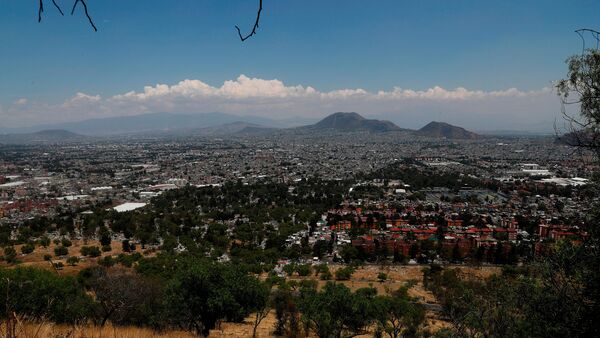
Mexico City, which is known as the fastest sinking metropolises in the world and home to nearly 22 million people, is sitting on an ancient lake bed and sinking by nearly 10 inches a year. The new satellite imagery released by NASA can now map the ground of the Mexico City and determine how fast the city is sinking.
The U.S.-India satellite NISAR shows where the land has subsided, leading to “fracturing roads, buildings, and water lines” over decades of changes and “extensive groundwater pumping, combined with the weight of urban development, has resulted in the compaction of the ancient lakebed beneath the city for more than a century.”
In Mexico City, many downtown streets were once canals, a tradition that continues in the rural fringes. But continuous development and groundwater pumping has resulted in the city sinking for more than a century, leaving many monuments visibly tilted to a side.
The aquifier has also contributed to a chronic water crisis that is only expected to worsen.
Enrique Cabral, a researcher studying geophysics at the National Autonomous University of Mexico told AP, “It damages part of the critical infrastructure of Mexico City, such as the subway, the drainage system, the water, the potable water system, housing and streets. It’s a very big problem.”
How can sinking be spotted from space?
Mexico City is sinking so fast that the subsidence can be spotted from space.
According to NASA, the new analysis, based on preliminary measurements taken by NISAR between October 2025 and January 2026, during Mexico City’s dry season show parts of the region subsiding by more than half an inch per month.
Nasa’s newly released report mentioned that in some parts, the average rate of the land subsiding is 0.78 inches, such as at the main airport and the iconic monument commonly known as the Angel of Independence.
Overall that means a yearly subsidence rate of about 9.5 inches. Over the course of less than a century, the drop has been more than 39 feet, according to Cabral.
“We have one of the fastest velocities of land subsidence in the whole world,” he said.
ABOUT NISAR
NISAR can track real-time changes on the Earth’s surface and is a joint initiative between NASA and the Indian Space Research Organisation. It was launched from Satish Dhawan Space Centre in Sriharikota, Andhra Pradesh.
The NISAR satellite is the first to carry two SAR instruments at different wavelengths and is monitoring Earth’s land and ice surfaces twice every 12 days, collecting data using the spacecraft’s giant drum-shaped reflector, which measures 39 feet (12 meters) wide — the largest radar antenna reflector NASA has ever sent into space, NASA said.
(With AP inputs)


