
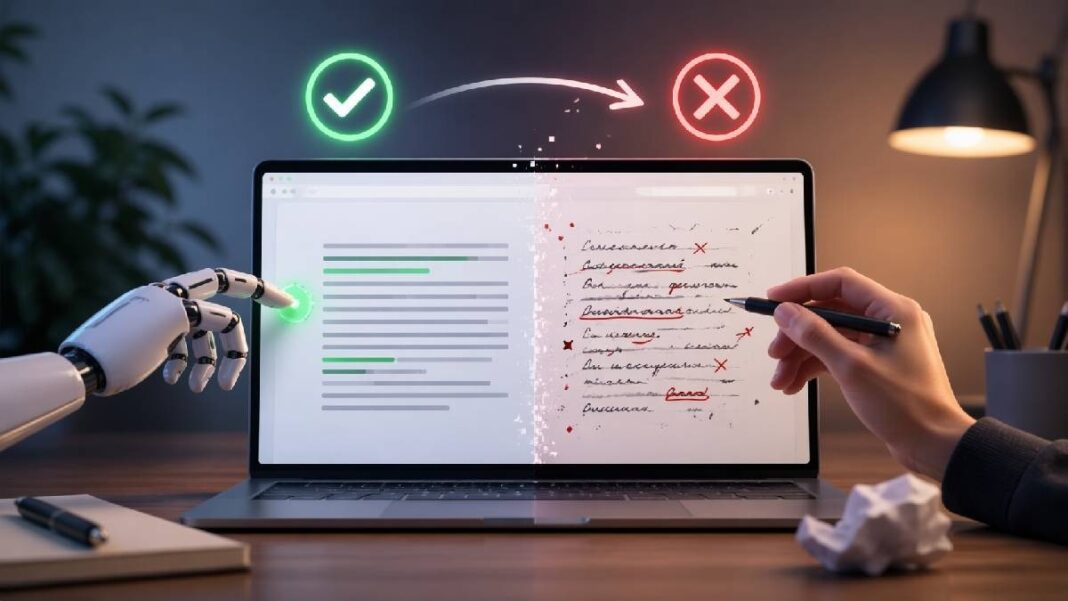
Ben Horwitz, who is about to graduate from Harvard Business School, has created an anti-Grammarly tool called Sinceerly that rewrites text to add mistakes. If you are wondering why he has created such a tool, the reason behind Horwitz’s new quest is the widespread use of artificial intelligence in writing emails, letters, and even personal messages. Earlier, people gave importance to perfectly framed sentences, good grammar, and spelling. If a piece of text had all these ingredients, it was considered perfect, and most writers focused on these aspects in their writing. Then came AI, which read every possible book on the internet to build its intelligence.
Now, when you ask an AI to write a text, it uses all the knowledge it has gained by reading billions of books and generates flawless text that does not have any grammatical or spelling mistakes and is also strong in framing fluent, meaningful sentences.
As AI became popular and reached the masses through tools like ChatGPT and Gemini, people started using it for writing everything from personal messages to official letters because AI is good at creating meaningful, fluent, and structured sentences—a skill that was earlier limited to experienced writers. But now this AI-generated flawless text is everywhere. And whenever people come across such text, their first guess is that it is generated by AI.
Writers raise concerns over mislabelling
While this may not have much impact on general users, content writers are flooding social media platforms such as LinkedIn with complaints that the writing skills they have built over the years are now being labelled as AI-generated.
AI detector tools are also adding to the problem, as they search for linguistic and structural patterns common in text generated by large language models. However, human-written texts can also exhibit these patterns, as AI itself has learned writing by analysing human-written books during training.
Deliberate mistakes to appear human
To bypass this problem, people have deliberately started making mistakes, writing poorly framed sentences so the text looks more like it is written by a human—and this is where Sinceerly comes into the picture.
How the tool works
Sinceerly is available as a Chrome plugin and offers three modes—”Subtle,” which streamlines the text by removing filler words and turning phrases into contractions when possible. Then there’s “Human,” which adds an even more conversational tone—both Subtle and Human typically introduce a typo in the first sentence. And finally, there’s “CEO,” which goes all lowercase and injects intense brevity. If there’s no signature in your email, it sometimes adds a “sent from my iPhone.”
It is not available for free. After a few free test runs, it asks you to pay $4.99 to continue using it.
Inspired by personal experience
AOL reported that Horwitz, who is about to graduate from Harvard Business School in May, created Sinceerly using Claude and was inspired by his own experience.
“I am a terrible typist, naturally, and lightly dyslexic,” he told AOL. “It would take me so long in my first job straight out of college to write emails and make sure there were no typos and everything. When Grammarly came around, it was like, ‘Oh, OK, this is pretty good for me.’ But now my email inbox is filled with AI slop.”


