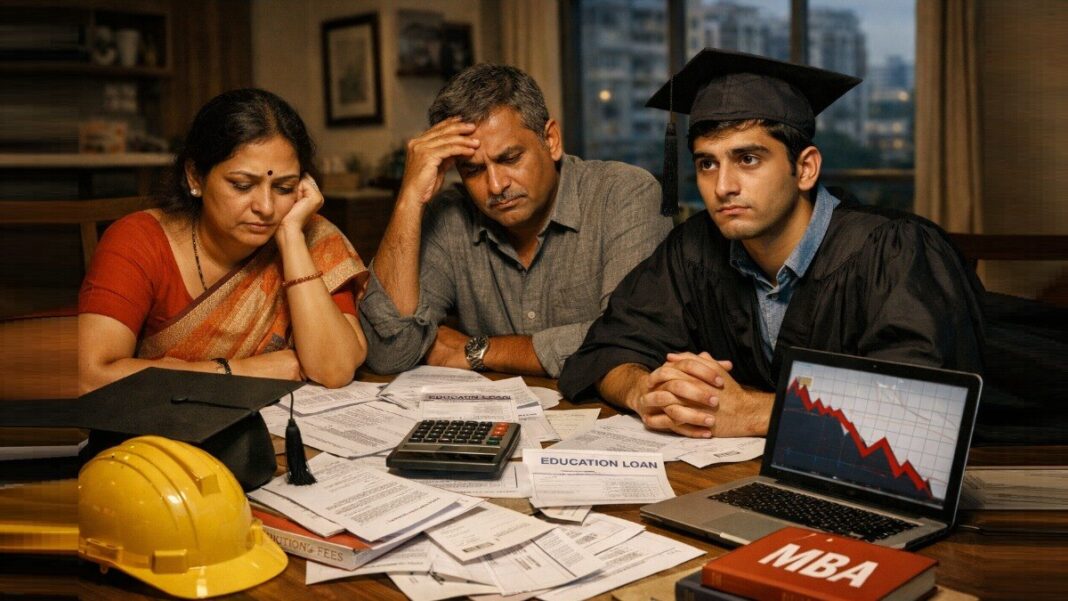
For generations, Indian families believed in a golden formula — study hard, get a respected degree, secure a good job, and life becomes more stable.
That belief shaped household budgets, career dreams and family sacrifices. Parents saved for years. Many took loans. Students moved cities, joined coaching centres, and spent some of their best years chasing engineering seats, MBA admissions or professional qualifications.
The promise seemed simple. There was no doubt that education would pay back.
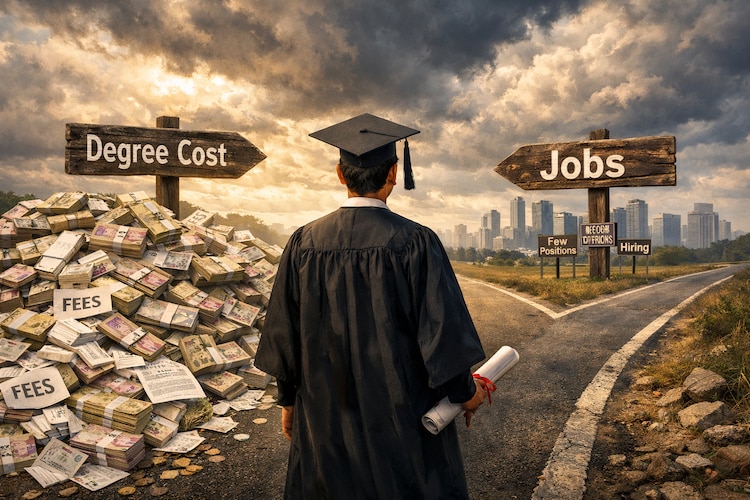
But a growing pile of numbers now suggests that for many students, the return on investment (ROI) is no longer automatic.
Fresh findings from 1 Finance’s Global Economic Outlook 2026 point to a deepening ROI crisis across some of India’s most sought-after degrees, including engineering, MBA and professional pathways. Costs are rising, placements are uneven, and starting salaries in many sectors are struggling to keep pace.
That does not mean degrees have become worthless. But it does mean that families now need to ask harder questions before spending lakhs.
THE Rs 34 LAKH ENGINEERING DREAM
Engineering remains one of India’s most popular career choices. It is still seen by many households as a safe route into the middle class.
But the economics are becoming harder to ignore.
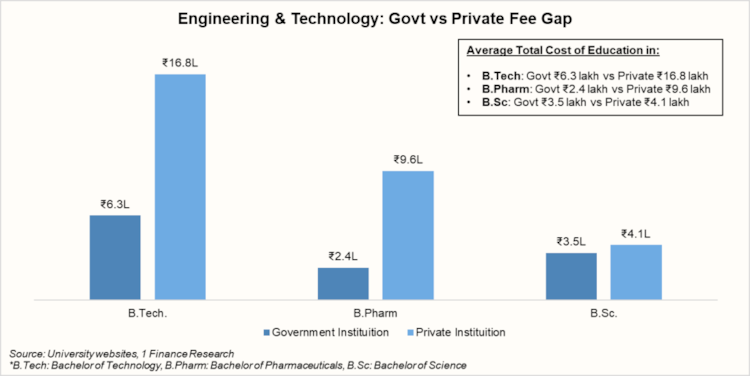
The report offers a realistic family example. Thirteen years of schooling at a mid-range Mumbai school can cost around Rs 17.3 lakh. Add a four-year BTech from a private college at roughly Rs 16.8 lakh, and total educational spending reaches Rs 34.1 lakh.
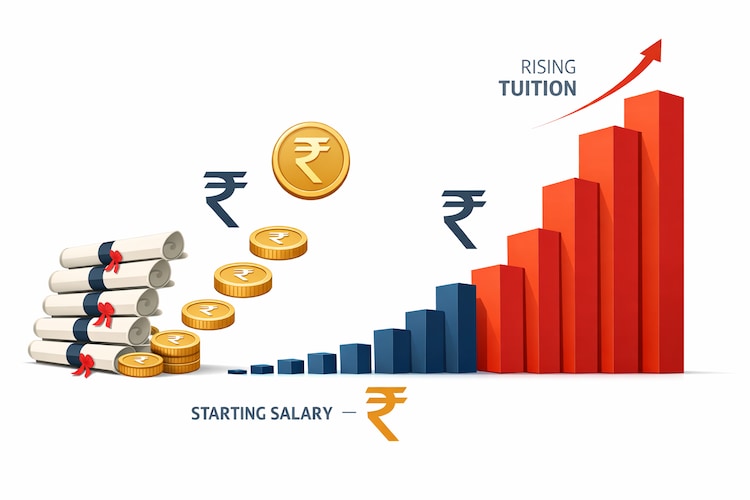
Now compare that with the average starting salary cited for a graduate entering software development: Rs 4.74 lakh per year.

Even assuming annual increments of 10 percent, which many would consider optimistic, the report says it may take more than two decades to break even after factoring in inflation and living costs.
That is the real shock.
Two decades — not to build wealth, or to buy a home, or to create returns.
It would take two decades just to recover the family’s education spending on one person pursuing engineering.
For households taking loans or stretching finances, that timeline matters enormously.
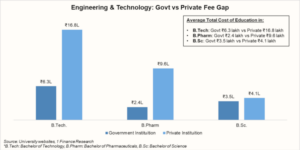
The report also shows how institution choice can sharply change returns. A four-year BTech from a government college averages around Rs 6.3 lakh, compared with nearly Rs 16.8 lakh at a private institution.
For many families, that fee gap alone can reshape the ROI equation.
ENGINEERING IS NOT ONE MARKET ANYMORE
Yet, the crisis is not equal across all graduates.
A major divide has opened inside the tech world itself. According to the report’s analysis of 950 job postings across Mumbai, Pune, Delhi-NCR, Hyderabad and Bengaluru, AI and machine learning roles are paying significantly more than many traditional IT roles.
As per Job Postings, 1 Finance Research, here is how yearly salaries compare between AI-related roles and traditional IT roles in India across various experience levels:
| Experience | AI-Related Roles (Salary Per Annum) | Traditional IT Roles (Salary Per Annum) | ||||||
| Average | Max | Min | Median | Average | Max | Min | Median | |
| 0-3 years | 6L | 23L | 2L | 5L | 5L | 18L | 2L | 5L |
| 3-5 years | 12L | 38L | 3L | 12L | 9L | 29L | 3L | 8L |
| 5-10 years | 22L | 65L | 5L | 20L | 17L | 75L | 1L | 15L |
| 10+ years | 36L | 70L | 13L | 35L | 26L | 58L | 9L | 23L |
At 0 to 3 years of experience, AI-linked jobs averaged around Rs 6 lakh, versus Rs 5 lakh for traditional IT roles.
By 3 to 5 years, the gap widened to Rs 12 lakh vs Rs 9 lakh.
At 5 to 10 years, it became Rs 22 lakh vs Rs 17 lakh.
At 10+ years, AI roles averaged Rs 36 lakh, compared with Rs 26 lakh for traditional IT roles.
The broad pattern is clear: AI and data-focused roles are paying roughly 20 to 40 percent more than many conventional IT tracks.
This means two students may both say they studied engineering, but their earnings path can be dramatically different depending on specialisation.
Today, the branch may matter as much as the degree.
THE MBA MARKET IS GETTING CROWDED
For years, an MBA was seen as a fast track to management jobs, prestige and salary jumps.
But the supply of MBA seats has exploded.
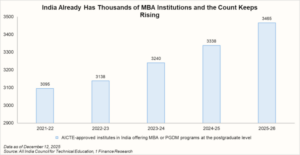
India now has more than 5,000 institutions offering MBA or PGDM programmes, including 21 IIMs. AICTE-approved MBA institutes reportedly rose from 3,095 in 2021-22 to 3,465 in 2025-26.
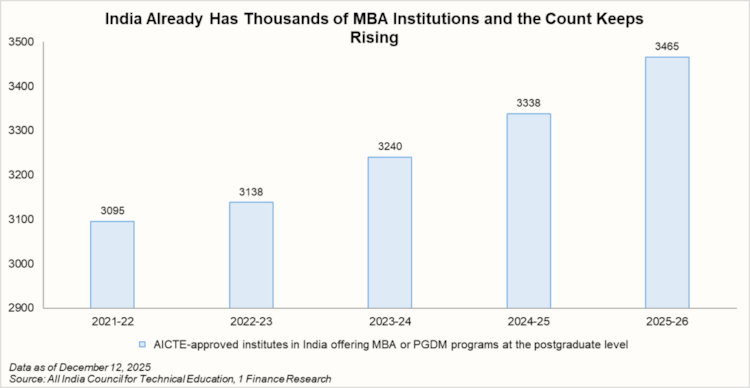
More seats mean more graduates.
Demand has also surged in recent years. MBA enrolments reportedly rose 25 percent between 2017-18 and 2021-22, adding to the growing pipeline of management graduates entering the market.
But quality corporate jobs have not grown at the same pace.
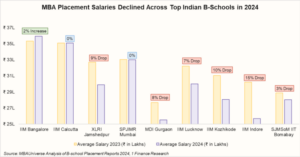
That mismatch is starting to show up in placement numbers. The report notes that placement salaries declined across several top B-schools in 2024. For example, IIM Indore’s average placement salary reportedly fell nearly 15 percent from 2023 levels, it cites.
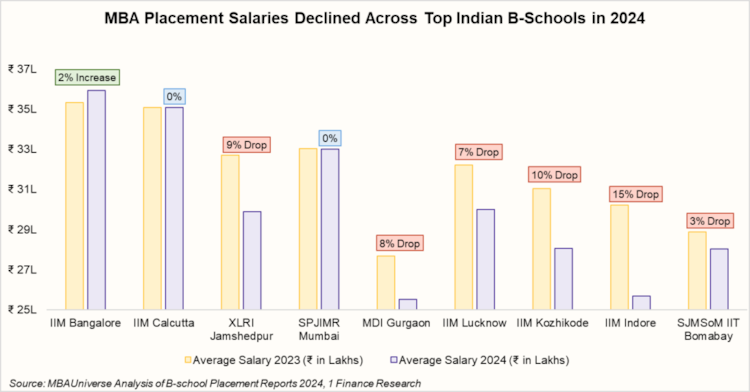
If pressure is visible on elite campuses, students lower down the rankings may face an even tougher reality.
This is especially serious because many MBA programmes cost Rs 15 lakh to Rs 25 lakh or more.
THE UNPLACED GRADUATE PROBLEM
Perhaps the most eye-catching data point in the report comes from the broader employability picture.
As per the Unstop Talent Report 2025, which surveyed over 30,000 respondents across engineering and management institutes:
- 46 percent of B-school graduates entered the market without a job or internship
- 83 percent of engineering graduates had no job or internship at graduation
That second number is hard to ignore.
The report also claimed that nearly one in four graduates from its selected top-tier B-schools remained unplaced.
This suggests the issue is not limited to weaker colleges. It reflects a wider disconnect between rising enrolments and actual market absorption.
EVEN CA ASPIRANTS FACE A LONGER ROAD
Professional qualifications still carry prestige, especially Chartered Accountancy.
But competition is intensifying here too.
The report says total CA exam appearances rose from 6 lakh in 2019 to 12 lakh in 2025, effectively doubling in six years.
That means more aspirants chasing limited high-quality opportunities.
For semi-qualified candidates or those in fallback roles such as account executive positions, starting pay often remains around Rs 3 lakh to Rs 5 lakh annually, according to the findings.
As per Job Postings, 1 Finance Research, here are the typical CA salary offerings in India across various experience levels:
| Experience | Account Executive (Salary Per Annum) | ||
| Average | Min | Median | |
| 0-3 years | 3L | 1L | 3L |
| 3-5 years | 4L | 2L | 4L |
| 5-10 years | 5L | 3L | 4L |
| 10+ years | 7L | 4L | 5L |
Many eventually do well. But the road may be narrower and slower than families assume.
WHY THIS IS HAPPENING
Three structural forces appear to be driving the shift.
Costs have risen faster than salaries: Tuition, coaching, rent, hostel fees, laptops and travel have all climbed. Entry-level salaries in many sectors have not kept up.
Too many graduates, too few quality jobs: India has expanded access to higher education rapidly. But strong jobs have not expanded proportionately.
Curriculum vs market gap: Many colleges still prepare students for yesterday’s job market. Employers increasingly want AI fluency, data skills, communication, problem-solving and practical experience.
SO, ARE DEGREES WORTH IT?
Yes, but not blindly.
A strong degree from a credible institution, at a sensible cost, with market-relevant skills can still transform lives.
But expensive degrees with weak placements, outdated teaching and no clear career edge can become poor financial bets.
The old question was: Which degree is prestigious?
The new question is: Which degree creates outcomes?
WHAT STUDENTS AND PARENTS SHOULD CHECK NOW
Before spending lakhs, treat education like a major investment.
- Look at median salaries, not just highest packages
- Check placement percentages, not brochure claims
- Study loan burden honestly
- See whether alumni outcomes are consistent
- Understand whether the field is growing or overcrowded
- Ask what actual skills you will graduate with.
And most importantly, compare the cost with realistic earnings, not dream scenarios.
WHERE THE DEGREE DEBATE STANDS NOW
Degrees are not dead. But guaranteed returns may be.
In India today, the certificate alone carries less power than it once did. Skills, specialisation, affordability and employability matter far more.
Families once bought certainty through education. Increasingly, they are buying possibility.
And in a country where lakhs are at stake, that difference can shape an entire decade of a young person’s life.