
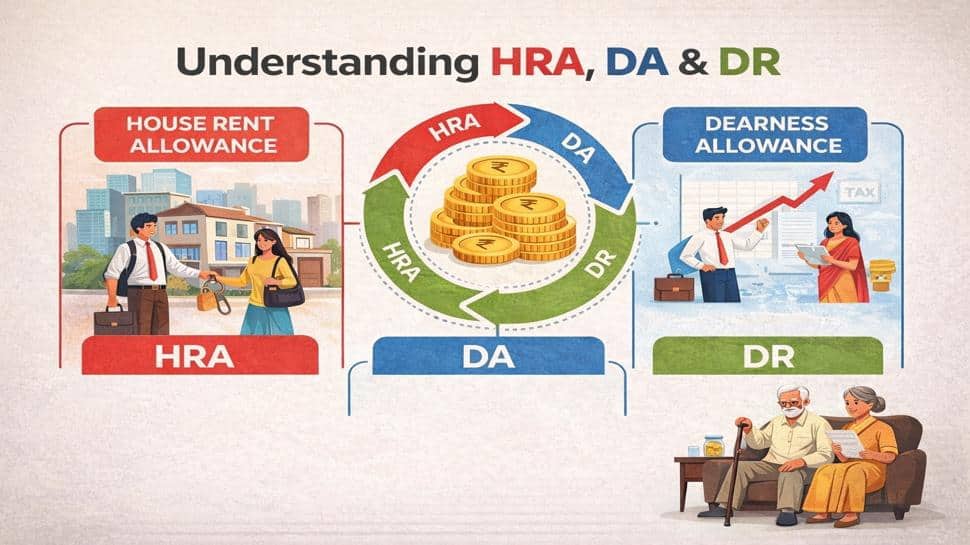
New Delhi: If you have ever looked carefully at your salary slip or a government employee’s pay structure, you have probably noticed several allowances listed below the basic pay figure. Three of them — House Rent Allowance, Dearness Allowance, and Dearness Relief — appear regularly and are often confused with each other. They sound related, and in some ways they are. But they serve entirely different purposes, are calculated differently, and apply to different groups of people. Here is a clear explanation of each one.
House Rent Allowance — the money meant for your home
House Rent Allowance, universally abbreviated as HRA, is a component of salary specifically designed to help employees cover the cost of renting a place to live. It acknowledges a basic reality: if you work in a city, you probably need to pay rent, and rent is expensive, especially in large urban centres.
The amount of HRA you receive depends on where you live. The government classifies Indian cities into tiers based on population. Employees living in metro cities like Mumbai, Delhi, Kolkata, and Chennai, along with Bengaluru, Hyderabad, Pune, and Ahmedabad under the new 2026 rules, receive HRA equal to 50 percent of their basic salary. Those living in other cities and towns receive 40 percent of basic salary. The logic is simple — rent is higher where more people live, so the allowance is proportionally larger.
HRA is paid to working employees only. If you are retired, you do not receive HRA. And crucially, HRA is not automatically tax-free. The actual tax exemption you can claim on HRA depends on three factors calculated together: the HRA you actually received, the rent you actually paid minus ten percent of your basic salary, and fifty or forty percent of your basic salary depending on your city. Whichever of these three calculations produces the smallest number is the amount you can exempt from tax. The remaining portion is taxable income.
One important rule: if you live in a house you own, you cannot claim any HRA tax exemption. The allowance is specifically for people paying rent to someone else. However, if you pay rent to a parent or family member and can prove it with documentation, the exemption applies.
Dearness Allowance — protection against rising prices for working employees
Dearness Allowance, known as DA, is a completely different kind of payment. It has nothing to do with housing. It is entirely about inflation — specifically, protecting the purchasing power of employees whose salaries would otherwise lose real value as prices rise around them.
The concept is straightforward. Suppose you earned Rs 50,000 per month last year and prices across the economy have risen by six percent since then. Your salary buys six percent less than it used to. DA is the government’s mechanism to compensate for that loss. It is calculated as a percentage of basic pay and revised periodically — twice a year for central government employees — based on changes in the All India Consumer Price Index for Industrial Workers, commonly called the AICPI-IW.
DA applies to working employees — both government employees and, in many cases, employees of public sector undertakings. It is linked to active employment. The moment you retire, DA as such stops applying to your salary.
Because DA is tied to inflation data that changes over time, it is not a fixed number. When inflation is high and prices are rising quickly, DA rises to compensate. When prices stabilise, DA adjustments are smaller. The percentage is revised typically in January and July each year for central government employees.
DA is fully taxable. Unlike HRA, there is no tax exemption mechanism for DA. It is treated as regular income and taxed according to your applicable income tax slab.
One more thing worth knowing: whenever the accumulated Dearness Allowance crosses 50 percent of basic pay, it is typically merged with the basic pay itself, and DA resets. This merger has happened several times in Indian pay history and effectively raises the base from which future allowances and pension calculations are made.
Dearness Relief — the same idea, but for pensioners
Dearness Relief, abbreviated DR, is the retired employee’s version of Dearness Allowance. It serves an identical purpose — offsetting the impact of inflation on a fixed income — but applies to pensioners rather than active employees.
When someone retires from government service, they begin receiving a monthly pension. That pension is a fixed amount based on their last drawn salary and years of service. The problem is that inflation does not stop because you have retired. The prices of groceries, medicines, transport, and utilities keep rising. A pension that covered your expenses comfortably in 2015 may cover significantly less by 2025.
DR is the government’s answer to this problem. It is calculated as a percentage of the basic pension and revised on the same schedule as DA — twice a year, in January and July — using the same Consumer Price Index data. When DA for serving employees goes up, DR for pensioners goes up by the same percentage. They move in lockstep.
DR is paid alongside pension every month, and like DA, it is fully taxable.
The key distinction to keep in your mind is this: DA is for people who are currently working. DR is for people who have retired and are drawing a pension. Both fight the same enemy — inflation — but they fight it for different groups of people at different stages of their working lives.
The three, side by side
The simplest way to remember the difference between these three is to ask two questions: who receives it, and what is it for?
HRA is for working employees who pay rent. It is a housing support mechanism and comes with partial tax exemption. DA is for working employees across the board, compensating them for the rising cost of living. DR is the exact same compensation, but for retired employees drawing a pension.
All three are calculated as a percentage of a base figure — basic salary for HRA and DA, basic pension for DR. All three are revised based on official benchmarks, though HRA changes only when pay commission recommendations are implemented, while DA and DR change twice every year in response to actual inflation data.
If you work for the government or a public sector organisation, all three may appear in your financial life at different points. HRA and DA while you are employed. DR when you retire. Understanding what each one does, and how each is calculated, helps you plan your taxes more efficiently when you are working — and understand your post-retirement income more clearly when that time comes.


