The concept of remote surgery did not begin in a hospital, and it did not begin with a eureka moment.
It began with a quiet, uncomfortable question that Nasa scientists asked in the 1970s: what happens if an astronaut needs an operation in space?
A 2021 peer-reviewed study published in the Journal of Telemedicine and Telecare said that Nasa began exploring the possibility of treating astronauts remotely as far back as 1970.
Around the same time, the US Defence Advanced Research Projects Agency, known as DARPA, was pursuing a parallel goal: performing surgery on wounded soldiers on battlefields too dangerous for a surgeon to enter.
According to a history of robotic surgery published in JSLS: Journal of the Society of Laparoendoscopic and Robotic Surgeons, DARPA’s prototype was a surgical robot mounted inside an armoured vehicle, controlled remotely by a surgeon at a safe distance.
Neither idea fully succeeded at the time. The machines were too bulky, the signals too slow, the technology too raw. The vision was shelved.
Half a century later, it has returned. And the man who helped India put satellites into orbit believes the most important chapter is only just beginning.
WHAT AN EX-ISRO SCIENTIST IS DOING AT A SURGERY CONFERENCE
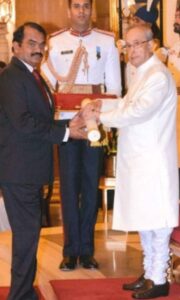
At the third Global SSI Multi-Specialty Robotic Surgery Conference held at Bharat Mandapam in New Delhi on April 9, indiatoday.in spoke exclusively to Dr Mylswamy Annadurai, former Director of the UR Rao Satellite Centre, previously called the Isro Satellite Centre.
Dr Annadurai is widely known as the Moon Man of India for his role in the Chandrayaan missions.
His presence at a robotic surgery conference was not ceremonial. The engineering connection he drew between space technology and surgery is one of the most scientifically significant things said at the conference, and one that most in the room may have missed entirely.
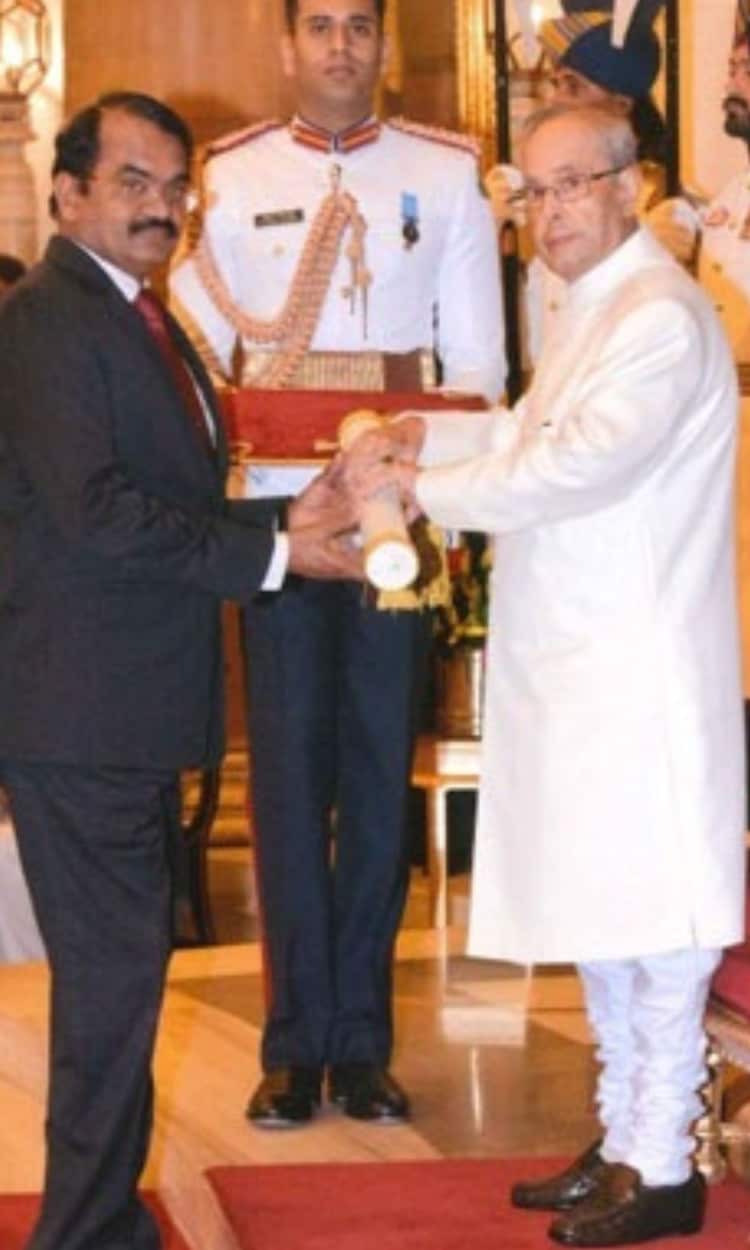
“Robotic surgery itself is basically meant for people living in space travel,” Dr Annadurai told indiatoday.in. “The problem is that robotic surgery technology did not go to space as planned because it became so bulky during those days. But now, a compact system has come.”
While robotic-assisted surgery has been performed in India for over two decades, initially through the adoption of imported platforms in premier private and government institutions, the landscape has been defined by high costs and limited geographic reach.
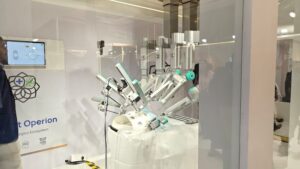
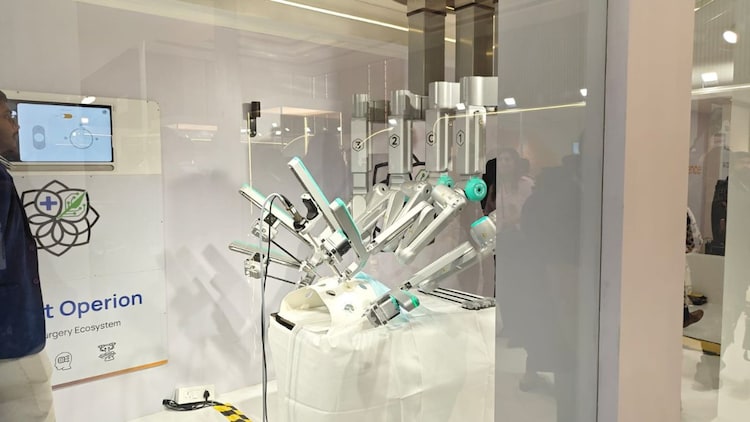
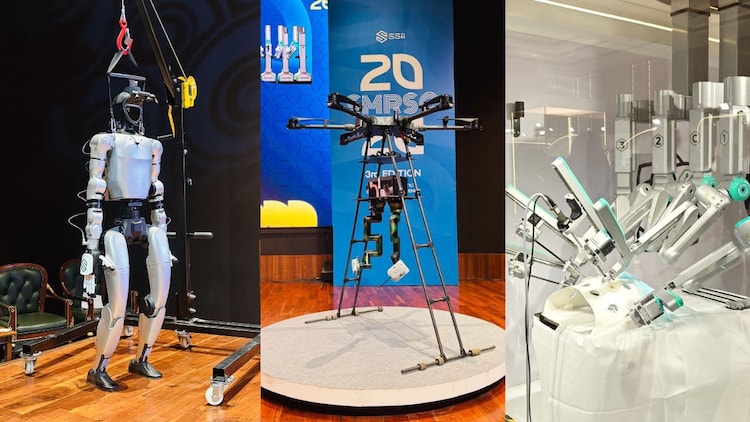
The compact system Dr Annudurai was referring to is the SSI Mantra, India’s only homegrown surgical robot, developed by SS Innovations International.
It operates at 0.1 mm accuracy, which is one-tenth of a millimetre, a level of precision the human hand cannot consistently maintain.
THE TECHNOLOGY THAT CONNECTS SATELLITES AND SCALPELS
The deeper connection Dr Annadurai drew was not about robots at all. It was about a technology called digital twins, and it is where space engineering and surgery are quietly converging.
A digital twin is a precise virtual replica of a real system. Before Isro launches a satellite, scientists do not simply send it into orbit and hope.
They build a complete digital copy of the satellite, simulate every orbital correction, every manoeuvre, every command sequence in a virtual environment, verify that everything works, and only then upload those instructions to the real machine in space.
“Digital twin technology is something we already have,” Dr Annadurai explained. “We operate it and see if everything is okay. Upload it prior and that will do the work.”
According to a 2025 peer-reviewed paper in NPJ Digital Medicine, this same approach is now transforming surgery.
A digital twin of a patient, built from CT scans and MRI imaging data, can be used to rehearse an entire surgical procedure virtually before a single incision is made on a living body.
Every cut, every instrument movement, every anatomical challenge is tested and resolved in the virtual environment first. The surgeon essentially uploads the plan. The robot executes it.
It is, in the most direct sense, the same engineering philosophy that guides Indian spacecraft.
WHEN THE DRONE LANDS, SURGERY BEGINS
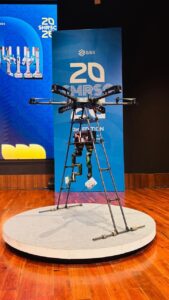
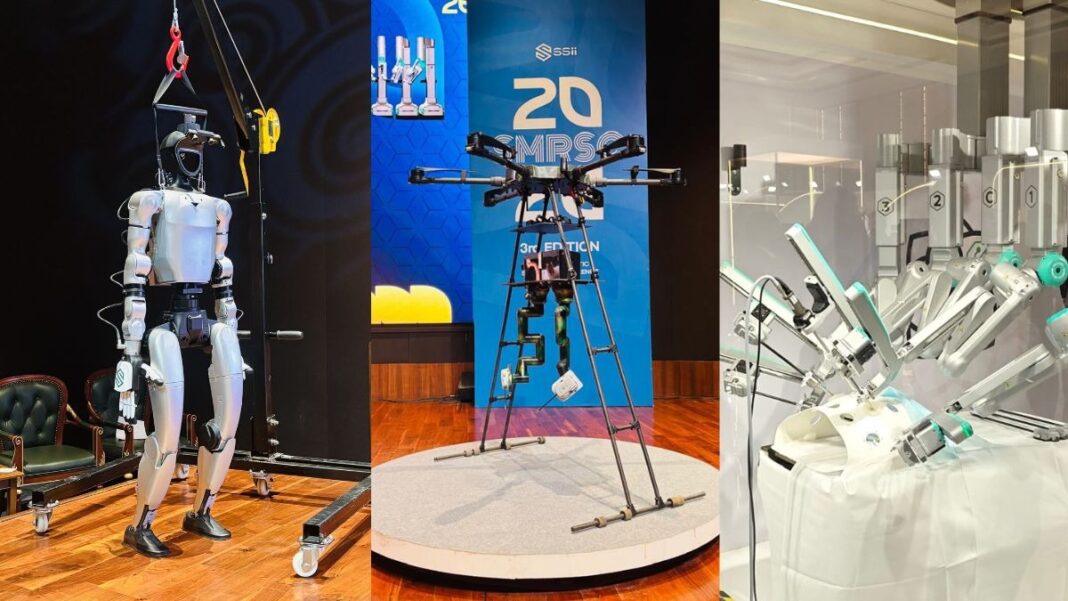
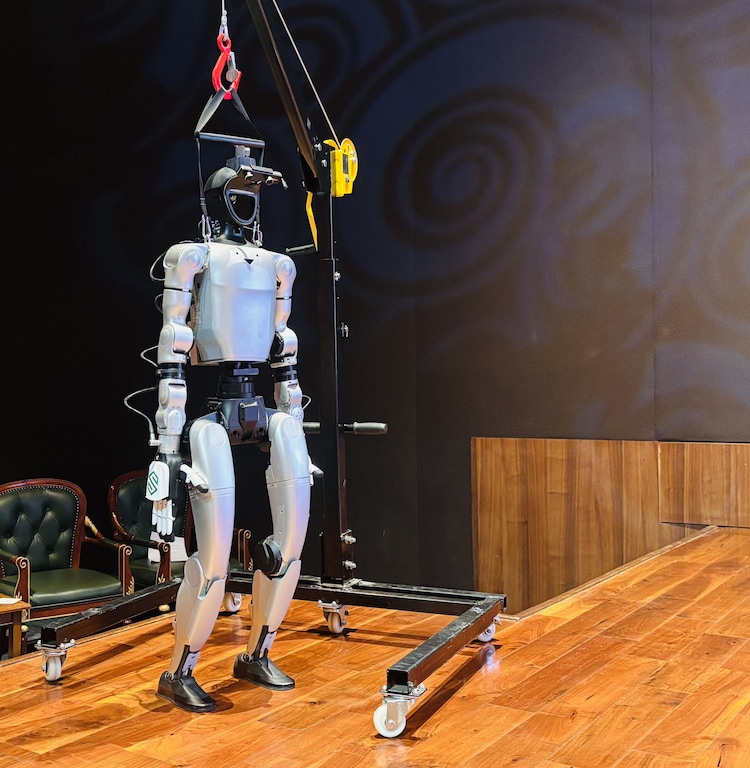
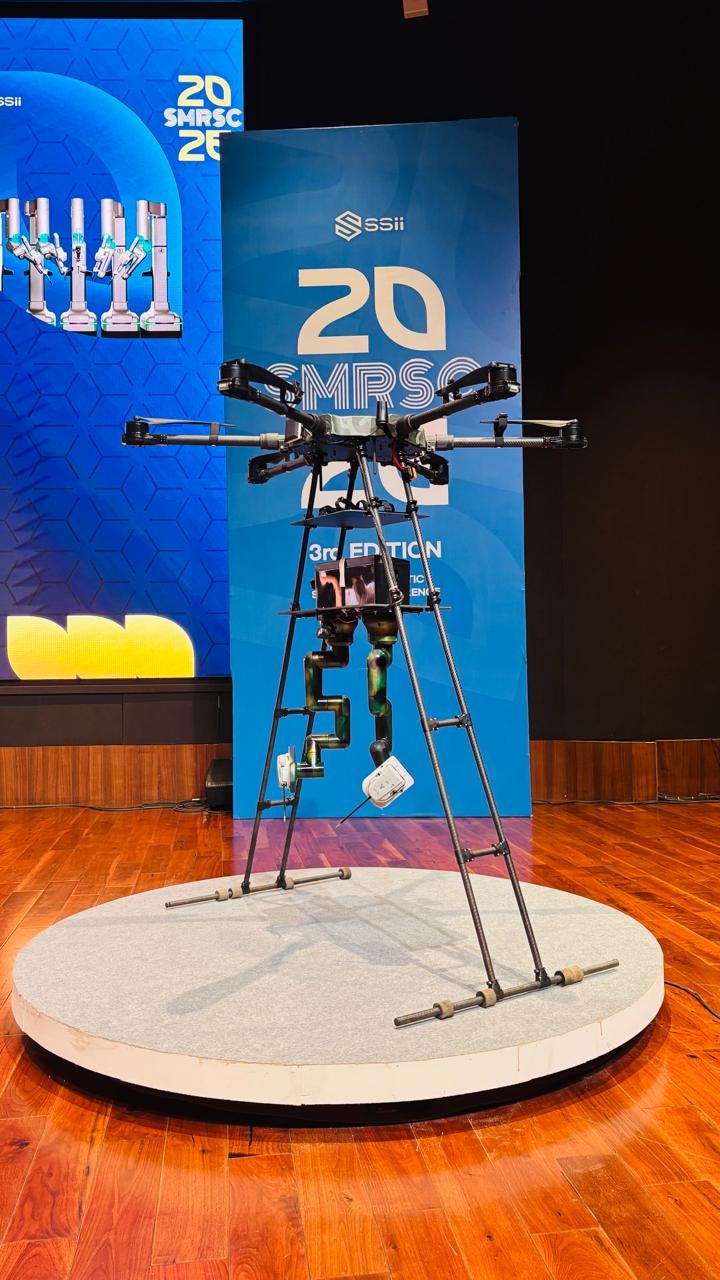
At the conference, SS Innovations also unveiled Project Vimana, a battlefield surgical system that arrives by a heavy-lift autonomous drone. The drone carries dual robotic arms, each with seven degrees of freedom.
Degrees of freedom, in engineering, refers to the number of independent directions in which a mechanical system can move.
Seven degrees of freedom means the robotic arm can bend, rotate and reach in seven independent ways, closely mimicking the full range of motion of a human wrist, elbow and shoulder combined.
The drone lands near a wounded soldier in a combat zone. A trauma surgeon, sitting at a remote command centre, then operates through those robotic arms in real time, performing procedures such as haemorrhage control, chest decompression and wound repair.
There is a critical engineering detail that Dr. Sudhir Srivastava, founder of SS Innovations and the world’s most prolific robotic cardiac surgeon, confirmed to India Today: when Vimana arrives at the surgical site, its rotors are shut down completely before any procedure begins.
This matters because a spinning rotor creates three problems simultaneously: mechanical vibration that travels along the platform, air turbulence above the surgical field, and electromagnetic interference that can disrupt the robotic systems.
All three are threats to sub-millimetre surgical precision. By shutting the rotors and converting the drone into a stable, stationary platform, the surgical environment is isolated from all three effects.
Dr Annadurai drew a direct parallel to how Isro manages vibration in its earth-observation satellites. When a satellite’s scanning mirror moves to capture images of Earth from 36,000 km above, the movement creates a subtle mechanical disturbance in the satellite’s body.
Isro compensates for this in real time, with a technique called mirror motion compensation, using onboard systems that apply a counterforce to keep the satellite stable. “Same thing for the robotic system,” Dr Annadurai said.
He added that high-altitude logistics drones capable of carrying 50 to 60 kg payloads are already qualified and operational in India, suggesting the infrastructure for such deployment already exists.
THE SURGEON WHO CANNOT FEEL
There is something quietly remarkable about how robotic surgery already works today that most people outside medicine do not know.
In all 20 million robotic procedures performed worldwide to date, no surgeon has been able to feel a single thing. No tissue resistance. No pressure. No sensation of the instrument moving through muscle, nerve or blood vessel.
Dr Srivastava confirmed this plainly. True tactile feedback, the kind the human hand provides naturally through millions of nerve endings, does not exist in any commercial robotic surgery system today.
According to a 2025 study in NPJ Digital Medicine, the absence of haptic, or touch-based, feedback remains one of the central unsolved challenges in robotic surgery.
What some companies describe as haptic feedback, Dr Srivastava said, is digitally reconstituted and borrowed from the gaming industry, essentially the same technology that makes a controller vibrate when a character takes damage in a video game. “It has no clinical meaning at this point in time,” he said.
And yet, 20 million surgeries. And outcomes that, in many cases, exceed those of conventional open surgery. How? Surgeons develop what Dr Srivastava called a sixth sense.
Operating through a 3D camera magnified up to ten times, they learn to read tissue behaviour entirely through vision: how much a structure resists when pulled, how tissue deforms under pressure, the visual difference between healthy and compromised anatomy.
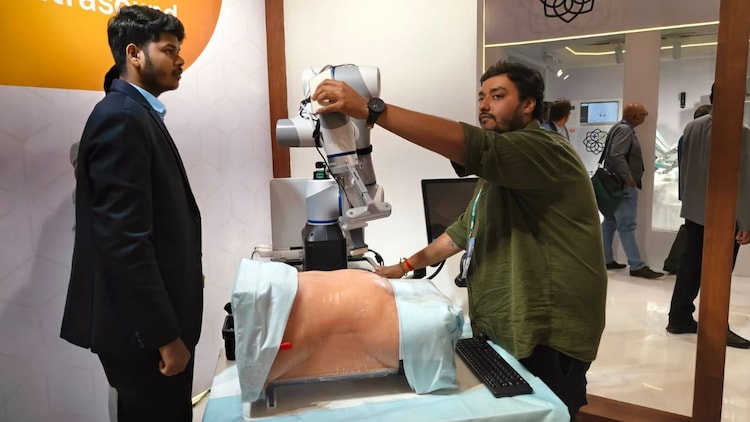
“I feel that there is resistance,” Dr Srivastava said. “Intellectually, I know I cannot. But the brain fools you.”
The human brain, deprived of touch, builds a new sensory system from what it can see. It is one of the quieter scientific discoveries in modern medicine.
WHAT COMES NEXT
Both Dr Srivastava and Dr Annadurai pointed toward the same future: autonomous surgery, where AI and machine learning algorithms make decisions that surgeons currently make through experience, instinct and that hard-won sixth sense.
Dr Srivastava was precise: current surgical robots make no independent decisions whatsoever. Every movement, every adjustment, every cut is directed by a human surgeon. The robot is an instrument, not an agent.
But the next generation will be different. When autonomous surgery arrives, AI algorithms will take over functions that currently depend entirely on human judgment.
Dr Annadurai put the timeline into perspective: “By the time AI will also have evolved a lot. These two things coming together; I think it is possible.”
The two things he meant were artificial intelligence and compact robotic systems small enough to travel where surgeons cannot always go.
The concept of remote surgery was shelved in the 1970s because the machines were too big. The machines are now small enough to fly on a drone. The technology that rehearses satellite missions is now rehearsing surgeries.
And an Isro scientist and a cardiac surgeon, standing in a conference hall in New Delhi, are quietly describing the same future.